Showing posts with label Lord of the Rings. Show all posts

Wednesday, October 7, 2026

A Middle-Earth Traveller (John Howe)

A Middle-Earth Traveller is predominantly a sketchbook, presenting selections from John Howe's work during his time on the sets of The Lord of the Rings and The Hobbit movies—though Howe includes sketches of events and places covered in other Tolkien works, too (from the First and Second Age).

One of two principle artists on set*, I love Howe's art. He does a good job of immersing the viewer in an enchanted tale. This is a nice collection of his work, though it felt too short (I would have loved more). There are colored prints sprinkled throughout, but the vast majority are sketches (makes sense given the frantic pace at which artists work on set). The accompanying text didn't explain the art (or movie-making details) so much as provide select snippets of Middle-Earth lore. If you like Middle-Earth and John Howe, you'll like this.

Rating: A

*the other, Alan Lee, has also produced sketchbooks for LOTR and The Hobbit, respectively

Monday, October 5, 2026

The Lord of the Rings: The Battle for Middle-Earth

Today's review is of the 2012 release, The Lord of the Rings: The Battle for Middle-Earth. For 2-4 players, it takes 20 minutes.

Overview
You and your friends  are competing to create fellowships and send them to battle against the forces of Sauron. Accumulate the most victory points (gained through defeating enemies) and you win!

This simple game has two common decks: the enemy deck (with enemies of Middle-Earth) and the ring deck (which contains fellowship and Mordor cards). To set up, each player draws three cards from the ring deck [before the Mordor cards are shuffled in], displays the top three enemies, and play begins. 

On your turn, you either:
- draw a card from the ring deck (if a Mordor card, place in the Mordor row and draw again), or
- play a card from your hand to the table to an existing (or new) fellowship and (if desired) attack one or more creatures in the enemy row. 

Once all the enemies are defeated, players tally their respective victory points and highest wins.
game in progress
Four key concepts:
 - A fellowship is a grouping of one or more cards that will attack as one unit; you can have as many fellowships as you wish, but you cannot rearrange the groups once chosen.
- Each fellowship (and enemy) character has one or more colored symbols on it. For a given fellowship to attack an enemy, it must have all the matching colored symbols. You can attack multiple enemies simultaneously if you have enough symbols for them all. Once you make an attack, collect the enemy card(s) into your victory pile and put the fellowship cards involved in the ring discard pile. Replenish the enemy row.
- Once the Mordor row is full, it triggers a counterattack; do the effect listed on the right-most Mordor card (generally causing players to lose cards in hand, on the table, or enemies in the enemy row). Then place the right-most Mordor card in the enemy discard pile [important nuance], place the other two Mordor cards in the ring discard pile, place the right-most enemy in the enemy discard pile, replenish the enemy row, and play continues.
- Some fellowship characters have special abilities (explained in more detail in the rulebook). These can be critical to success, to pay attention!

Review
This is a simple, light, and fast game with some fun twists suitable for the family. The theme is pasted on (but the artwork is nice nonetheless). There aren't a lot of meaningful decisions, but the board state can alter unexpectedly and leave the outcome unpredictable. The fellowship character abilities can shake things up, too. Overall, I enjoyed this more than I expected.

Rating: B-

Saturday, September 19, 2026

The Atlas of Middle-Earth (Karen Wynn Fonstad)

The Atlas of Middle Earth is a semi-official reference for J.R.R. Tolkien's Middle-Earth. In it, Karen Wynn Fonstad provides a plethora of meticulously-researched and carefully-drawn maps in broad categories:
- The First Age
- The Second Age
- The Third Age
- Regional Maps
- The Hobbit (maps focused on the routes/journeys mentioned in that book)
- The Lord of the Rings (ditto, though here we also get maps of five key battles)
- Thematic Maps (looking at landforms, climate, vegetation, population, and languages of Middle-Earth)

The maps are in varying levels of detail and accompanied by explanatory text. Two examples follow.

Though intended more as a reference, I really enjoyed this work and read most of it. As a visual learner, I appreciated the maps of the pre-LOTR Ages (covered in The Silmarillion or other works). The author did her homework and has considerable artistic talent. She is honest about all the uncertainties—Tolkien's voluminous writings in this world occasionally clashed or omitted details—and does a good job handling those. I view this as 'semi-official' because it holds as true as possible to the Tolkien canon shares a publisher with him, yet I don't think this is officially blessed by the Tolkien estate. Whatever the case, this is a good volume for those who love both maps and Middle-Earth.

Rating: A

Tuesday, June 23, 2026

The Two Towers Deck-Building Game

Today's review is of the 2013 release, The Two Towers Deck-Building Game (hereafter, Towers DBG). For 2-5 players, it takes 30 minutes.

Overview
You are one of the heroes from The Two Towers movie; your goal is to have the most victory points. In this deck-building game, each player starts with a 10-card deck (one of which is based on your chosen hero) and draws 5 cards per turn. On your turn, you play the cards to gain power, with which you buy cards in the 'path' or defeat arch-villains; in either case, the chosen cards go into your discard pile, which is shuffled to make a new deck when you run out of cards. Over the course of the game, your hand will get increasingly powerful. Can you prevail?
The game contents; image from here
This game is a sister to The Fellowship of the Ring DBG and nearly identical; the only difference here is wall cards which provide an alternate way to end the game. 

Review
In the same game family as the DC Deck-building Game, this has all the pros and cons of that line. It is quick to learn, fun to play, and a little strange that you can buy villains from the path to incorporate into your deck (though thematically I can buy it if you look at it as 'gaining experience' from defeating them). The addition of wall cards was a helpful way to accelerate the game's end (sometimes these drag on). Overall, recommended for a light experience. 

Rating: A-

Wednesday, January 21, 2026

The Hobbit: There and Back Again

Today's review is of the 2025 release, The Hobbit: There and Back Again. For 1-4 players, it takes 30 minutes (per chapter).

Overview
Relive The Hobbit in this dice-drafting/roll & write game! The story is broken into eight chapters (or adventures). In each, you will compete to collect resources, create paths (with a dry erase marker), and perform actions to ultimately complete the chapter goal. Do so with the most points and you win!

On a turn, the first player rolls the five dice, choosing one and executing its action (creating a pathway of certain geometry, collecting resources, or performing an action). The next player clockwise chooses one of the four remaining dice and does the same. Play continues clockwise until the dice are all claimed. Then the next player in clockwise order rolls the five dice again and the cycle repeats.
Chapter One in progress; image from here
Each chapter has a stated objective (condition which ends the game) and rules on how points are earned. For example, the first chapter's objective is to connect 12 dwarves to Bag End (when the first player does so, the game immediately ends). You get points for each dwarf you connect, but you get more points if you have bread on-hand when a given dwarf arrives. And you get more points still if you collect swords (to arm them) or can get Gandalf and Thorin to visit, too. 

Review
My boys and I played only the first chapter so far, but this is fun! It is easy to learn with lots of meaningful choices (both in the dice you choose and the paths you draw). They do a good job of giving multiple options for the dice, so if your preferred option is unavailable, you may be able to get something else through crafty choices stated on the board for a given chapter. The chapter approach is appropriate for The Lord of the Rings tales (another publisher took the same approach to The Lord of the Rings Adventure Book Game to good effect). I look forward to the other chapters.

Rating: A-

Wednesday, January 7, 2026

The Adventures of Tom Bombadil (J.R.R. Tolkien)

The Adventures of Tom Bombadil, published in 1962, is a collection of sixteen poems supposedly from the Hobbits' Red Book, which Tolkien describes as containing "a large number of verses . . . [many of which] are found on loose leaves, while some are written carelessly in margins and blank spaces."  This "present selection is taken from the older pieces, mainly concerned with legends and jests of the Shire and the end of the Third Age, that appear to have been made by Hobbits, especially by Bilbo and his friends, or their immediate descendants. Their authorship is, however, seldom indicated . . . and were probably written down from oral tradition." 

Of the sixteen poems, the first two star the merry fellow himself. The others have a tenuous link to Middle Earth (often variants of poems Tolkien did years prior) and are more akin to folklore or nursery rhymes. Several are mentioned (or partly quoted) in The Hobbit or The Lord of the Rings.

The original publication occurs from pp. 33-118 (with the original illustrations by Pauline Baynes); a hearty introduction (pp. 7-30) precedes and lengthy commentary (pp. 119-274) follows. The commentary is a summarized history or analysis of each poem and often presents earlier versions of them.
------
I enjoyed this collection. I would have liked a more obvious focus on/tie to Middle Earth, but Tolkien is a talented poet. He is well-versed in various meters and styles, and some of his rhymes are impressively intricate. A fun read.

Rating: B+

Wednesday, December 24, 2025

LOTR: Book vs. Films

Last month, I finished re-reading The Lord of the Rings. This post reflects on the book vs. the films. I've done this before; this post will complement my original.

The Differences
1) So many things are condensed (or omitted) in the films. In my original post, I mentioned a few, but there are others. What I noted this time around:
- Frodo and Sam (and others, as they join) take much longer to get to Rivendell. Many days and adventures, including an encounter with elves (led by Gildor), a supper with Farmer Maggot, a stay in Frodo's new house (he sold Bag End), a journey in the Old Forest (with Old Man Willow, Tom Bombadil, and Goldberry), the Barrow Wights, the long walk from Bree to Rivendell (with Glorfindel's aid towards the end).
- The Council of Elrond (and the fellowship's overall stay there) is much longer.
- Their time in the Mines of Moria is longer, and events rearranged [but largely retained] between book and film.
- Their time in the Forests of Lothlorien is much longer, and we get to see the Elvish city Caras Galadhon [which we see in passing in the extended edition of the film].
- Merry and Pippin's time with the Ents is drawn out over days, and includes a stay in Treebeard's house.
- Frodo and Sam's time in Emyn Muil navigating the rocks.
- Gamling's role in Rohan. (He is in the films, but Eomer takes the dominant role)
- Theoden/Rohan's journey to Isengard after the Battle of Helm's Deep.
- Aragorn's journey to summon the Army of the Dead (and their subsequent actions before, but not during, the Battle of Pelennor Fields).
- Theoden's/Rohan's journey to Pelennor Fields and his encounters with (and assistance from) the wild men of the mountains.
- Prince Imrahil and his army's role at Pelennor Fields.
- The Healing House in Minas Tirith and people therein (Ioreth and others).
- The entire story after the destruction of the One Ring. This includes Aragorn's assumption as king and his activities there, the Scouring of the Shire (and Battle of Bywater), and other elements.

2) A few things were extended in the films compared to the books. Off the top of my head:
- The humor of Merry and Pippin. They provided very occasional and mild comedy in the books (about the same as Frodo and Sam); that was drawn out heavily in the films as they were made the comic relief.
- The Righting of Theoden's mind.
- Aragorn's interactions with Arwen and Eowyn. Those relationships were the romantic interests in the films and played up to maximum effect.
- Aragorn and claiming (or fearing) his kingship.
- The Battles of Helm's Deep and Pelennor Fields. Pinnacles of the second two films were raced through in the books.

3) Characters that got more (or less) screen time than page time.
- Who got more screen time: Arwen, Eowyn, Theoden, Legolas, and Aragorn stood out to me
- Who got less: Radagast, Glorfindel, Tom Bombadil/Goldberry, Gamling stood out 
- The below graphic is helpful and has more comparisons. (copied from Facebook)

The Similarities (in Spirit)
I'll keep this short, but what I mention below is huge.
1) The overall story.
2) The main characters.
3) The iconic quotes. Though who said them and when may differ, I was impressed with just how much dialogue from the books made it into the movies.
4) The 'tone' of the world. You know you're in an ancient story with much impression of depth. 

Overall
I think they did an amazing job capturing the spirit of the books in the films. Yes, many things had to be condensed. (I found this mildly ironic, as people complain the films are so long.) As always, the books pack in so much more. But what works on the page doesn't always work on the screen—the medium is the message, as Neil Postman would say. And the changes they made for a visual representation in large part made sense to me.

Many people have a favorite book that was ruined by a movie adaptation. I'm thrilled that LOTR managed to be a hit in both worlds. These artifacts should be (and probably are) used in a storytelling class, looking at the art of conveying the same story in different media.

Sunday, November 30, 2025

The Lord of the Rings (J.R.R. Tolkien)

The Lord of the Rings is a classic tale. I have previously reviewed and summarized its constituent parts (The Fellowship of the Ring, The Two Towers, and The Return of the King); today, I finished reading this one-volume edition illustrated by the author. I even read Appendices A and B ("Annals of the Kings and Rulers" of the Third Age and "The Tale of Years," respectively) and skimmed C through E (Family Trees, Calendars, and Writing and Spelling).

Of the tale itself, little need be said. It is full of wisdom and wonder. It has impression of depth. I enjoyed it perhaps more now than I have in the past, despite this being my third or fourth re-reading. 

Of the version: I liked it. This version of the book is as the author intended, meaning presented in one volume. (I have read it could not be so produced in his era, due to paper shortages from World War II.) Having his illustrations in it is a bonus (this is a 'companion' volume to The Hobbit version I read earlier this year). Having this in one volume improved the flow (or seemed to), though it can still jar the reader by not interleaving various threads of the story (when the fellowship parts, Tolkien will follow one thread, then rewind and do the other).

Observation: for as much as I love the story, Tolkien most certainly does not invest in suspense. I believe his son claimed that he wrote with "no sense of narrative urgency," and that shines forth in places here. Things I believed to be the most suspenseful, even climactic, were handled abruptly with little fanfare. It almost seemed as though Tolkien wanted more focus on the wonder of the world, the history, and the languages than the suspense of the story itself. The story was excellent, but it was not delivered in modern fashion.

Finally, I read two appendices this time because of subsequent big-screen adaptations: The Rings of Power (seasons one and two) and The War of the Rohirrim. Both feature events mentioned in Appendices A and B. 

Rating: A

Monday, November 24, 2025

The Fellowship of the Ring Deck-Building Game

Today's review is of the 2013 release, The Lord of the Rings: The Fellowship of the Ring Deck-Building Game (hereafter, Fellowship DBG). For 2-5 players, it takes 30 minutes.

Overview
In the Fellowship DBG, your goal is to have the most victory points. To do so, you must plan wisely, buying powerful cards and ridding your deck of weak and worthless ones. This will enable you to gain enough strength to take down archenemies (the standard game has eight in succession). 

This deck-building game works like most in this genre. You start with a deck of 10 cards, drawing 5 to form your hand. The cards grant power (and sometimes other abilities), enabling you to buy cards from the central row ("the path"): allies, artifacts, locations, maneuvers, even enemies. You will buy one or more cards, then replenish the path from the main deck each turn. Cards you buy, plus any in your hand or played to the table that turn, go into your discard pile. Then draw 5 cards to prepare for your next turn, shuffling your discard pile to form a new deck as needed. Play passes clockwise.

You can also use power to fight archenemies. (The game comes with 12 but recommends you play with 8, placed in a stack next to the lineup.) If your power on a given turn equals or exceeds the super-villain on the top of the stack, you defeat them, putting them in your discard pile (yes, this means you can use them on a later turn). Once all super-villains have been defeated, each player tallies their victory points (printed on each card) to determine the victor.

Review
This game is almost exactly like the DC Deck-building Game (not surprising, as it is by the same company). My comments for this are the same as that offering: it is a fun game, easy to learn, with some aspects that were counter-intuitive (like buying enemies to incorporate into your deck). There are mild differences:
- the hero you choose does not have a special ability, but instead a unique card you start with in your deck
- there are 'fortune' cards that are free and can be played immediately
- there is the 'ambush' keyword that is similar to attacks, but affects only the player whose turn it is

Overall, this one seems a touch simpler than its DC counterpart, and that is okay.

Rating: A-

Thursday, September 25, 2025

The Lord of the Rings: Fate of the Fellowship

Today's review is of the 2025 release, The Lord of the Rings: Fate of the Fellowship. For 1-5 players, it takes 60-150 minutes.

Overview
Anyone familiar with The Lord of the Rings knows the story: save Middle-Earth by destroying the one ring and defeating Sauron and his armies. The task seems impossible, with swarms of Orcs, the fearsome Nazgul, and other threats in the way. Yet hope remains, if the fellowship is true . . . 

This is a cooperative game in the Pandemic line, meaning the basic rules follow that game system. Each player controls two characters from the story. On your turn, you will:
  • Perform 4+1 actions (one of your characters takes 4 actions, and the other takes 1, in either order)
    • actions include travel, give/take a card from a player, discard a card to take a token, add an army to a location, attack, or capture an enemy stronghold
  • Draw 2 cards
    • if you draw a 'shadow increasing,' follow the (regrettable) instructions to add threats to Middle-Earth
  • Draw X shadow cards, where X=2-5 based on where the marker is on the threat rate track
    • resolve them one at a time, which generally means moving shadow armies (and attacking), moving Nazgul towards Frodo (and searching), or other terrible things
There are many details to the above, and this video is an excellent (if lengthy) overview of everything.
Game contents; image from here
The game ends when either you complete all objectives (the introductory scenario has four) and collectively win or your hope drops to zero and all is lost.

Review
I was greatly looking forward to this one. I love both the Pandemic game engine and The Lord of the Rings; I wanted to see how they combined them. I think they did it well. This is more complicated than the other Pandemic games (there is a lot going on), but the core concepts are still there, so it was easy enough for my playgroup to pick up the rules. It is challenging and lengthy, so be warned. It is highly replayable, with 20 different objectives and 13 different characters, each with unique abilities. Overall, this is well done and worth a look.

Rating: A

Friday, July 25, 2025

The Hobbit (J.R.R. Tolkien)

The Hobbit is a familiar tale; Bilbo Baggins goes with dwarves and a wizard to re-take the Lonely Mountain and gold therein. Along the way, he finds a magic ring, etc. etc. Cool. I've read this multiple times and reviewed it before.

I bring it up here because:
1) I just finished reading it out loud to my son,
2) It was the pictured version, with original illustrations by the author, and
3) I think it was the first time I had read it since viewing The Hobbit trilogy of films.

So, how did these factors change my experience of the tale? Reading it out loud is nice, giving insights I lacked from prior readings. It was fun seeing the original illustrations by Tolkien—some were quite good—and how they inspired the films. Finally, what surprised me about reading this after the films is just how much the films omitted. Three films to do one book, and they left out or condensed things. That surprised and disappointed me (especially given how poorly the third film was done).

Rating: A

P.S. Two quotes near the end caught my eye and are worthy of committing to memory. Both have to do with friendship.
"This has been a bitter adventure . . . yet I am glad I have shared in your perils—that has been more than any Baggins deserves."
"The oftener you appear in my halls the better shall I be pleased!"

Saturday, June 21, 2025

Similo (The Lord of the Rings edition)

Today's review is of the 2019 release, Similo. For 2-8+ players, it takes 10 minutes. Many versions of this game have been produced; here, I look at The Lord of the Rings edition.

Overview
One player (the "Clue Giver") shuffles the deck of cards, draws the top 12, secretly looks at one, and then lays out all 12 in a 4x3 grid pattern (see below). That same player draws a hand of five cards, and the game begins.
Example Lord of the Rings Similo layout; image from here
In this cooperative game, the goal is to remove every character from the grid *except* the one secretly known to the Clue Giver. The game is played over five rounds. In each, the Guessers (everyone except the Clue Giver) will have to remove a number of cards from the grid. Here is how each round works:

In round 1, the Clue Giver choosed one card from his hand and plays it horizontally next to the grid. 
The played card has "something similar to one or more cards the Clue Giver would like the Guessers to remove." The Guessers choose and remove one card, and if the secret character remains, the Clue Giver draws a card (replenishing their hand to 5 cards) and the next round begins.

Rounds 2-5 play out the same way, except there are differing numbers of cards to remove in each:
- Round 2: two cards
- Round 3: three cards
- Round 4: four cards
- Round 5: one card

If, at the end of round 5, the secret card alone remains on the grid, everyone wins! If at any time the secret character is chosen to be removed, everyone loses.

Review
This is a light, fun, and fast game; I think of this as a party game. The theme matters; I played with friends with varying knowledge of The Lord of the Rings, which is a twist (the one who knew nothing about the movies ended up being a great Clue Giver). The differing numbers of cards to be removed each round makes the Clue Giver think about when to play which card. And the game has high replayability given the number of cards. Overall, this is a winner.

Rating: A

Tuesday, March 11, 2025

The Fellowship of the Ring Trick-Taking Game

Today's review is of the 2024 release, The Fellowship of the Ring Trick-Taking Game. For 1-4 players, it takes 20 minutes.

Overview
You hold a ring of great power; one that must be destroyed. It all starts with leaving home. Can you travel through the Shire successfully, or will the challenge prove too great?

This cooperative game is played over a series of chapters. In each, you will be dealt a hand of cards, choose an available character (the pool differs from chapter to chapter), carry out that character's setup instructions (if any), and play begins. To win a chapter, each player must meet their respective character's goals for the round (generally, winning a certain number of tricks or ring cards) unless the victory condition for that chapter says otherwise. If you meet the condition, move on to the next chapter. Play proceeds until you've won it all . . . or Sauron has.
Example cards; image from here
Like all trick-taking games, each card has a suit (forest, hill, mountain, shadow, ring) and number (1-8 for most, 1-5 for the ring cards); in a given trick, the high card in the lead suit wins . . . unless the one ring is played (for that rules them all—which in this case means he who played it chooses who wins that trick). You cannot share your hand with the other players, so pay attention and play strategically to make sure you each meet your respective goals. 

Review
My boys and I played the first two chapters of this . . . I really like it. It is easy to learn, hard to master. The characters with their differing abilities and win conditions make things interesting. The chapters add another level of variation and fun. And I assume (based on the name) that we might see two other games to round out the trilogy. You can learn how to play here . . . highly recommended.

Rating: A

Friday, January 3, 2025

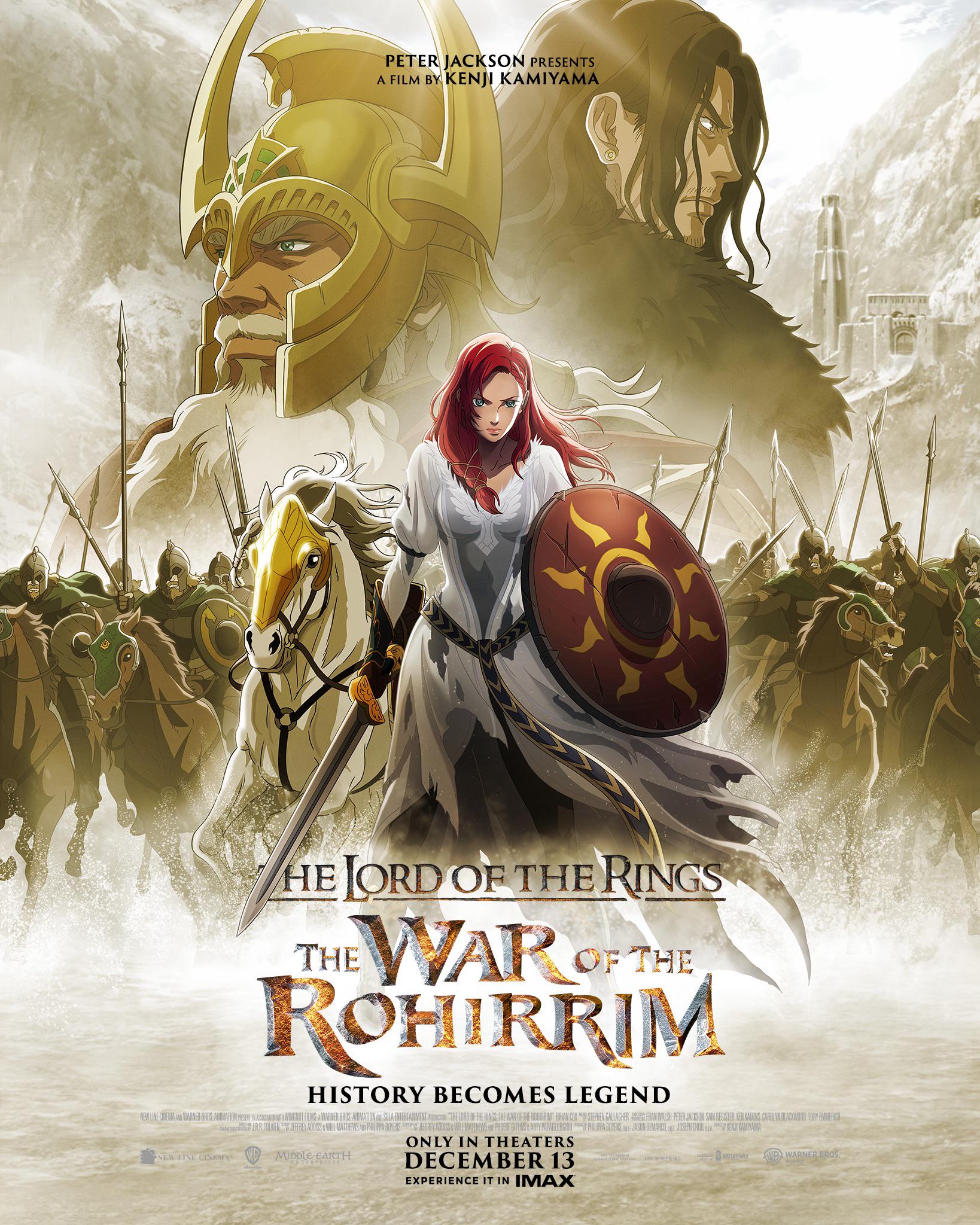
The War of the Rohirrim

200 years before Bilbo Baggins and a certain ring . . .

Helm Hammerhand rules in Rohan, and trouble is brewing. A Dunlending lord is set on his son (Wulf) marrying Helm's daughter (Hera). Unwilling, Helm fights the lord and banishes Wulf, who swears vengeance. Years later, he'll get his chance . . . and Helm's people will flee to a familiar fortress, the Hornburg, and try to survive the ensuing siege. Will they survive? Or is hope lost?

This movie was a mixed bag for me. It was exciting to see another film set in Middle-Earth. The animation style (anime with realistic backgrounds) was cool if jarring/disorienting at times. The plot was . . . underwhelming and cliche. It also borrowed too heavily from the original Lord of the Rings films, packing in plenty of scenes/plots/phrases as a deliberate homage to that trilogy (in places, it felt like they simply mashed elements from the films together, put them into anime style, and put it on the big screen). The main message was "women are powerful, too," which was fine. It had its moments, but overall, I rate this just above the third Hobbit movie and below everything else (to include Rings of Power). 

Rating: C+

Monday, October 28, 2024

The Lord of the Rings: Duel for Middle-Earth

Today's review is of the 2024 release, The Lord of the Rings: Duel for Middle-Earth (hereafter, DME). For 2 players, it takes 30 minutes.

Overview
Sauron's malice and will to dominate is clear. Can the Free Peoples of Middle-Earth stop him, or will he rule them all?

In DME, you play as either the Fellowship or Sauron. There are three chapters to the game, each with their own unique decks of cards, laid out at the start of the chapter in a prescribed pattern.

On your turn, you either:
  • take a card (an available card from the display)
    • pay its cost (if any) and place it in your play area, obtaining its benefit, OR
    • discard the card to earn 1, 2, or 3 coins (equal to the chapter you're in)
  • buy a tile
    • pay its cost and place it in your play area, obtaining its benefit
Costs can be paid by using skills on cards (gray cards) you have previously taken and/or paying coins for each symbol you lack on the card/tile's cost. Coins can be attained by discarding a card from the display on your turn or selecting an available yellow card. Some cards (of any color) also have symbols in their upper right that can be used as an alternate cost for some other cards (this is called 'chaining').

A chapter ends when the cards in its display are gone.
Chapter 3 in progress; image from here
There are three possible victory conditions; the first to fulfill one of them wins:
  • Quest for the Ring: 
    • uses the fellowship track and advances through blue cards
    • If Frodo and Sam make it to Mount Doom, the Fellowship wins. If the Nazgul catch them, Sauron wins.
  • Support of the Races:
    • achieved through collecting green cards
    • if any player gathers one of the six different race symbols on such cards, they win
  • Conquering Middle-Earth:
    • achieved through collecting red cards and tiles
    • if any player has presence (unit and/or fortress) an all seven regions of the 'main' board, they win
Review
I like this game. I assume it is based on 7 Wonders: Duel, which is itself based on 7 Wonders. As with that offering, DME forces you to be balanced (in approach) and mindful (of your opponent's strategies). You need skills (gray cards), but if you neglect other cards, your opponent can take the day. So they all matter, and as you build your tableau, your choice will depend on both what is available on your turns and what you are trying to do (or stop your opponent from doing). There were turns, especially late in the game, where I was forced to take a card simply so my opponent could not. But he was forced to do the same to me, and I enjoyed the overall experience.

There is a lot to keep track of, but it is easy enough to pick up after a few turns. This is a nice two-player game, especially for The Lord of the Rings fans. And the art is fantastic!

Rating: A

Sunday, October 13, 2024

The Rings of Power: Season 2

Continuing from season one . . . (with mild spoilers concerning character appearances below), multiple things are happening in Middle Earth and Numenor:

Two Harfoots accompany the mysterious visitor through the arid region of Rhun as he continues searching for his name and purpose. But a dark wizard is keenly interested in the visitor . . . and everyone is in great danger. Hope fades . . . but Tom Bombadil might prove helpful. 

Their lands in shadow and army defeated, southern humans flee to other lands to re-settle. Isildur, surviving the battle, finds and settles with them in Pelargir, an abandoned Numenorean colony. There they will face the perils including Wild Men, but they find powerful allies, too.

In Numenor, the old king is dead. At Queen Regent Miriel's coronation, revelation of a dark secret, accompanied by a foreboding omen, spurs her cousin, Pharazon, to claim the throne. The land descends into chaos as sides are chosen and distrust abounds. Elendil, faithful supporter of the queen, faces the most difficult decision of his life.

In Mordor, Adar raises an army of Uruks intent on defeating Sauron. Adar knows Sauron is in Eregion . . . and so the Elvish city must fall.

The Elvish rings have restored hope to the Elves. But all is not well . . . in Linden, Elrond mistrusts the rings, while Galadriel remains laser-focused on countering Sauron and his schemes. Their fears of a threat to the south are realized when they find legions of Uruk marching on Eregion . . . the Elves might be able to stop them in time, if the Dwarves send aid.

Shadow has fallen upon Khazad-dum in more ways than one. Their light shafts have collapsed, and traditional methods for finding new ones have been unsuccessful. Hope dims until the rings arrive from the Elves, granting King Durin impressive powers. But with it, increased malice and greed . . . and when he delves too deep in quest of riches, an ancient evil may rise.

After creating the three Elvish rings last time, Celebrimbor ponders what comes next in Eregion. He receives a familiar visitor—a so-called emissary from the valar who now goes by Annatar—who encourages and helps him to craft more rings. First comes seven Dwarvish rings, distributed to the Dwarf lords. Now Annatar is intent on creating nine rings for men. But when concerns arise regarding the Dwarvish creations, Celebrimbor has suspicions and struggles to understand what is going on around him. Is he helping Middle Earth . . . or helping to destroy it?
-------
The theme of season two could be summarized as "things fall apart." 

What I liked:
- the portrayal of Sauron. He is the ultimate manipulator/deceiver, and they do a fantastic job capturing that.
- the overall story. Despite many criticisms from Tolkien fan(atic)s, Amazon is adhering to the spirit of the events in the Second Age, even if they compress timelines, add characters, and inject other differences. (After all, the Peter Jackson films did this, too.)
- the visuals are beautiful.
- the dialogue and wisdom are mostly good.
- the story remains (mercifully) unfocused on romance and inappropriate/unnecessary things in this vein. Tolkien's legendarium had romance, of course, but not in today's way (or for today's purposes), and the show's creators are doing a good job of sticking to that.
- 'cameos' or appearances of familiar characters, events, locations, objects, and beings mentioned in The Lord of the Rings.
- aligning the style with Peter Jackson's films.

What I didn't:
- too many story arcs. There are roughly seven by my count, each getting a paragraph above. Three—Harfoot/stranger, southern human, and Uruk—have their 'cool' moments, but aren't contributing to the progress of the story as much as they are muddying the waters by introducing new elements and that much more to keep track of. 
- the speed of the story. With so many arcs, some moved too quickly. I believe three more seasons are planned, and am curious how those will shake out.
- the portrayal of Galadriel. I think the actress does a good job, but am not convinced the character is faithful to the spirit of the books.
- a few head-scratching plot points. One character appears to die in an episode but returns in the next with no apparent injuries. That is the most egregious one, but there are other, more minor, things that could have been better.

Overall, I think it is a powerful story that is done well. I look forward to season three (likely two years out).

Rating: A-

Saturday, September 14, 2024

Unfinished Tales of Numenor and Middle-earth (J.R.R. Tolkien)

In Unfinished Tales of Numenor and Middle-earth, Christopher Tolkien presents a collection (sometimes edited) of his late father's writings on these regions. Per him, this "book is no more than a collection of writings, disparate in form, intent, finish, and date of composition (and in my own treatement of them), concerned with Numenor and Middle-earth." Further, "many of the pieces in this collection are elaborations of matters told more briefly, or at least referred to, elsewhere . . ." This new version, a reprinting (the original was published in 1980), contains wonderful full-color plates of illustrations by the three most famous illustrators of Tolkien: Alan Lee, John Howe, and Ted Nasmith. The tales herein are separated by the Age in which they take place (per Tolkien's timeline):

First Age Tales:
- Of Tuor and his coming to Gondolin
- Narn I Hin Hurin
These are covered in The Fall of Gondolin and The Children of Hurin, respectively.

Second Age Tales:
- A description of the island of Numenor
- Aldarion and Erendis: The Mariner's Wife
- The Line of Elros: Kings of Numenor
These are covered in The Fall of Numenor.
- The history of Galadriel and Celeborn

Third Age Tales:
- The disaster of the Gladden Fields [where Isildur lost the One Ring]
- Cirion and Eorl and the friendship of Gondor and Rohan
- The Quest of Erebor
- The Hunt for the Ring
- The Battles of the Fords of Isen
These give interesting backstory/context to The Hobbit and The Lord of the Rings.

Part Four:
- The Druedain
- The Istari
- The Palantiri
These gave backstory to the titled topics. The Druedain are a race (very short, but not Dwarves or Hobbits) that dwindled and may have disappeared by the Third Age. The Istari are the wizards who came to Middle-earth; Gandalf and Saruman being the most known. The Palantiri are the seeing stones mentioned in The Lord of the Rings.
------
Delving into Tolkien's legendarium is at once enjoyable and confusing. He often had many (and sometimes contradictory, or at least wildly varying) versions of tales, so it can be hard to follow along or reconcile a given tale with other knowledge. I read about 40% of this, being familiar with the remainder. I would have found these tales, frankly, pretty boring only ten years ago. Now, especially with Rings of Power out (and much-discussed/maligned), I did take a heightened interest, even as the variations made me hold not too closely to any one telling. I enjoyed fleshing out the events and locations mentioned in The Lord of the Rings the most.

Rating: B+

Saturday, September 7, 2024

The Fall of Numenor (J.R.R. Tolkien)

This book "seeks to present, in a single volume, selections from J.R.R. Tolkien's postumously puslished writings about the Second Age of Middle-earth." Here, we learn of the forging of the rings of power and Sauron's dealing with the elves. But the bulk of the account is about Numenor, an island created by and given as gift of the Valar to men—the Edain—who helped defeat Morgoth in the First Age. These men, hence called the Dunedain, were also granted long lifespans (400 years or more) as they cultivated and enjoyed this island between Valinor and Middle-earth. They were forbidden to travel west, but otherwise free to explore the seas and lands to the east. So Numenor rose and became mighty for centuries, but it was not to last. For Sauron was at work and determined to bring its downfall. His handiwork would eventually lead to Numenor's destruction, a Last Alliance of men (including Numenoreans who fled the island and founded Gondor) and elves, and the end of the Second Age.

I quite enjoyed this work, and was excited to learn the canon of the Second Age, being as that is the time period addressed in the Rings of Power television show. This is a mixture of material found in Tolkien's other works, including the Silmarillion and Unfinished Tales, but it presents the various writings in a chronological fashion with commentary as needed to fill in the gaps. Mildly boring or confusing in places, but excellent overall.

Rating: A-

Thursday, August 8, 2024

The Hobbit Sketchbook (Alan Lee)

In The Hobbit Sketchbook, artist Alan Lee displays and explains "hundreds of his sketches and early conceptual pieces that reveal how the project [The Hobbit films] progressed from idea to finished art." 

In February, I reviewed The Lord of the Rings Sketchbook. My comments there apply here—I love Alan Lee's art and am delighted that his evocative, lyrical style was reflected in the films. And I never cease to be amazed at how much work goes into such movies . . . to think how many sketches were produced to create a few-second scene is mind-boggling. I enjoyed the commentary to that effect in addition to the pictures.

Rating: A

Sunday, February 4, 2024

The Lord of the Rings Sketchbook (Alan Lee)

Artist Alan Lee spent six years producing 2500 drawings to bring to life the 400 sets and myriad characters that would be involved in The Lord of the Rings movie trilogy. In The Lord of the Rings Sketchbook, he shares his insights into the movie-making process as well as copious amounts of the sketches he made during it. Two examples are below.
This book is fun. Peter Jackson (director) said Lee's art had a lyricism about it that he wanted to capture in the films; I think he succeeded, and I'm glad he did. I've long been a fan of both Alan and John Howe (the other LOTR artist); their works evoke a memory of something lost, a longing for restoration, and often have an impression of depth to them. I was surprised how many of Lee's drawings were precisely portrayed in the films: they took his sketches and used CG (or the props department) to bring them to life. His work, combined with Tolkien's story and Jackson's "understanding of the text, and of the possibilities of cinema," has made for an amazing experience indeed. Well done all around.

I had hoped this book would feature more finished watercolors (Lee's specialty and my favorite); most of the work is sketches in various stages of completion. But it is a sketchbook, so I shouldn't have expected otherwise.

Rating: A