Showing posts with label castle. Show all posts

Thursday, December 5, 2024

Exploring Britain's Castles

Exploring Britain's Castles does just that, looking at 135 such structures across the island. The book is geographically arranged into six sections; most castles get one page (some two-four) with a few pictures and paragraphs covering history or other facts of interest. There is a good mix of castles, meaning the book includes ruined, 'real,' and restored castles (see this post for an explanation of these terms). 

This is a nice book for getting ideas of what to see: for picking out the castles of most interest if you live or are traveling in the area. There is far too little information to be comprehensive; this is just a taste. I enjoyed this book while we lived there, but now that we're ten years gone, I will pass it on to someone who can use it.

Aside: I think we got to see ~32 of these castles when we lived there. I felt like we covered a lot of ground, but apparently only scratched the surface. What a blessing, and also a reminder that we can't do it all.

Rating: B

Sunday, November 20, 2022

Ruins


Having recently posted my talk for a recent church event, called Ignite, I realized that I had never done so for the same event we held in January. Here it is. The pictures were the powerpoint presentation.
-------------
Good morning everyone. Most of you know that I spent 10 of the last 15 years living in Europe- in Germany and England. I miss many things about our time there, and I’d like to share with you today one aspect in particular: ruins of castles and abbeys. We’ll start with castles.
Castles became increasingly prevalent in Europe from ~1000AD. Castles were popular for obvious reasons. They protected borders, trade routes, strategic spots, people, and goods. They could house armies and be a base for nearby raiding. And they were numerous- at one point, there were ~20,000 castles in Germany- the most in Europe.
Castles reigned supreme for centuries, but it would not last. With gunpowder and advances in technology, artillery could break through stone walls by the 1400s, and the structures gradually became obsolete (though still effective even in Napoleon’s time- some castles were used against him and destroyed by his army as they swept through Europe in the 1800s). Today, what remains are four types of castles: real (never destroyed or seriously altered), restored (rebuilt, often in more modern styles), romantic (built after the age of fortification, in the 1800s), and . . . ruined.

Today 80% of German castles are in a state of ruin (and half of those have only ground-level foundations (if that!)). Some have disappeared entirely; we know about them only through literature. Castles were expensive to upkeep; when they became obsolete, they were abandoned or auctioned off. They decayed naturally, or were used as a quarry- it was a valuable source of dressed stone for local residents.

Abbeys
Hundreds of monastic communities developed in Great Britain starting in the 1100s. Over the centuries, some of these had become impressive estates, with beautiful buildings and ample land for crops or livestock. In fact, monasteries owned over 25% of all cultivated land in England.
In the 1530s, the Reformation swept through England. In 1534, the English parliament broke from the Papacy and established King Henry VIII as the Supreme Head of the Church of England. Two years later, Henry started disbanding religious houses in what would be called the Dissolution of the Monasteries. He ultimately shut down about 800. He took their money and removed the roofs of their buildings, stripping the valuable lead and rendering them uninhabitable. Much was lost- libraries, artwork, and livelihoods for ~7,000 people. Historians disagree on the motive- money was one obvious factor (Henry made £500M in today’s money through this act), but reform may have also been on Henry’s mind. Regardless, it created many abandoned religious sites that fell to ruin and can be seen to this day. 
So What? 
Be it castles or abbeys, I love ruins. I like them more than intact structures of antiquity. I am at peace amidst the decay. Why? I think it’s because ruins show us an important truth about our reality- they are powerful examples of the tension between God’s commands to build and flourish, and our finite and seemingly vain existence. The grass withers, the flower fades. Yet our work has meaning and purpose well beyond our own lifespans. We’ll explore this more in the devotional I’ll give shortly [which may be my next post].

Sunday, October 10, 2021

Abandoned Castles (Kieron Connolly)


Abandoned Castles is largely a picture book, looking at impressive fortified structures from ancient times to the modern era that were abandoned and fell into disrepair. There is a short paragraph with each picture, providing concise backstory (and, often, why it was abandoned). Though most of the buildings are in Europe, it does cover fortifications from Asia, Africa, and America as well.

This was a bargain bin pickup, so I didn't have high expectations, but I enjoyed this one. Ruined castles is something I miss dearly about Europe, and this collection brough back fond memories. The pictures are almost all good; there are a few head-scratchers ("how did this get included?"), but they're rare. The backstories were appreciated, and the section introductions were informative (though I wish they were longer). Overall, not bad.

Rating: B+

Friday, June 18, 2021

German Castles


I'll conclude my "Long Goodbye" series by looking at the thing I'll miss the most (outside of people): castles.

I love antiquity, and reminders of it abound in Europe. Within 10 miles of my home, one finds ample evidence of settlements going back 2,000 years. It's amazing, and I'm reminded of the contrast when I'm in America- the USA is just so new. (Of course, people have lived there for thousands of years, too, but their cultures didn't leave the same sorts of traces behind.)

Looking through time, I have a particular love of Medieval history and architecture. It's so prevalent and accessible here. I'll miss many facets of it- from cathedrals to half-timbered homes (like in Idstein or Schiltach) to the focus of today's post, castles.

The next few paragraphs are from my series on German history.

Near the beginning of the Holy Roman Empire, we started to see those wonderful fortifications: castles. They became increasingly prevalent from about 1000AD. At one point, there were ~20,000 castles in Germany- the most in Europe (that’s one castle every 7 square miles)!

Castles were popular for obvious reasons. They protected people and goods from harm, and could oversee and protect important lands/strategic spots. Gunpowder (in Europe from 1300s) and artillery advances gradually made them obsolete in subsequent centuries (though still effective in Napoleon’s time- some castles were destroyed by his army, ~1800).Today, there are four types of castles: real, restored, ruined, and romantic (this delineation is my own and subject to criticism).

  • Real: the castle exists today in a ‘natural’ state, perhaps expanded over the centuries (as most castles were) but never destroyed or appreciably altered for other purposes. (Marksburg is an example)
  • Restored: the castle exists today but was destroyed and rebuilt (often in more modern styles or in accordance with fashions of the era); it has a degree of original authenticity but has been substantially changed. (Cochem is an example)
  • Ruined: the castle was destroyed or abandoned and has decayed naturally, often helped by residents using the stone for other projects. (Eppstein is an example)
  • Romantic: the castle was built after the age of fortification and never intended for use as a stronghold. (Neu Schwanstein is an example)

Today, only 20% of castles in Germany have roofs, 40% are in a state of ruin, and 40% have only ground-level foundations (if that!). In fact, some have disappeared; we know about them only through literature. Castles were expensive to upkeep; when they became obsolete, they were abandoned, auctioned off, used as local quarry, etc.

For a more in-depth introduction to these structures, check out Medieval Castles or Marc Morris's Castle.

In the pandemic, we made seeing castles a priority- it was easy to socially distance and enjoy these structures of old. In Pandemic Tourism, I provide a few resources for locating the nearby structures. We've seen over 20 in our region; I link to many of them below, providing a map for those interested.

 
Ehrenfels & Rhein Castles (and again here)

Like ruined abbeys, ruined castles in particular fill me with peace. These mighty structures are now destroyed, delapidated, or repurposed. It's a testament to the flitting nature of life, and turns the attention to what really matters. 

Saturday, May 15, 2021

Burg Rodenstein


At long last! We get out and about in local nature, but it was nice to do a day trip today (the first since last October- oi). We had a 3.7-mile route planned, but cut it down to 2.2 miles given the weather forecast. It was a good decision; a light rain started as we neared the end, and our drive home was mostly wet.

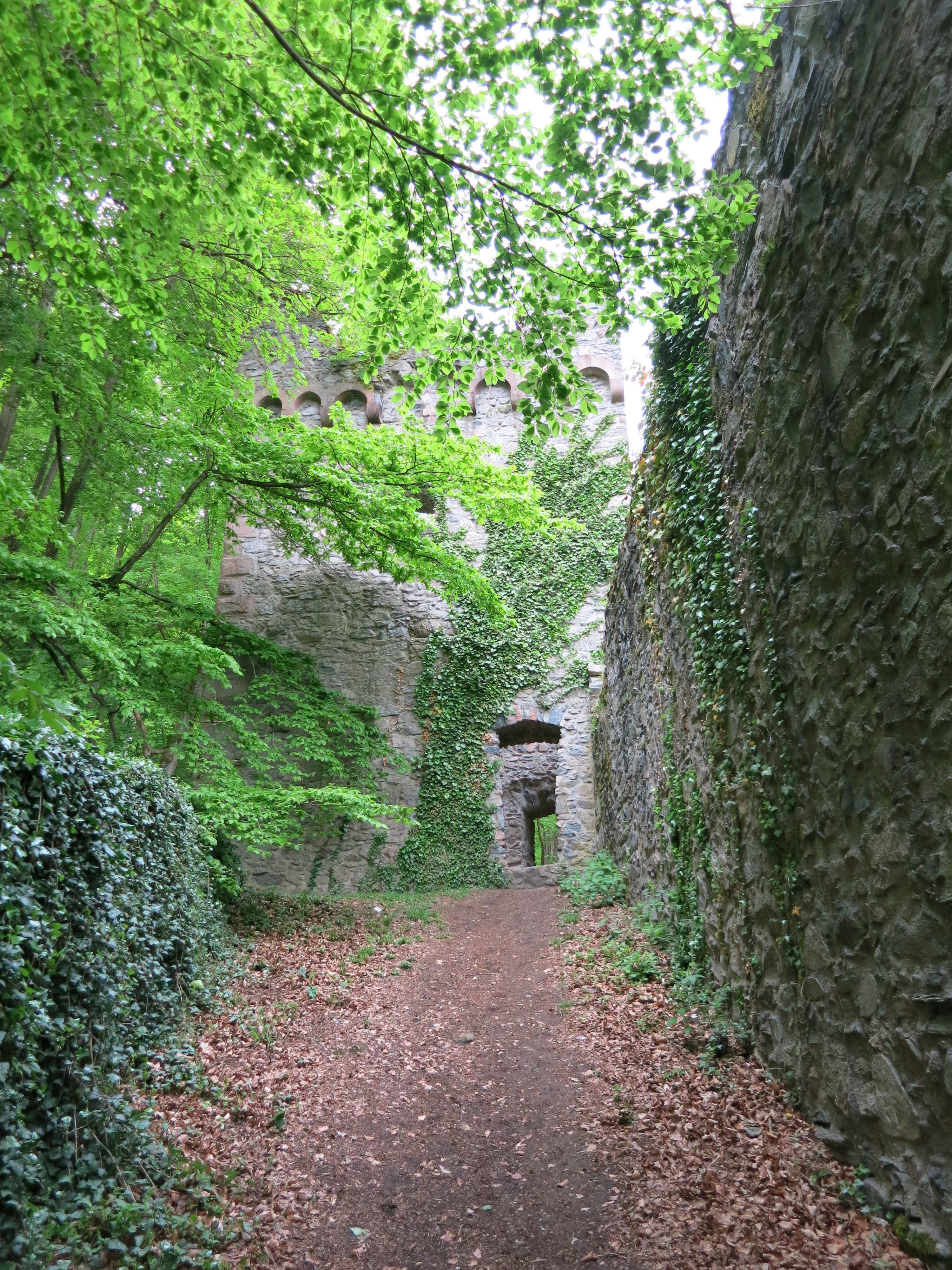
The objective was Burg Rodenstein, a castle ruin nestled in the mountains south of Darmstadt. We began at an elevation above the castle, passed a site where (I think) women used to live in a cave or something, then cut down a mountain bike path (and what a trail that was- the jumps were impressive) to curtail our journey and reach the castle. 

I wonder why Rodenstein was constructed at that site. It's surrounded by the hill, so enemies would have had a nice vantage point in a battle. Whatever the reason, its ruin makes a scenic area even better, and it was delightful to 'stumble upon it' as we walked (the GPS tipped us off, of course).


Another day, another castle. I'll miss this so much.

Saturday, October 10, 2020

Manderscheider Burgen


Today we visited the two castles of Manderscheid. About 100 miles from Wiesbaden (but highway the entire way), these sets of ruins are nestled in a quiet valley on the way to Luxembourg. We saw the lower castle first.


The upper castle is an easy 1km hike from the lower, across a stream and up a narrow (but easily navigated) path. It was wonderful.


We drove a short way the other direction to capture the structures from above.

All in all, a lovely day out.