Thursday, September 8, 2016

The Horse and His Boy (C.S. Lewis)


It is the golden age in Narnia, and the reigning monarchs (Peter, Susan, Edmund, and Lucy) are ruling the land well.  It is not so elsewhere.  Shasta, orphaned and serving a harsh master in the equally harsh land of Calormen (south of Narnia, across a vast desert) is about to be sold into slavery when he discovers a talking horse (Narnian, named Bree, and desperate to go north himself).  Together they escape and eventually join up with fellow escapees Aravis (girl) and Hwin (talking horse).  But as they head north, they catch wind of a terrible Calormene plot to conquer Narnia and Archenland.  Can the horses and children warn the northern countries in time?

I enjoyed this tale well enough, but it doesn't seem to quite compare with the other Narnia books I've read to date.  There are profound Christian truths illustrated here, but they don't come in until towards the end.  It's nice to get a view of lands outside of Narnia, but the tale seems like a bolt-on and not as integrated into the saga as other volumes.  It's pretty good; just not as good as the others.

Rating: A-

Monday, September 5, 2016

The Lion, the Witch, and the Wardrobe (C.S. Lewis)


Things look bleak for the Pevensie children- Peter, Susan, Edmund, and Lucy- when they're sent to a strange professor's house in the countryside to escape the London bombings during World War II.  But when Lucy stumbles upon a new world, accessed through a wardrobe, life takes quite a different turn.  She and the others have found Narnia, a land of talking animals ruled by the evil white witch, where it's always winter but never Christmas.  Things are changing, though, as Aslan- a lion and the rightful ruler of Narnia- has returned and is eager to rid the land of the witch forever.  To do so, however, he must pay a terrible price.

This, the first published and most famous volume in the Chronicles of Narnia, is an allegory of Jesus' death and resurrection.  Aslan is Christ, suffering for the sins of others and ultimately overcoming death itself to heal and restore Narnia.  It's a good story of friendship betrayal, love, and healing.  It's worth your time.  Just be warned: Aslan "isn't safe.  But he's good."

Rating: A

Saturday, September 3, 2016

The Magician's Nephew (C.S. Lewis)


Digory and Polly, bored during a typical gray London summer, get more than they bargain for when their explorations take them into Uncle Andrew's study and all the wonders therein.  When the greedy relative tricks them into helping him conduct an experiment, they find themselves traveling between worlds and unwittingly awaking the evil Queen Jadis.  Finally, they arrive in Narnia as it is sung into being by the powerful lion Aslan.  Can Aslan set things right?

The Magician's Nephew is book 6 (in publication order) but book 1 (in the tales' chronological order) of The Chronicles of Narnia by noted Christian author C.S. Lewis.  Here, we learn how Narnia is created and the evil Queen (who will play a prominent role in the best-known tale, The Lion, the Witch, and the Wardrobe) comes into that world.

This is a children's story, and it's done well.  I'm not sure how well it would stand on its own- the enjoyment is heightened with prior knowledge of Narnia and Aslan- but it's good.  Aslan obviously represents Jesus, and Lewis makes heavy use of symbolism throughout this book (and the series) to teach Christian truths in a witty, powerful, and (at times) light-hearted way.  I'll end with some quotes to reflect upon from the book:
For what you see and hear depends a good deal on where you are standing: it also depends on what sort of person you are. 
Now the trouble about trying to make yourself stupider than you really are is that you very often succeed. 
O Adam's sons, how cleverly you defend yourselves against all that might do you good! 
All get what they want; they do not always like it.

Rating: A

Thursday, September 1, 2016

The Quest of the Holy Grail (Author Unknown)


Monty Python did a movie about it, Indiana Jones sought it, and a great many real people have, too.  The Holy Grail is based in history but tales concerning it are mostly of Medieval legend.  The Grail was the cup used by Christ at the last supper (Matthew 26:26-29).  In some versions of later tales spun over the centuries, it was also used by Joseph of Arimathea to catch the Savior's blood while on the Cross (this is nowhere in Scripture).

The legend of the Holy Grail was weaved into Arthurian legend in Medieval times (the literary history is somewhat convoluted; see here for an overview).  So, on to today's review.  Written in the early 1200's in France by an author lost to history, The Quest of the Holy Grail fused Christian symbolism into the Arthurian court.  Here, the Holy Grail was sought by King Arthur's knights- in fact, its pursuit breaks up the fellowship of the Round Table.  In the story, the Grail symbolized 'the secret and hidden wisdom of God' (as mentioned in 1 Corinthians 2:6-10), and knights sought to attain it by virtue.  Each encountered many 'adventures' (we'd think of them as trials) along the way, and all fell short save for one destined to achieve it (name withheld to avoid spoilers).  Many of the adventures were close parallels to stories in Scripture; in fact, often a handy hermit or priest would explain the meaning or symbolism of an adventure to the participants after the fact.

As later Arthurian works discuss the Grail, I was interested in this, one of the earlier ones, and certainly the longest treatment of the subject.  It was pretty good.  I especially enjoyed the Penguin Classics edition; the translator did an excellent job with explanatory notes, walking the reader through the Christian symbolism which pervades this book and pointing the reader to referenced or relevant Scripture passages along the way.  It's clearly meant to instruct.  Of most interest to me was the aspects of Medieval theology we can infer from this.  Here, one virtue (mentioned perhaps more than any other) is chastity- sex was viewed as bad, even (apparently) in marriage.  Perhaps this betrays the author as being a celibate clergyman.  Another common theme is earning merit through virtue (or works)*.  The Reformation (hundreds of years in the future) would address this and give a counter-claim that only by the unmerited favor- or grace- of Christ, in reliance upon His works, can one be saved.  There are other examples; time and space preclude full exploration.  In closing, this is a worthy and insightful addition to the Arthurian saga.

Rating: B+

*Though, to be fair, the only knight who ends up being worthy of the Grail may be symbolic of Christ- the only one who was worthy- so this may be saying that we as sinful humans cannot merit salvation, which would align with Reformation thought.

Wednesday, August 31, 2016

Some Magic: The Gathering Resources


The collectible card game Magic: The Gathering has been around for over 20 years.  One of the strengths of the game is a strong support community, through both official and unofficial channels.  And it needs it- as new cards are routinely released through several new expansions each year, it can be overwhelming for a new player to know where to begin- over 14,000 cards have been made.  This post is intended as a one-stop resource for players of all backgrounds.


Rules & Formats

Both basic and comprehensive rules can be found on the official page here.  One of Magic's appeals is the ways the game can be played- the different formats.  Those are discussed here.


Cards

To search for individual cards (or text on cards), use either the official card database (The Gatherer), Magiccards.info, or magidex.  They all feature the latest card wording for optimal clarity or resolving rule disputes (for example, some cards used to have abilities that trigger when it "comes into play," but now the language is "enters the battlefield."  It's the same for rules purposes, and these online resources help verify that when questions arise).

If you're interested in tournament play, make sure your deck doesn't include cards that will disqualify you.  Some cards have proven so powerful over the years that they have been banned or restricted, and this official page has lists of such.

If you'd rather visually peruse large sets of cards efficiently, MythicSpoiler is great.


Deck Builders/Viewers/Articles

Deck building is a key part of Magic.  This official site has some deck building principles, and my recommendations on it are here.  One way to deck build is to look at what others have already constructed (called 'net-decking'), and the sites in this section have plenty of examples.

Building a deck is most efficiently done virtually.  You can do this in a number of places.  DeckStats is a great site which provides a number of stats about the deck(s) you enter.  It's a great place to spot any big problems during the design phase (rather than discovering them during play).
MTGGoldfish is another place to build your own decks or view others.  It also has articles about cards (or card combos) that are quite helpful when designing.  MTGTop8 lists which decks are winning at the many tournaments and championships all over the world.

MTGSalvation is another site with articles, forums, and other resources, as is StarCityGames.


Card Collections

If you want to store your inventory online, you can do so at DeckStats or DeckBox.  The latter allows you to make your collection public for trading opportunities.

This official website has printable checklists for many expansions, if you're old school and prefer to track these things by hand.


Prices & Purchasing

Of course, if you want to play, you have to pay.  Cards can be obtained from many outlets.  You can get large collections on eBay or elsewhere.  For factory-sealed products (like booster boxes, packs, and starter sets), there are many options.  I've used CoolStuffInc for years and been impressed by their customer service and flexibility.  TrollAndToad is also a great place to buy.  I'm told TCGPlayer is good, too, as it lists private sellers as well as stores, giving you lots of choices.

As Magic is a living game, card prices fluctuate over time.  This is because new card releases can create synergies with older cards that vastly increase value.  MTGStocks is a site to track prices and popularity.


Video Coverage

Yes, Magic is popular enough to have plenty of sites dedicated to steaming videos of tournaments and other events.  MTGCoverage is one; twitch.tv another.

Sunday, August 28, 2016

The Brothers Karamazov (Fyodor Dostoyevsky)


Last month, I did a quasi-review of The Brothers Karamazov, by Fyodor Dostoyevsky.  I had to put it down for an odd reason- the book was misprinted and pages were missing (see my post for more details).  But, the publishing company graciously mailed me a new one, and so I was able to continue the story.  This is, therefore, a full review.

The Karamazov brothers are an interesting lot.  Their father is a womanizing, free-spending jerk who had four boys by two wives and an illicit encounter.  He ignored his kids while growing up, and they've dealt with it in different ways.  Dmitri, the oldest, had a short stint in the military and is in many ways like his carousing father; Ivan looked to philosophy and turned against God; Alexei walked with God and lived in a monastery for a time, learning from a venerable elder; Smerdyakov (the illegitimate son) resided with the old man as his servant/cook.  Things are seldom good in this dysfunctional family, but when Dmitri and his father are chasing the same woman, and Dmitri believes his father owes him inheritance money, things get ugly quickly.  The father is murdered, and all signs point to the oldest . . . but is there more than meets the eye?

This book was okay.  The theme was outstanding, looking how our sinful, broken nature can manifest itself differently from person to person.  And many characters in the book showed the ability to both love greatly and fall horribly- a poignant (and accurate) portrayal of reality.  These gems aside, the execution left something to be desired.  Some chapters were good and fast-paced; others were lengthy rants or philosophical treatises that were hard to follow and (in many ways) probably unnecessary to the story.  The latter half of the story picked up and was markedly better than the first, so press on if you're intrigued.  It's clear the author was using the novel to discuss different ideas about God and man, love and hate, moral wrong vs. legal wrong- always good topics.  I just wish it had been done in a more readable, condensed style.

Dostoyevsky excels at painting pictures of human brokenness.  I see it here, in The Idiot, and in Crime & Punishment.  Of the three, the last is by far, in my opinion, the best.

Rating: B

Friday, August 26, 2016

Baltimore


Another travel post today: Baltimore.

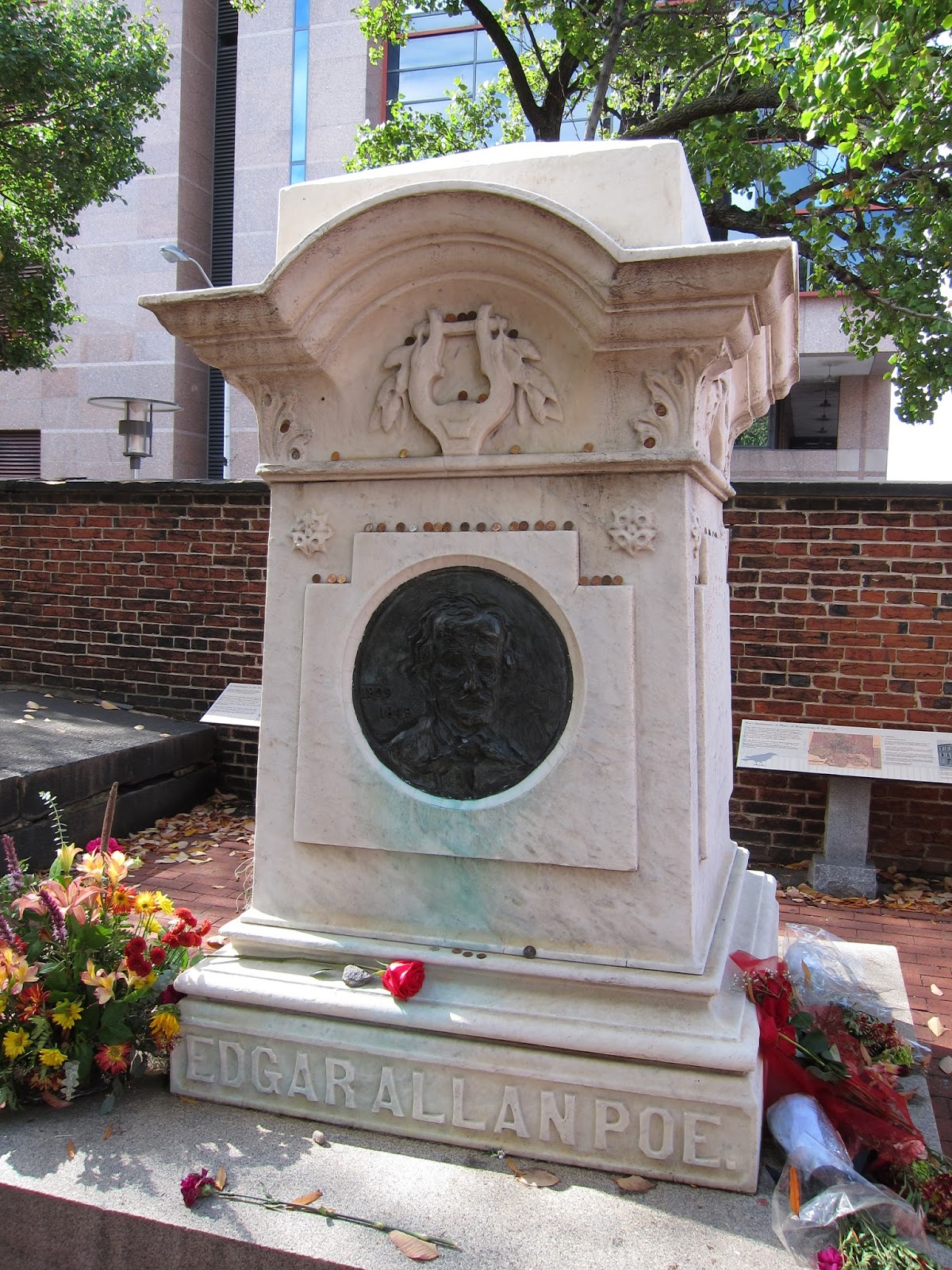
Poe's Grave
Edgar Allan Poe, author of The Telltale Heart, The Raven, and other tales of the macabre, lies just outside the Inner Harbor district.  The cemetery is haunting and befitting the man's legacy.


Lexington Market
A nice place to grab a bite to eat.


Camden Yards
Home of baseball's Baltimore Orioles, this is one of the nicest stadiums in America.


Inner Harbor
The highlight of Baltimore is its Inner Harbor.  Shopping, tourism, museums- there's a lot to see and do here.


Aquarium
Perhaps the highlight of the Inner Harbor is the Baltimore Aquarium- well worth a visit.  If you're local, get an annual pass- pays for itself in just two visits.


Fun Buildings
Barnes & Noble is in an old power plant, and is one of the cooler bookstores around.  The clock tower at left is nice, too.


Conclusion
I need to do back to Baltimore and get more pictures.  It's a great place, small (for a city) and surprisingly easy to access.

Rating: A