Saturday, April 8, 2017

Elfenroads


The 2015 Elfenroads release is three games in one package: Elfenland, Elfengold, and Elfensea.  Today's review is of Elfenland.  For 2-6 players, it plays in 45-90 minutes.

Overview
You are a young elf about to undertake the rite of passage to adulthood.  Your goal: visit as many towns in Elfenland as possible.  The challenge: you'll have to use many different types of transportation (dragons, unicorns, giant pigs, elfcycles, magic clouds, ferries, rafts), as the roads connecting the towns cross varying terrain (plains, woods, desert, mountains, river/lake) and permit only certain 'vehicles'.  The card below shows which means of transport can cross which types of terrain, with associated costs to do so (for example, a dragon costs 2 cards to travel over woods, but 1 to travel over anything else).
taken from the rulebook, available here
Since the goal of the game is visiting as many regions as possible, this game is all about efficient transportation.  You'll use Travel Cards to pay to use roads; the method of transportation allowed on a road (and thus, the type of Travel Card you'll need to pay) is determined by which Transportation Counter is on that road on a given turn (see the next section for more information).  You can't traverse a road at all if it doesn't have a Transportation Counter on it.

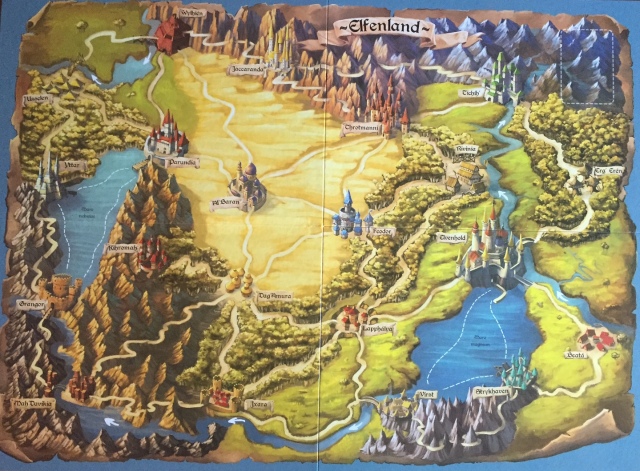
the game map; image from here

Simplified Gameplay
The game is played in three rounds, where each round has six phases:
taken from the rulebook
In a given round, each player takes turns and:
1. Draws 8 Travel Cards
    - in the first round; in subsequent, each player draws back up to 8
2. Draws a Transportation Counter and keeps it secret
3. Draws 3 more Transportation Counters and keeps them face-up
    - players can draw from the five face-up Transportation Counters or from the face-down pile
4. Plans Travel Routes by placing Transportation Counters face-up on roads
    - only one Transportation Counter can be on a road; this indicates what vehicle may use the road
    - Transportation Counters must be legally placed (example: a giant pig can't be on a desert road)
    - players are not obligated to place Counters; they can choose to pass
5. Moves his elf boot to as many cities as possible
    - players can traverse only roads that have Transportation Counters on them
    - players traverse roads by paying the appropriate type and number of Travel Cards
    - players can visit more than one city if they have the Travel Cards to pay for multiple roads
    - example: if a giant pig Transportation Counter is on a road in the woods, the player can traverse that road by paying (discarding) one giant pig Travel Card
    - when a player visits a city, he/she takes his 'town piece' from that city
6. Finishing the round,
    - turn in all unused Transportation Counters except one
    - remove all Transportation Counters from the board
    - the next round begins (go to phase 1), unless three rounds have been played

game in progress; image from here
The player with the most town pieces at the end of three rounds wins!

Review
I have mixed feelings.  The game is by Alan Moon, who later designed the excellent Ticket to Ride.  I see similarities between the two (goals, varying transportation flavors & costs).  Elfenland is a touch more restrictive than Ticket to Ride, and perhaps not as satisfying.  Your drawn Travel Cards are random, and some (or all) of your Transportation Counters are, too.  Since you must "match" them to travel, that amount of chance can leave you in a bind through no fault of your own (though to be fair, you can make use of opponents' Transportation Counters, so that can offset the problem).  And wow, can opponents destroy your chances by placing one simple obstacle.  The map and theme are fun, though, and despite my reservations, something does keep drawing me back to this game.  It's also neat to have two more games (Elfensea and Elfengold) in the box.  Ticket to Ride is better, but this is pretty fun, too.  The game rules can be downloaded here.

Rating: B+


Tuesday, April 4, 2017

Canon

image from here
The below is a transcript of a talk I plan to give at an upcoming retreat.  The quotes below are taken from FF Bruce or Bruce Metzger; some general thoughts are credited to the same.  Their books- and summaries of them- are presented below.

The Canon of Scripture

INTRODUCTION
The canon of scripture refers not to divine artillery, but rather the collection of texts we receive and recognize as authoritative, the measuring stick of our belief and behavior. We call it the Bible- here's how it came to be.

OLD TESTAMENT
Remember that from the beginning, the Christian Church possessed a canon of sacred writings. In those days, it was referred to as the Scriptures or by its traditional divisions- the law, the prophets, and the writings. Today, we call it the Old Testament. This collection of Hebrew and Aramaic texts had been used for centuries and was well established by Jesus’ day. To Jews, these writings had authority. Jesus Himself “regularly appealed to the Hebrew scriptures [both specific passages and the collection as a whole] to validate his mission, his words and his actions.” Indeed, he is the fulfillment of them (Luke 24:44). And in debates, scripture was the common authority, acknowledged even by His opponents. So Christians accept the Old Testament because Jesus did.

Were the exact boundaries of the Old Testament canon established during Jesus day? We think so. Three books- Esther, Ecclesiastes, Song of Songs- were discussed at a council in Jamnia in AD 70, but the debate concerned their right to remain in the canon, and of course they did.

APOCRYPHA
Some Churches recognize an additional collection, called the apocrypha. This was because the Septuagint, a widely-used Greek translation of the OT, had come to include books not found in the original Hebrew canon. Because these extra books had become tradition, the Roman Catholic and Orthodox churches accept them. Because they were added later, most Protestant Churches do not.

NEW TESTAMENT
On to the New Testament. Christians, by definition, follow Jesus as Lord. Jesus left no written record, but His words and deeds were witnessed by a select group called the apostles, to whom He granted understanding (Mark 4:11, Luke 24:45), authority, and the command to teach others (Matthew 28:20). The apostles and some of their close companions would produce a new set of writings, which were collected and would become the New Testament.

Most NT books were written before AD 70* and received without dispute as authoritative. And yet, the early Church did not think much about a new canon, perhaps due to a strong cultural preference for oral tradition left by the apostles. Attitudes changed about 100 years later- in the second century- when heretics (like Marcion and Montanists) and popular movements (like Gnosticism) encouraged the early church fathers to start explicitly listing books received as authoritative. Though produced from diverse cultures and backgrounds, it is remarkable how similar their lists were. 20 of the 27 NT books were accepted universally; the remaining 7 (Hebrews, James, 2 Peter, 2 & 3 John, Jude, Revelation) were accepted by some but not others. These were debated largely due to questions of authorship (apostolic or not?), though orthodoxy (agreement with accepted texts) and consensus among churches also played a role.

In 367, Athanasius was the first to articulate the NT canon as we have it today. Within decades, Jerome and Augustine’s concurrence would cement the collection. At that point the canon was considered closed and seldom discussed for over 1000 years, until the Reformation revisited earlier uncertainties about those 7 NT books. The reformers left it unchanged, however, because they recognized an important truth: The Church does not have authority over the Scriptures; the Scriptures have authority over the Church.

NT APOCRYPHA
As with the OT, there were other writings from this era that were ultimately not accepted as canon and called apocryphal. In general, these works are clearly inferior theologically and historically to the canonical accounts. Some have obvious problems like late authorship or false teachings (like denying the OT). Others are simply amalgamations of verses from canonical works. Some are even antagonistic, perhaps due to competing philosophical influences of the day. In short, these "books excluded themselves from the canon."

CHAPTERS & VERSES
As an aside, the books of the canon have been set for centuries, but the presentation has changed- chapters were added ~AD 1200, and verses ~1550. Though such numbering makes locating passages easier, some argue these additions encourage de-contextualization and misinterpretation.

CONCLUSION
Though grounded in evidence and history, the canon of Scripture is ultimately a statement of belief. As we believe individual books were inspired by God, so too we believe the assembling of the collection was from the Lord. As the Reformers found, doubting the canon can reveal the human tendency to put personal preference (and cultural bias) above the word of God. So “Taste and see that the Lord is good” (Psalm 34:8a), “for the Word of God is living and active, sharper than any two-edged sword.” (Hebrews 4:12a)


Resources

Two books set the standard in discussions of canon:
  • Bruce, F.F. The Canon of Scripture. Downers Grove, IL: InterVarsity Press, 1997. (Summary)
  • Metzger, Bruce. The Canon of the New Testament: Its Origin, Development, and Significance. Oxford: Clarendon, 2009. (Summary)
Two free online pdf documents are quick and valuable reads:
In many ways, the New Testament validates the Old.  See my blog post here for a summary of the argument.

*approximate dates of authorship for all NT books

Monday, April 3, 2017

Carcassonne


Continuing to look at popular board games, today's review is of the 2000 release, Carcassonne.  For 2-5 players, it plays in 30-45 minutes.

Overview
Carcassonne is a tile placement game.  Each tile has a piece of landscape on it- monastery, road, city, field (and sometimes, combinations thereof).  Through successive tile placement, players create and expand a region consisting of many roads, towns, etc.  Tiles must be legally placed, which means:
- they must be adjacent to existing tiles, and
- they must continue the existing landscape (so a road tile must be placed adjacent to an existing road,  a city segment next to a city, etc.)

The goal, of course, is scoring the most points.  Points are scored with meeples, which are small wooden people you can place on your turn.  Meeples can be placed standing up on unoccupied* roads, in unoccupied towns, on monasteries, or lying in unoccupied fields.  They score points as follows:
- road (complete or incomplete): 1 point for each road tile in a road segment
- completed city: 2 points for each city tile in a city (+2 points for each coat of arms in that city)
- incomplete city: 1 point for each city tile in a city (+1 point for each coat of arms in that city)
- monastery: 1 point for each tile surrounding the monastery (including itself)
- lying in fields: 3 points for each adjacent completed city

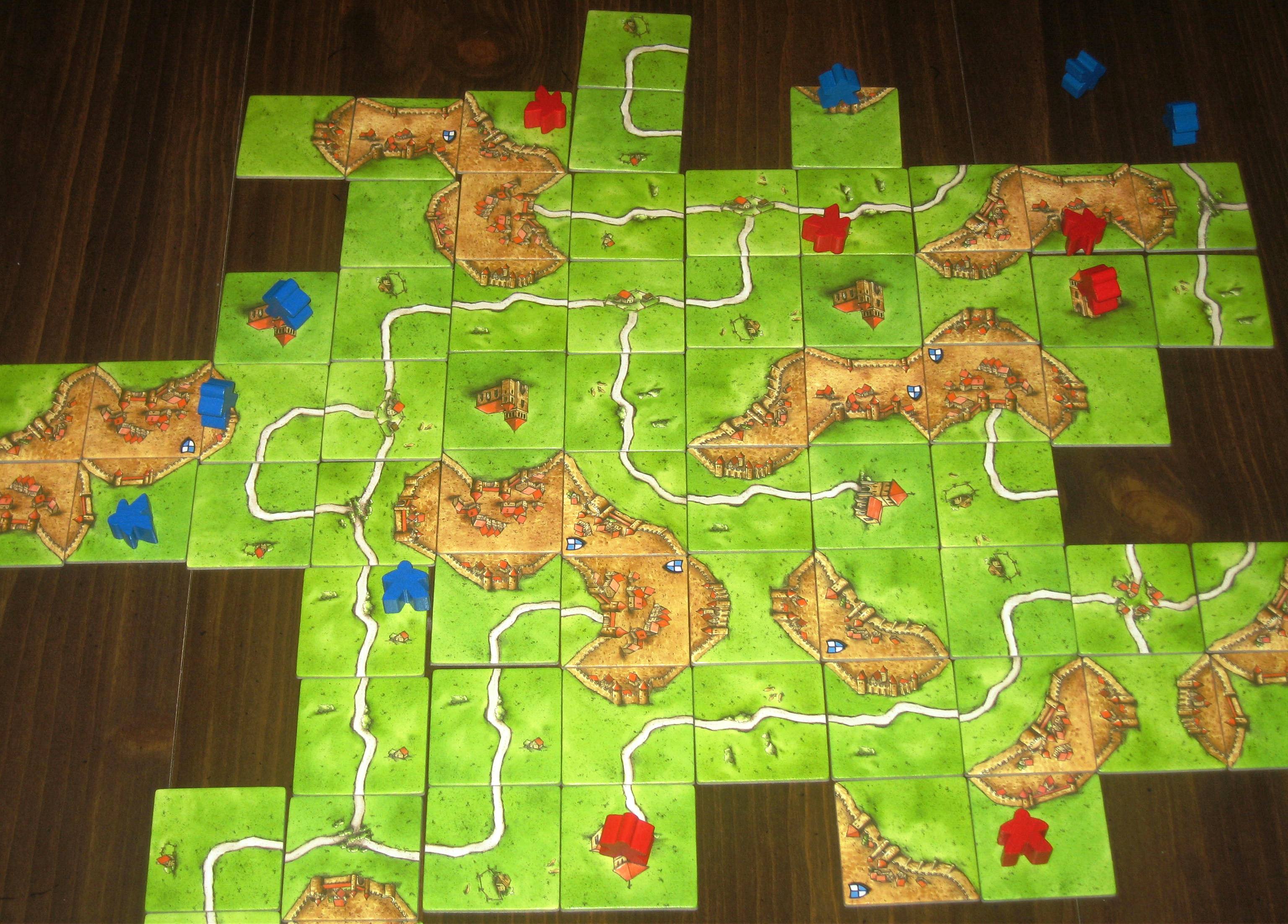
A 2-player game in progress; image from here
If you have meeples on roads, in cities, or on monasteries that are completed during the course of the game, you score points and get your meeple back immediately- so you can use it again later!  Completed means:
- roads: both ends terminate in an intersection (or loop) or at a city (or monastery)
- city: it is completely enclosed by a wall
- monastery: it is completely surrounded by 8 tiles


Simplified Gameplay
Each turn, you:
- draw and place a tile
- if possible and desired, place one of your meeples in a legal area on the tile you just laid
- if applicable, score meeples on any completed roads, cities, or monasteries

Play proceeds clockwise until no more tiles are in the draw pool.  Then, score meeples in incomplete roads/cities/monasteries, score them in the fields, and see who wins!

Review
Carcassonne is a good game.  I get why it, like Catan, is so popular.  It's easy to understand, full of depth, and plays quickly.  The only bad thing is the luck component- you're at the mercy of what tile you draw on your turn.  That aside, this is a winner.

Rules can be found here.

Rating: A-

*'unoccupied' means no other meeples are present on a continuous segment.  So if you expand an existing road, and a meeple is already on an existing road segment, you cannot place a meeple on the newly-placed road segment.

Sunday, April 2, 2017

A Curious Engagement

image from here

Twelve years ago today, she said yes.  Then the pope died.  Read on for more.

On April 2, 2005, my girlfriend and I were visiting friends and family at our alma mater, Penn State.  The trip was special- it was always nice to see the place we had called home as recently as two years prior, but this time, I also planned to propose!

The plan was simple:
1. take a morning stroll through downtown
2. stop in the comic book store to pick up a new Star Wars Miniatures release
3. walk by the gazebo on west campus where we had often hung out
4. deliver an eloquent and beautiful message, finishing with ring presentation
5. welcome into my arms an ecstatic and breathless fiancee
6. enjoy an afternoon collectively lost in a romantic fog
7. meet family for dinner to enjoy a chorus of congratulations and ring adoration

Aside: why comic book store, you say?  Being quite excited, I felt a way to mask it was to talk up the new Miniatures release, and make her think my awkward behavior was due entirely to anticipation of that.  <she saw through it, of course>

My plans were dashed early on by rain.  Steps 1 & 2 happened without incident, but when we walked by the gazebo, she refused to go in.  It was raining and the gazebo was surrounded by wet grass . . . I understood.  But I pressed the matter; several attempts to get inside were rebuffed, so we kept walking.  "No big deal," I thought.  "I'll do it somewhere else.  I have plenty of time."

As the day progressed, I sought opportunities to propose.  There were none.  We went to the mall . . . the luggage section of Bon-Ton didn't seem suitable.  We went other places . . . no dice.  I started to get nervous.  We were supposed to be engaged by now, and the ring was burning in my pocket.  Plus, remember step 7?  My family knew I was proposing . . . if they didn't see a ring, they'd assume a negative response, might react poorly, and we'd probably all end up on Jerry Springer.  What was I to do?

I'm not proud of what happened next.  I managed to hide the ring in the glove compartment of my car (Gold 1 . . . long may you ride).  As we pulled into Olive Garden for lunch, I asked her to get something for me from said compartment.  She saw the ring, I stumbled through a proposal, and she said yes.  We strolled into lunch happy.  Then I explained my original plan.  My fiancee quietly reflected at first, but once back in the car . . .

"You should have made me go to the gazebo."  Of course I had tried several times, and noted as such.  Apparently, it wasn't enough.  "I would have gone if you had been persistent."  "I was persistent," I retorted.  The exchange continued in like fashion, with my fiancee claiming I could have convinced her, while I countered that her obstinance would have made that unlikely (to avoid complete discord, I don't think I worded it in quite that way).  We ended with a plan: we drove back to the gazebo and I proposed properly.  All was good . . . or so I thought.

Every woman wants a nice proposal, and I had messed up.  My fiancee, though not angry, was disappointed with my apparent inability to deliver a romantic experience (12 years later, this is still a  problem).  We continued our day as she thought on this.  Thankfully, we then learned that Pope John Paul II had just passed away.  (I was thankful for the distraction, not the event itself.)

That evening, we met my family for dinner, and all appeared well.  Then Sunday came.  The pastor opened his sermon with the following, which I can quote verbatim 12 years later for reasons that will be obvious: "If I had known how many times my proposal story would be told, I would have planned it much better."  Thanks, buddy . . . a day late on that one.

I am a blessed man.  We've been married for almost 12 years, have three wonderful (if belligerent) children, and she's more beautiful and amazing than the day we met (at least one of us is aging well).  But both of us wish we could get that day back- with same outcome, but better delivery.  It's not just what you do, folks . . . it's how you do it.  Delivery matters.  

Friday, March 31, 2017

Catan


Today's game review is of the 1995 release, Catan.  For 3-4 players, it plays in 60-120 minutes.

Overview
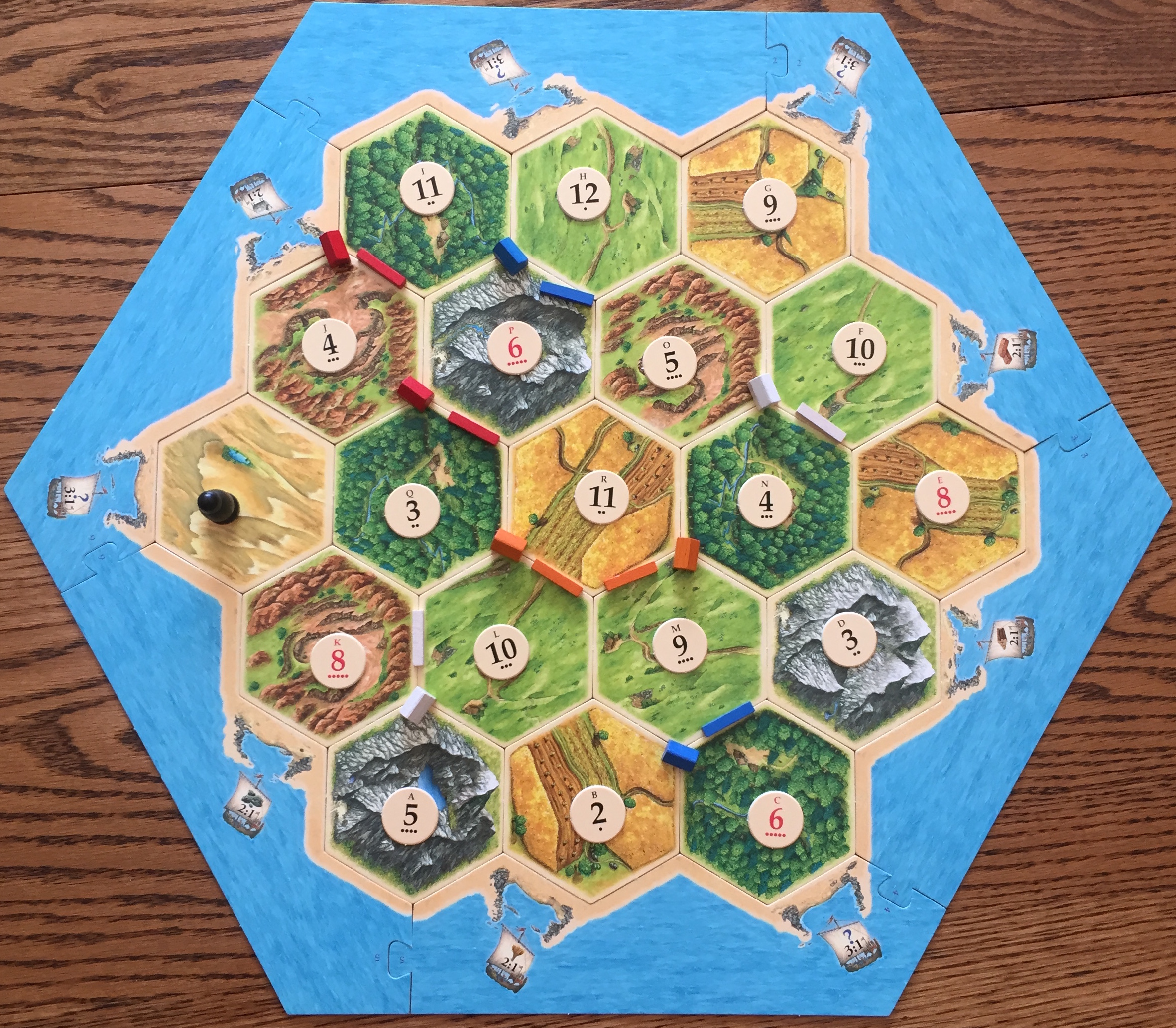
Your goal is to get 10 Victory Points.  You do this by dominating the island (a collection of hexes), which happens through building (settlements, cities, and roads) and collecting certain development cards.  Each hex has one of five kinds of resources (wood, sheep, grain, stone, brick) that you must acquire to build these structures, as well as a number associated with it.  When that number is rolled, any player with a settlement or city adjacent to that hex gets the associated resource card.  For example, if an '11' is rolled, the orange player in the image below would get 2 grain cards (because they have 2 settlements bordering the hex with '11', which happens to be a grain hex).

a game in progress; image from here
Simplified Gameplay
This game is all about resource management.  To start the game, each player gets to place 2 settlements and 2 roads (if the players are A, B, and C, they choose in the following sequence: ABCCBA).  Turns then proceed clockwise.  On your turn,

- Roll two dice and distribute resource cards to all players who have settlements or cities adjacent to hexes matching that number. If you roll a '7,' you can place the robber on a hex of your choosing (probably one that your opponent occupies) and take a resource from that opponent.  But watch out- the robber also steals resources from any player who has too many cards in hand, including you.  So be wary!

After rolling (and resolving the robber, if applicable), you have several optional actions, which can be performed any number of times:
- Trade resources with other players.
- Build settlements, roads, or cities.  Each type has a differing resource card cost (example: one road costs 1 wood + 1 brick).
- Buy a development card.  These cards can grant additional resources, provide knights to protect against robbers, or have other effects.

Buildings, the longest road, and some development cards grant points.  The first person to accumulate 10 points is instantly the winner, and lord of Catan.

Review
Of ~90,000 games reviewed on BoardGameGeek, Catan has the most ratings (66,800+).  That should tell you it's wildly popular, and many variations/expansions to this game have been produced in the 20+ years since its release.  I've heard the claim that Catan was a game-changer,* its popularity being the catalyst for the explosion in board game options we enjoy today.  So I have to give the game its due.  And it is a fun game- simple to learn, full of suspense, and has no end of variety/strategy.  That said, I don't often choose this game.  The robbing and trading stress me out, games can last forever, and you're ultimately at the mercy of dice rolling- if your numbers never come up,  you're out of luck.  The 3-person minimum can also be annoying.  This is a good game . . . but I'm more fond of others.

Rating: B+

*nyuk nyuk

Thursday, March 23, 2017

Adventure Land


Today's game review is of the 2015 release, Adventure Land.  For 2-4 players, it plays in 45 minutes.

Overview
The kingdom is in peril, being attacked by vicious fog monsters who appear at random in the plains.  Beat them and win the king's favor!  To do so, you'll need to prepare by collecting herbs (randomly appearing in the forests), swords (randomly in the mountains), and companions (randomly in the cities).  You can also find gold in the river, but beware the water sprite, who roams up and down the stream devouring all in his path.  Can you prevail?

An important thing to note is movement rules.  All players start their adventurers in designated slots on the top left of the board.  The adventurers can move only right or down throughout the game- never left or up.  Therefore, choose your moves wisely . . . for once an adventurer reaches the lower right of the board, their adventure is over.

Simplified Gameplay
After setting up the game board and components, players alternate turns (clockwise order).  On his turn, each player takes two actions:

  1. Turn over 2 terrain cards and place items on the game board
    • Each terrain card will have a grid coordinate and an item- herb, sword, companion, gold, or fog creature
    • For each terrain card, randomly choose a matching item from the stockpile and place it face-down on the appropriate grid coordinate
  2. Move adventurer(s)
    • Move one adventurer as far as you like in a direction you choose (must be right or down)
    • Move one adventurer (it could be the same or different) as far as you like in a direction you choose (must be right or down)
    • When your adventurer lands on a grid coordinate occupied by an object (herb, sword, companion, gold), you obtain that object
    • When your adventurer lands on a fog creature, you fight that fog creature

Fighting fog creatures

  • Each fog creature has a strength value (lower left) that you must match or exceed to defeat it
  • Your combat strength is calculated as follows:
    • Your adventurer and each companion with him counts as 1 each
    • You can choose to use your herbs, which increase your strength by the number indicated on the herb
    • You can choose to use swords, which increase your strength by the number indicated on the sword (if any) AND by rolling one die for each sword you use
  • If you win combat, you defeat the fog creature and earn points (lower right)
  • If you lose combat, your adventurer and all companions are defeated
Game in progress (image from here)

The ultimate goal is to have the most points at the end of the game.  How you earn them depends on the adventure you play (three are included).  You generally earn points by collecting gold, defeating fog monsters, and accumulating companions.

Review
I like this game reasonably well.  It's easy to pick up and fun to play.  The items popping up on the board is an interesting twist, and collecting them is fun.  There's a nice balance between collecting and fighting- do too much of either and you'll probably lose.  The movement rules are interesting (if a bit odd), too- you need to pace yourself to not exhaust a given adventurer too soon.  Different adventures add further variety.  Though the game is listed as ages 10+, my 4- and 7-year-old love this game- which heightens its appeal for me.  It's not the deepest game out there, but it's an enjoyable experience.

Rating: A-

Saturday, March 18, 2017

The Canon of the New Testament (Bruce Metzger)


The canon of Scripture is the list of writings the Church holds as authoritative and therefore should be used to determine what Christians should believe and how we should behave.  Many scholars over the years have studied this important topic.  As F.F. Bruce did for the entire Bible, here Bruce Metzger looks at the canon of the New Testament- how the list of 27 books Christians recognize today as canonical became so.  Let's start with a book summary; the myriad quotes below are Metzger's.

Summary

What is the New Testament?
The New Testament "is a collection of writings that bear witness to what God has wrought through the life and work, the death and resurrection of Jesus Christ, and through the founding of his Church by his Spirit."  But let's start at the beginning.

The Initial Scriptures
Though this book focuses on the New Testament (NT), it rightly begins with the Old Testament (OT), which was known as the Jewish (or Hebrew) Scriptures during Jesus' day.  These Scriptures were considered canon to Jews and Christians alike.  So "from the first day of its existence the Christian Church possessed a canon of sacred writings- the Jewish Scriptures."  "Jesus accepted the Hebrew Scriptures as the word of God and frequently argued from them in his teaching and controversies."  Nowhere do we see Jesus and his opponents debate the authority of OT books- the collection was largely established.  (I say largely because 3 OT books may have been in question- Esther, Ecclesiastes, and Song of Solomon- but the debate concerning them wasn't about whether to accept them into the OT canon, but rather "the right to remain there."  Indeed, "the precise limits of the Jewish Scriptures seem to have been settled by about the end of the first Christian century.")  So Christians had a starting point.

If Christians already had sacred writings, why add to them?  
Because a new authority "had taken its place alongside the Jewish Scriptures"- the words of Jesus, who "claimed to speak with an authority in no way inferior to that of the ancient law."  Eventually, "narratives were compiled recording the remembered words, along with recollections of his deeds of mercy and healing."  These narratives would result in Gospels.

In addition, we have Jesus' apostles, who interpreted the significance of Christ's "person and work for the lives of believers."  They, too, claimed authority as direct followers of Jesus during his earthly ministry, and issued precepts and directives through letters sent to new congregations (or individuals).  These were called Epistles.  "It is natural that such Epistles were cherished and read again and again by the congregations that had first received them, and by others who came to appreciate copies of such valued testimonies from the apostolic age."

"As time went on, a Christian literature grew in volume and was circulated throughout different congregations."  "In the collections that were gradually formed, a place was found beside the Gospels and the Epistles for two other kinds of books- the Acts of the Apostles and the Apocalypse of John [Revelation]."  "Thus, side by side with the old Jewish canon . . . there sprung up a new, Christian canon."  Today, this is what we call the NT.

How quickly was the NT canon formed?
It formed very slowly- it was a long and gradual process, and "many questions and problems confront the investigation of the canonization of the New Testament."  There's a lot we don't know; below is what we do.

"At first Jesus' teachings circulated orally from hearer to hearer . . . [and] the circulation of Paul's letters began already during his lifetime."  (Aside: it appears that "devotion to oral tradition hindered development of a clear idea of canonicity."  More on this later.)  Early church fathers (like Clement, Ignatius, Polycarp, and Papias) do appear familiar with both written documents and oral traditions, using phrases found in the gospels and Pauline letters.  Initially, however, these were allusions or casual statements- there was little talk of which writings were considered authoritative, perhaps because of the preference given to the oral tradition.

Over time, "tastes begin to shift from oral to written sources."  "By the close of the second century lists begin to be drawn up of books that had come to be regarded as authoritative Christian Scriptures."  These lists were "judgments purposely delivered in order to delineate the limits of the canon."  Even so, there's a lot we don't know.  "Opinions differ as to which part of the NT was first in attaining general recognition as authoritative in the Church . . . [but it] seems to be that the Gospel was recognized first, then Pauline Epistles."

Many in the church had much of the NT and considered it authoritative from ~170 AD.  "By the close of the second century ... we can see the outline of what may be described as the nucleus of the New Testament . . . by the end of the third century and beginning of the fourth century, the great majority of the 27 books that still later came to be widely regarded as the canonical NT were almost universally acknowledged to be authoritative."  Later (in 367 AD), Athanasius was first to list the exact 27 books of our NT.  Jerome would agree and help produce the Vulgate- a Latin translation of the Bible- in the 380s, and Augustine further cemented the list through synods in subsequent decades.  At that point the canon was considered closed and seldom discussed until the Reformation, where "there was an awakening of earlier uncertainties concerning the authenticity of several books of the NT."  Ultimately, though, the canon would be unchanged by the Reformers, and it remains today as it has stood for centuries.

Why did it take so long to form?
As previously mentioned, oral tradition may have slowed the process, and of course the challenges of the age (posed by communication and travel limitations) meant things didn't happen quickly.  Remember, too, that this was a different culture with a different mindset: ". . . there was as yet no conception of the duty of exact quotation . . . consequently, it is sometimes exceedingly difficult to ascertain which New Testament books were known to early Christian writers; our evidence does not become clear until the end of the second century."

From the early church fathers, we find "a knowledge of the existence of certain books that later will comprise the New Testament, and more than once they express their thoughts through phrases drawn from these writings.  These reminiscences tend to show that an implicit authority of such writings was sensed before a theory of their authority had been developed- in fact, before there was even a consciousness of their authority."

Interestingly, the formation of the canon got some help from unexpected places- several internal and external trials spurred the process.  Heretical people or movements (like MarcionGnosticism, and Montanism) "stimulated the process of canonization" by "provoking a reaction among members of the Great Church so as to ascertain still more clearly which books and epistles conveyed the true teaching of the Gospel."  Additionally, periods of persecution (like Diocletian's edict to burn Christian Scriptures in 303) forced believers "to be certain which books were Scripture and which were not."  These factors had other interesting effects, including "devaluation of oral tradition," "a mistrust of apocalyptic literature," more frequent listings of sacred books, and the Church's emphasis on "the final authority of apostolic writings as the rule of faith."

How were books included (or excluded) from the canon?
To be clear, at first there were no councils that formally made such decisions.  Instead, early church fathers recorded their thoughts on authoritative writings in correspondence to their congregations and other leaders, and later church authorities used this data in refining their own conclusions.  From them we see that, broadly speaking, the canon developed based on three criteria, which were a "combination of historical and theological criteria:"

1. Apostolicity
This is the historical component.  "The superior standing of apostolic writers, living so close to the time of the earthly ministry of Jesus, more and more set the earlier documents apart . . . and helped to consolidate them as a distinct body of literature."  "In the age that followed that of the apostles, the expression 'the Lord and the apostles' represented the standard of appeal to which reference was made in all matters of faith and practice."  Apostolic authorship could be direct (like Matthew and John) or indirect (like Luke and Mark, companions of the apostles).  Ultimately, apostolicity was "established by historically verified testimonies of patristic writers of the early Christian centuries."

2. Orthodoxy
This is the theological component.  A book should agree with the sacred writings the church already acknowledged.  They had to conform to the 'rule of faith,' "that is, the congruity of a given document with the basic Christian tradition recognized as normative by the Church."

3.  Consensus among the churches
This is a cultural component (or a combination of historical and theological).  "Another test of authority for a book was its continuous acceptance and usage of the Church at large."

"These three criteria (orthodoxy, apostolicity, and consensus among the churches) for ascertaining which books should be regarded as authoritative for the Church came to be generally adopted during the course of the second century and were never modified thereafter."

It's interesting to note that "the concept of inspiration was not used in the early Church as a basis of designation between canonical and non-canonical orthodox Christian writings."  To clarify, "the Scriptures, according to the early Fathers, are indeed inspired, but that is not the reason they are authoritative.  They are authoritative, and hence canonical, because they are the extant literary deposit of the direct and indirect apostolic witness on which the later witness of the Church depends."

Which canonical books were questioned, and why?
As stated above, the bulk of the canon was never in serious question, and was set by late in the second century.  Of the 27 NT books, 20 fell in this category.  The remaining 7 were disputed in the early Church (and opened to renewed investigation during the Reformation): Hebrews, James, 2 Peter, 2 & 3 John, Jude, and Revelation.

Hebrews was received in eastern churches, but the authorship was questioned (was it by Paul, or Barnabas, or Clement?).  Theologically, Martin Luther didn't like some of its teachings.
James was claimed by some to have been published by someone else under his name.  Luther didn't like the emphasis on justification by works.
2 Peter appeared different in style from 1 Peter; this could be due to the apostle having employed different amanuenses (secretaries).
2 & 3 John were disputed because of authorship- was it John the Apostle or John the Elder?
Jude was rejected by a great many because it appeals to the apocryphal book of Enoch.
Revelation was received in western churches, but some distrusted apocalyptic literature (as a backlash against Montanism) and others (like Luther) felt the book didn't show Christ clearly.

In each of these cases, though, the aforementioned criteria eventually led to their widespread acceptance and inclusion in the NT canon.  Or, put a better way, "it is the simple truth to say that the NT books became canonical because no one could stop them doing so."

Why were some books excluded?
Some books "possessed temporary and local canonicity, but during the following generations the limits of the canon became progressively clarified."  The criteria mentioned above excluded these writings, which are called 'apocryphal.'

Some of the apocryphal books are considered edifying but not authoritative.  In general, apocryphal works are clearly inferior theologically and historically to the canonical accounts.  Some have obvious problems like late authorship or false teachings (like denying or twisting the OT).  Others are simply amalgamations of verses from canonical works.  Some are even antagonistic, perhaps due to competing philosophical influences of the day.  In short, "certain books excluded themselves from the canon."

Can I trust the NT canon?
It's a good question!  From above, it's clear that "the status of canonicity is not an objectively demonstrable claim, but is a statement of Christian belief."  As Christians believe the writers were inspired by the Holy Spirit when writing individual books of the Bible, so too we believe that the collecting of books was inspired.  In short, the Church does not have authority over the Scriptures- the Scriptures have authority over the Church.  This is not a new idea; John Calvin argued during the Reformation that "the authority of the Scriptures is based, not on the pronouncement of the Church, but on the interior witness of the Holy Spirit."  This internal testimony "is the means by which believers come to acknowledge" the authority of Scripture.  "From this point of view the Church did not create the canon, but came to recognize, accept, affirm, and confirm the self-authenticating quality of certain documents that imposed themselves as such upon the Church."

Before dismissing this concept, remember the OT was formed in much the same way- gradually, over centuries- and Jesus held it as authoritative.  Yes, " the Church has received the canon of the New Testament as it is today, in the same way as the Synagogue has had bequeathed to it the Hebrew canon."  Therefore, we can accept with confidence the NT canon as it stands today, and we would do well to learn from the experience of the Reformation, as the desires of some "to set aside certain books that proved to be awkward or embarrassing in ecclesiastical controversy" showed the human tendency to put personal preference (with associated biases) above the word of God.  This "should make us exceedingly wary in assessing our own motives and standards in evaluating the canonical status of the several books in the New Testament."

Does the NT canon contain contradictions?
I've heard this argument before- that the Bible in general (or NT specifically) contains contradictions.  Such statements fail to recognize that "the rich diversity of early Christian thought, preserving insights both Jewish and Greek, is reflected in the spectrum of the twenty-seven books in our canon today."  "As long as the chief doctrines and patterns of Christian life and thought within the New Testament at least point in the same direction, and not away from one another, they can coexist in the same canon.  The homogeneity of the canon is not jeopardized even in the face of tensions that exist within the New Testament.  These tensions, however, must not be exaggerated into contradictions as a result of giving inadequate consideration to the divergent situations in the early Church to which the writers addressed themselves.  To propose, therefore, to trim the dimensions of the canon in accord with an arbitrarily chosen 'canon within the canon' would result only in muting certain voices in the choir of witnesses that the Church has long found to be normative."  Indeed, some tensions have served to guard "against the extremes of misinterpretation."  "In short, the canon recognizes the validity of diversity of theological expression, and marks the limits of acceptable diversity within the Church."


I end the summary with this thought:
What is really remarkable is that, though the fringes of the New Testament canon remained unsettled for centuries, a high degree of unanimity concerning the greater part of the New Testament was attained within the first two centuries among the very diverse and scattered congregations not only throughout the Mediterranean world but also over an area extending from Britain to Mesopotamia.
Review

When you pick up a book intending to skim select portions and end up reading the whole thing, you know you have a winner.  Well-written, educational, thorough but concise, scholarly yet accessible . . . this is a good book.  Heavily annotated with references to other scholarly works, I recommend this resource heartily as a valuable reference to those interested in the formation of the Bible.

Rating: A