Monday, October 9, 2017

Nothing Like it in the World (Stephen Ambrose)


The transcontinental railroad, built in the 1860s and connecting Council Bluffs, Iowa to Sacramento, California, was a mammoth undertaking, not least because it was done almost entirely by hand.  The men who pulled it off are the subject of Stephen Ambrose's Nothing Like it in the World.

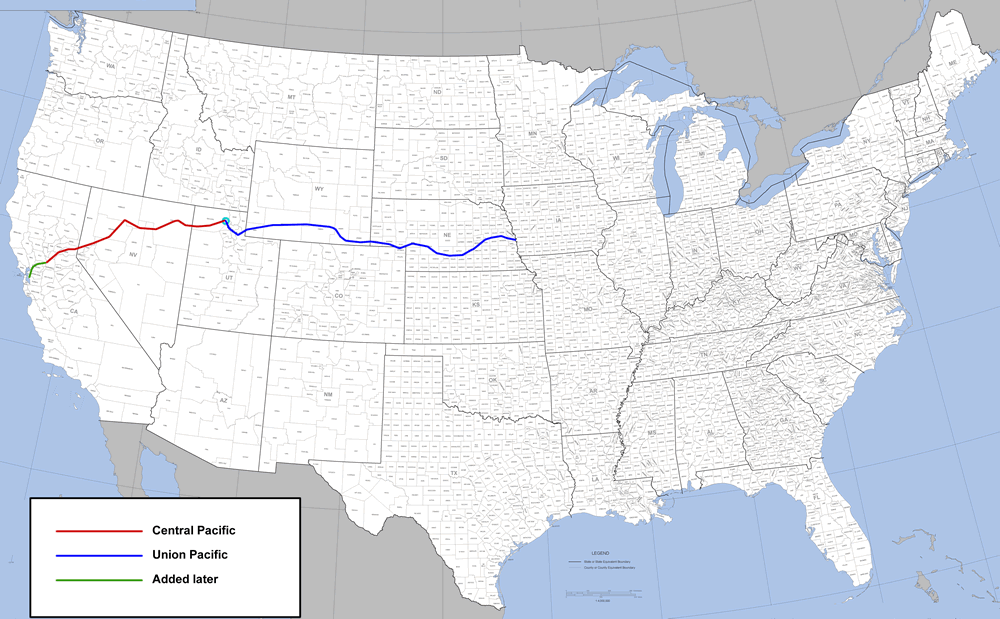
the first transcontinental railroad; image from here
Summary
In the nineteenth century, The United States saw its territory enlarge considerably until it stretched 'from sea to shining sea.'  Such size in an age before modern transportation posed prohibitive logistics problems.  Shipments and travelers to California had to go either:
- over land by horse/carriage
- by ship to Panama (over the isthmus by horse to another ship on the Pacific side)
- around South America
Each method had obvious dangers and costs.  The solution was a transcontinental railroad, though that too had breathtaking challenges.  Discussed since the 1830s (and more heatedly as the California gold rush and land opportunities encouraged explosive migration in the 1850s), people wanted it, but nobody knew if it could (or should) be done.  Who would undertake such a feat?

The answer was two companies: the Central Pacific (starting from California) and the Union Pacific (from Iowa).  First came surveyors like Theodore Judah (out West) and Grenville Dodge (in the East) to find the most feasible route.  Railroads required relatively straight and flat routes, and their work showed the possibilities and 'paved the way' (though there was considerable debate about the best way forward).  After that, funding needed to be obtained by a combination of private investors and government assistance/land grants.  Finally, both companies started in the early 1860s.  "The Union Pacific and the Central Pacific were the first big business in America."  They needed to be for the magnitude of work ahead of them.

How was it done?  "The surveyors went first, followed by the engineers, who laid out the exact line.  Then came the bridge gangs, so that when the gradings got to the bridge site they could continue.  Then there were the men who dug the cuts or who dug and dumped the dirt to make the fills.  Next came the track layers with their rails, spikes, fishplates, distance markers, sledgehammers, and ballast.  After them the carpenters, who built the roundhouses, depots, and other buildings."  The goal was to minimize cuts (in soil or rock) and fills/bridges (in valleys or spanning water) to save time and money.

Both the CP and UP faced considerable difficulties- technical, financial, and more.  Out West, the CP first tackled the mountains, requiring frequent tunneling (where progress could be as slow as six inches per day) and facing harsh terrain and climate (frequent blizzards could bury the track in 10-20 feet of snow), not to mention the challenge of getting all supplies shipped around South America from the East Coast.  In the east, the UP had a severe wood shortage on the plains, a similarly harsh climate, and hostile Indians, who regarded the land as theirs and rightly recognized the railroad's ramifications.  For both companies, even favorable terrain and weather couldn't overcome the sheer logistics challenges- typical progress was a mile or two a day; one day's progress of ten miles was unmatched.  In the end, the CP would lay a total of 742 miles of track, and the UP 1032 miles (source).

The workers out west were largely Chinese, who did their jobs well and behaved themselves much better than their Irish counterparts (who dominated eastern work crews).  Mormons in Utah were also critical.  Tens of thousands were involved, and many died during the work, though their numbers are unknown (no records were kept).  Their feats were unbelievable- the strength, endurance, and resilience they showed has been seldom equaled.

The teams met at Promontory Summit, Utah, in 1869.  An amazing achievement.  In early nineteenth century America, men "traveled no faster than Julius Caesar," and no "information could be transmitted any faster than in Alexander the Great's time.  In 1869, with the railroad and the telegraph that was beside it, a man could move at sixty miles per hour and transmit an idea or a statistic from coast to coast almost instantly."  Together, these inventions "made modern America possible."  A trip from New York to San Francisco that might have cost more than $1000 and taken months could now be done for $65 in 7 days.  And for a country recently torn apart as north and south, the railroad helped heal that wound and tie the land together from east to west.  Truly, there was nothing like it in the world.
meeting at Promontory in 1869; image from here
Review
Back in May, I read Ambrose's Undaunted Courage, an excellent account of the Lewis & Clark expedition.  I was eager for more, and this (largely) fit the bill.  His account is balanced and fair to many parties, thorough, and well-written.  And yet . . .

I should have paid attention to the subtitle: "the men who built the ..."  This is largely their story.  Of course, Ambrose covers the construction process and technical hurdles, but the emphasis is on the men behind things- the financial backers (and their corruption), the surveyors, engineers, and 'common' laborers, etc.  He does a good job with all of them, but some chapters (especially concerning the political and financial fights) were mildly confusing and (I felt) detracted from the story.*  The account also appeared unevenly paced at times, with several points repeated and some elements glazed over or skipped entirely.**  These things aside, this is a good read.  You get an idea of how impressive this accomplishment truly was.

Two things I didn't realize:
1) These companies were not friends- they were in competition, with the meeting place unknown until very late in the process.  That produced a furious race, which spurred men on both sides to do more than any thought possible (and to sacrifice quality for speed).  You can see which companies did which portions in the graphic above.
2) It wasn't truly a transcontinental railroad.  The portions east of Iowa were mostly in existence already, and Sacramento to San Francisco was completed later.  The result certainly tied the land together, but the actual construction covered 'only' 70% of the width of the States.

Rating: B+

*Though to be fair, perhaps understanding the complexity of this aspect should have produced the opposite reaction in me.  I like to focus on the technical side.

**Though again, I must be fair and admit it was probably the same challenges over and over again, so Ambrose probably felt justified in sparing the reader.

Sunday, October 8, 2017

Risk Europe


Today's review is of the 2015 release, Risk Europe.  For 2-4 players, it takes 45-180 minutes.

Overview
Don't be fooled- this isn't your traditional Risk game.  Set in Medieval Europe, here your goal is to own 7 crowns by the end of a round.  Most crowns are obtained by controlling territories with major cities (like Paris, Rome, Berlin).  To do so, you'll tax the populace to build castles and purchase units, and then use siege weapons, archers, cavalry, and foot soldiers to sweep across the continent to claim territories and expand your power.  Each 'gold crown' city you control grants you unique bonuses to further your aim.  Are you up for the challenge?
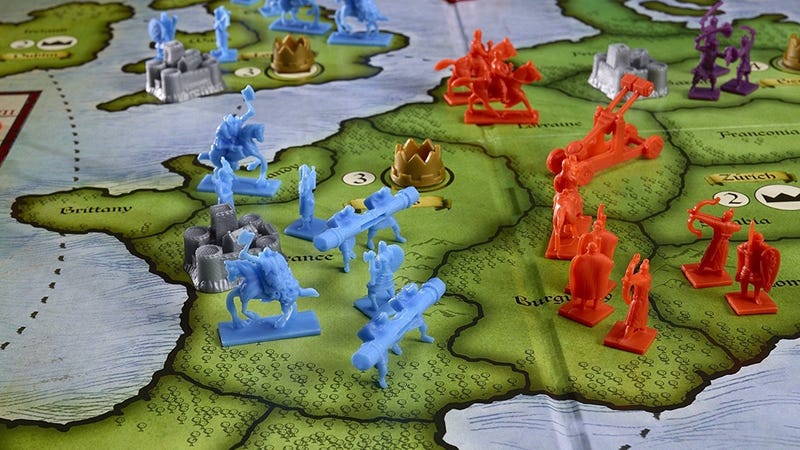
example of units; image from here

Simplified Gameplay
Unlike traditional Risk, Risk Europe gives each player a deck of eight cards, each with two orders on it.  At the beginning of a round, each player secretly chooses two cards and places them face-down in front of him.  The first player (determined by bidding or card effects) starts, revealing his top card and choosing/executing one order on it.  Turns proceed clockwise, with the players then revealing their second cards in the same manner.  Orders can be things like:
- tax (gain gold for your controlled territories, with bonuses in city areas)
- spend (spend your gold to buy military units or castles; units must be placed in city or castle territories)
- expand (move an army into an adjacent territory; if it's occupied, a battle will happen at the end of the round)
- maneuver (move any number of armies up to two territories away, if you control each)
At the end of the round, perform battles if applicable.  Here, Units go in a certain order before 'regular' Risk combat:
- 1: Siege engines attack first, rolling two dice per unit and hitting on 3+
- 2: archers, rolling one dice per and hitting on 5+
- 3: cavalry, rolling one dice per and hitting on 3+
for each of these, a 'hit' means the opponent chooses and discards one of their units.  If the opponent has equivalent units, they perform these same attacks simultaneously.  There are no 'attack' vs. 'defense' dice comparisons here. 
Then, the final order is like regular Risk:
- 4: everyone (foot soldiers on up); the attacker rolls one die per unit (up to 3), the defender up to 2.  The deltas are compared, with ties going to the defender.  If any units remain, then go back to step 1 and repeat the steps until one side is eliminated.  The winner claims that territory.
After battles are performed, victory check verifies if any player controls seven crowns.  If nobody does, the two cards each player used is set aside, and two new cards are chosen (out of the six you have remaining).  Rounds proceed in like manner until all cards are used; then the full eight-card deck is taken back into hand for the next cycle.  Play proceeds until one player satisfies the victory condition.
a game in progress; image from here
Review
Growing up, I played Risk a good deal.  And it always seemed to end in anger, primarily because 1) it took forever and 2) it generally involved shifting alliances and associated betrayals.  That said, I heard good things about Risk Europe, so I picked it up on clearance.  I was glad I did.  This game is superior to Risk in every respect.  The city bonuses, action cards, unit types, castles, and combat rules are all a step above the original.  It was simple yet strategic.  My one ding is that the rules must be modified for 2 players (and even 3), and (in my opinion) the changes aren't satisfying- play this as a 4-player game.

Rating: A-

Friday, October 6, 2017

Luther


Five hundred years ago, Martin Luther nailed 95 Theses to a door in Wittenberg, Germany, taking issue with certain Church practices.  The subsequent days and years would see Reformation and revolution far above what he intended, dividing families and nations as Protestantism was born.  Luther is his story.

This was a good film- better than I remembered.  It's not a large-budget movie; production value was adequate but not fantastic.  Plot and dialogue were good, if rushed (fitting years of seminal events into two hours isn't easy).  It even seemed reasonable accurate historically.  As the Reformation anniversary approaches, check out this film to understand the history.

Rating: A-

Thursday, October 5, 2017

The Illustrated Encyclopaedia of Arthurian Legends (Ronan Coghlan)


The Illustrated Encyclopaedia of Arthurian Legends is exactly what it claims to be.  "This book is primarily intended as a reference book and its main aim is to provide a detailed 'who's who', 'what's what' and 'where's where' covering all the different strands of the Arthurian legends, something which no book has hitherto achieved."  After a brief introduction concerning a potential historical Arthur, author Ronan Coghlan produces a 250-page encyclopedia, dotted with relevant artwork from the ages.

Long have I sought this out-of-print book, and delighted to find it on ebay for $12, I tore into it upon its arrival.  Though thorough and informative, I was disappointed.  The fault is not with the author- he accomplishes what he sets out to do.  I was expecting many more and larger illustrations, which I now realize is my ultimate interest.  This is mostly text.  Encyclopedias in the digital age are of limited value . . . google searches can tell me much of what exists herein.  But if you're fanatically interested in all things pertaining to King Arthur, this book would be a nice addition to your collection.

Rating: B

Tuesday, October 3, 2017

Hollywood (Ultimate Spider-man Vol. 10)


Spidey is outraged when Hollywood makes a motion picture about him.  As he stews, an imprisoned Doc Ock telepathically summons his bionic arms to rejoin him.  "Complete" once again, he wreaks havoc on the city as he fights one man he hates above all others: Peter Parker.

This book is good, in keeping with many others in the series to date.  Of the ten volumes, I liked eight of them.  They feature good art, some valuable insights (though I wish they'd develop those more), and accurate depictions of moody teenage life.  I won't be reading beyond this; here is a summary of the entire series.

Rating: A

Monday, October 2, 2017

Ultimate Six (Ultimate Spider-man Vol. 9)


Nick Fury has managed to capture Sandman, Doc Ock, Green Goblin, Kraven the Hunter, and Electro.  That's good.  He puts them all in one prison.  That's not so good.  When they escape, Goblin is dead set on revenge on Fury- and he knows the best way to get it comes through Peter Parker.

This one let me down.  The art wasn't quite as good as the other volumes, but the real disappointment was the pace of the story- way too fast- and the point- not sure there was one (aside from revealing that Fury actually funded Osborne's research- the very same testing that produced the villains- with the goal of creating more heroes like Captain America).  It was cool to see the Ultimates (the Avengers, apparently, with the same cast of heroes) show up, but I didn't see the point of the tale.  The title implies that Spidey joins the criminals, and indeed they attempt to convert him, but that part was especially rushed and poorly done.

Rating: B

Sunday, October 1, 2017

Cats & Kings (Ultimate Spider-man Vol. 8)


All is not well in New York.  The Kingpin has returned, using his resources to exonerate himself for his documented murder.  Peter's fury, but doesn't have much time to muse on the partiality of the justice system . . . for he gets caught in the middle of Elektra hunting the Black Cat after she robbed the Kingpin.  Meanwhile, Mary Jane's life is in tatters and her dad forbids her to see Peter.  What's a Spider-man to do?

I enjoyed this story, touching as it did on this idea of justice and partiality.  I wish it explored the topic more.  The series continues to do a good job capturing a teenage Spider-man, both heroic and temperamental.

Rating: A