Friday, May 20, 2022

Hiking in Daniels

It's been an unexpected week off work for me, so I used the time to explore a local ghost town. This post is about my two ventures into Daniels, the long-abandoned mill town on the Patapsco river. Roadside ruins blog has some nice information on this history, as does the Baltimore Sun. Highlights from the latter:
  • First called Elysville, the town was formed in 1834 next to a mill.
  • It would be re-named Alberton (in 1854) and then Daniels (in 1940).
  • It was home to about 800 families and featured 118 homes.
  • The town was 'closed' in 1968, with homes razed by the company.
  • Hurricane Agnes (1972) would wreak further destruction and deposit several cars still visible along the trails.
The highlights in Daniels are two church ruins (Pentecostal and Roman Catholic, respectively), the nearby dam, and various reminders of civilization (a ruin here, a barrel there, etc.).

Being a ruin enthusiast, this area was on my list for some time. Seeing it wasn't as easy as I thought (I ended up needing two hikes to find both churches), but it was worth it.

Hike 1
To start, I (erroneously) drove down Daniels Road to the dam. Parking nearby, I enjoyed the sights but soon realized there was no obvious way to cross the river on foot. I snapped a few pictures and hit the road.
I next went to a small parking lot called "Alberton Road trail parking" on Google maps (near the intersection of Dogwood and Hollifield roads). The unpaved parking area can accommodate perhaps 8 vehicles. Finding a spot, I set out on the following hike:
The "Church 1" on the map is the Pentecostal church (see pictures below). This hike ended up being 3.92 miles on easy track following the river. Some of it was paved, but even those sections were prone to mud. Wear appropriate footwear. You'll note I went past the church attempting to locate the Roman Catholic church (to no avail). Highlights from this hike included two decaying vehicles and the Pentecostal church.


It was a nice hike, but I was frustrated that I couldn't find the other ruin. So the next day . . .

Hike 2
After more Internet searches on the church's location (for reference, the full name is Saint Stanislaus Kostka Catholic Church), I had a better (but not perfect) idea of where to find it. Off I went again. This time, I'd cover 3.28 miles total.
You'll note that I overshot it the first time, veering off the main trail twice onto overgrown paths in my attempt to find this thing. I did come across some other ruins, but not nearly as cool, in those areas. As I was heading back to the car, I took what my app (komoot) labeled a 'power line access' trail, and sure enough, there was the church, along with two decaying cars and (north of the structure) a small graveyard. The pictures below are out of order for some reason, but it is to my advantage- the first photo below is one turn-off to get to the church. This path is .92 miles from the parking area. However, you'll note from the second photo that the path is hard to see and follow- I recommend walking further down to the broad and obvious trail, which will then circle back to the church. The map above shows the two ways- the first following the 'power line access' trail is what I recommend.


The other places I veered off the beaten track- farther down the trail- were not nearly as exciting, though they each had elements of interest.

Overall, hiking in this area was a lot of fun. Knowing where the highlights are now, you can do the entire thing in about 4 miles.

Monday, May 16, 2022

Inkspell (Cornelia Funke)


Shortly after the events of Inkheart . . . 

Capricorn has been defeated, and better- Meggie's mother Resa is back in the real world after ten years trapped in a story. And yet, not all is well. 
- Dustfinger desperately wants to go back to his story. It's been ten years.
- Basta and the Magpie are still in the real world, out for vengeance.
- Farid will never leave Dustfinger, and will do anything to be in his world.
- Meggie wants to visit Inkworld, and finds her power to read people into stories includes herself.

Before long, heroes and villains alike will find themselves in (or back in) Inkworld, a magical land with a frightening future- for the Adderhead rules in the south, and will stop at nothing to dominate the world. 
------
I read the first volume of this trilogy last year, so my memory is a bit fuzzy, but book two is good. You can tell the author hadn't originally planned a trilogy- she acknowledges as much in the opening pages- and so this volume doesn't stand alone as the first did. But it is a good story, told well, revealing again the power of words and story.

Rating: A

Saturday, May 14, 2022

Uniform goodness

The Orioles uniforms as of 2020
It used to be simple. In American professional sports, each team had two uniforms: home and away. A team might update their look (color scheme, style, or even logo) every so often, but in a given season, you had two choices. Those days are long gone.

Though this trend is true in every sport, I'll stick with baseball as the classic American pasttime. Though an Orioles fan, I enjoy watching the sport in general, and I admire the classic look many teams sport. (I previously blogged about a few of them here.) And I've been pleased with the recent trend in uniform changes for the Brewers, Phillies, and Padres in particular- more on them in a moment. But back to the uniform explosion.

I'm not quite sure when it happened- and it probably differs from team to team- but in recent years, the available uniforms for most clubs have skyrocketed. Now a given teams may have 4-5 choices in their standard rotation- plus more on special occasions (like Memorial Day) or for other singular events. Though each team still has labels like home and away, their 'alternate' jersey options can see frequent usage. It can be confusing, but it's also kinda fun. Here are a few teams or special looks I've been enjoying.

City Connect Uniforms
Introduced last year by Nike, these jerseys express "the personality and communities of the team's home city." They released these for 7 teams last year, and have 7 on deck for this year. The list of the 10 released so far, with pictures and one writer's ranking for each, is available here (which I just quoted). The two I like the best so far: the Astros (space-related heritage) and Nationals (cherry blossoms and Georgian lettering):

Turn Back the Clock Choices
If you're familiar with your team's uniform history, you might be surprised to see them don the jerseys of yesteryear from time to time. This website shows the "turn back the clock" uniforms teams wore in 2016, for example. Note that some teams' choices didn't go back far- wearing what they did only 20 years ago- but others go back many decades, and some even wore uniforms to honor the Negro League team of that city. My favorite from the choices shown on that site: the Detroit Stars:
Another turnback favorite of mine: since 2018, The Phillies have been wearing their old maroon & powder blue jerseys for Thursday home games:

Uniform Updates
Aside from City Connect and Turnback uniforms, I've appreciated 'recent' (in the last few years) uniform changes some teams have made. 
The Baltimore Orioles are my number one team, and I was delighted when they went back to a version of the 'happy bird' on their hats in 2012 (after 23 years of donning the 'ornithogically correct' bird that was nowhere near as fun).

The San Diego Padres went back to brown and yellow, which I find a unique and fun combination. I especially like the swingin' friar on their sleeves. You can see all Padres uniforms from history here.


The Milwaukee Brewers modernized their jersey in a way that paid homage to the Brewers' teams of old while bringing them into the modern area with a fresh look (the cap with the yellow splash is especially cool). I also like the Wisconsin patch on the sleeve.


I already mentioned the Philadelphia Phillies. They have quite the logo history (I imagine all teams do). They've had these digs for a few years, and I love them.

Everyone has an opinion on this subject- this site ranks all MLB uniforms in 2020, with nice graphics showing the options. There's a lot out there. A lot of uniform goodness.

Tuesday, May 10, 2022

Doctor Strange in the Multiverse of Madness

Shortly after Spider-man: No Way Home . . . 

America Chavez is gifted: she can travel between the different realities that collectively make up the multiverse.

Doctor Strange is conflicted: as he watches his ex get married, he ponders what might have been . . . what might have happened in another reality.

The Scarlet Witch is driven: obsessed to have children of her own, she seeks a reality where that's true- and will stop at nothing to get it. 

If Wanda can get her hands on Chavez and take her gift, all is lost. Strange does what he can to protect her, traveling with her through different realities to escape the witch, but can he do what must be done, even as he's tormented with his own desires?
-------
This movie was a mixed bag for me: 
- There was some good humor, great cameos, and the visual effects were stunning. 
- It touched on some worthy themes about our desires and bending reality to them (akin to Inception), but that wasn't explored enough, ending with a message that wasn't original (or good) in several respects.
- No Way Home explored the idea of the multiverse, and this movie blows that wide open. It was a little trippy and confusing- expected with such a theme- but the MCU is already huge and hard to track, so adding multiverses makes it overwhelming.
- Not much character development (with either the new face or the long-standing characters). That was disappointing.
- I was disturbed at several points. It was part Lovecraftian horror; I questioned the PG-13 rating. It was the first time I felt uncomfortable in a Marvel film. It has some really dark elements.

I struggled with how to rate this. Ultimately, I liked the cameos the best . . . which speaks volumes about the film itself. Looking back on how I rated other MCU titles, I'll be generous and say:

Rating: B-

Friday, May 6, 2022

J-Curve: Dying & Rising with Jesus in Everyday Life (Paul Miller)


In J-Curve, Paul Miller argues that "the normal Christian life repeatedly re-enacts the dying and rising of Jesus. I call it the J-Curve because, like the letter J, Jesus's life first went down into death, then up into resurrection." Though Jesus (and His J-Curve) was of course unique, "we have multiple J-Curves that echo his." Each has "their own unique cadences, but they all
  1. enter some kind of suffering in which evil is weakened or killed;
  2. weaken the flesh and form us into the image of Jesus;
  3. lead to a real-time, present resurrection."
The main message of the book is "see Jesus in his humility; don't run from his path of weakness." Miller's "goal is to draw you . . . into the dying and rising of Jesus- to reset your sense of the normal Christian life, freeing you from cynicism and despair. Inhabiting the J-Curve promises to transform your entire vision of how you engage life, freeing you from the world of resentment, touchiness, and just plain old grumpiness, and inviting you into Jesus's world, a world rich with joy, hope, and love." The concept of the J-Curve is prevalent throughout the Scriptures, to include "Philippians, 1 and 2 Corinthians, Romans 6 and 8, Colossians 1 and 3, and Ephesians 1 . . ." This book explores many of those passages and unpacks them.

Our human tendency is to operate on what Miller calls the "failure-boasting chart," where our confidence is in ourself and our boasting in our strengths. Even Christians- who should know better- fall into this trap, and the related idea of seeking prosperity (which generally means comfort, riches, or success) above all things. And yet, the gospel message is quite different: 
Have this mind among yourselves, which is yours in Christ Jesus, who, though he was in the form of God, did not count equality with God a thing to be grasped, but emptied himself, by taking the form of a servant, being born in the likeness of men. And being found in human form, he humbled himself by becoming obedient to the point of death, even death on a cross. Therefore God has highly exalted him and bestowed on him the name that is above every name, so that at the name of Jesus every knee should bow, in heaven and on earth and under the earth, and every tongue confess that Jesus Christ is Lord, to the glory of God the Father. (Philippians 2:5-11)
Jesus laid down his rights and substituted himself for his people. Christians are called to do the same, not just believing the gospel (faith) but becoming like the gospel (love):
Then Jesus told his disciples, “If anyone would come after me, let him deny himself and take up his cross and follow me. For whoever would save his life will lose it, but whoever loses his life for my sake will find it. (Matthew 16:24-25)
"Just as Jesus substitutes himself for us, we substitute the pieces of our lives for others . . . when we understand that substitution is the heart of love, we see life through a different lens." For us fallen humans, this takes the form of three J-curves:
  • "In the love J-Curve, you pursue a problem outside of yourself. Love leads you to go after evil, to absorb pain.
  • In the suffering J-Curve, evil comes at you from the outside, unwanted and unasked.
  • In the repentance J-Curve, evil is in you. You're the problem. You cause the pain."
In each case, there will be a descent/death followed by a rising. It may not be fast or easy, but "this is the way" (to quote The Mandalorian). Of course, we have multiple J-Curves (of differing magnitudes and durations) operating and intersecting at a given time, both in ourselves and in the communities in which we find ourselves. The book unpacks these concepts from various angles.

Review
We're working through this book in our Sunday school class, which is why it took me six months to read. The message is outstanding and much needed (by me personally and society at large). Laying down my rights is never fun or easy- after all, they're my rights!- but it is key. This has helped me through several ongoing problems in my life, for which I'm thankful. So the content of the book is great. The presentation is varied- some chapters are amazing and well-structured, others were haphazard and disorganized. The book needs an editor . . . but that aside, well worth your time. Highly recommended.

Rating: A

Thursday, May 5, 2022

The Belgariad

A rendition of some Belgariad characters; image from here

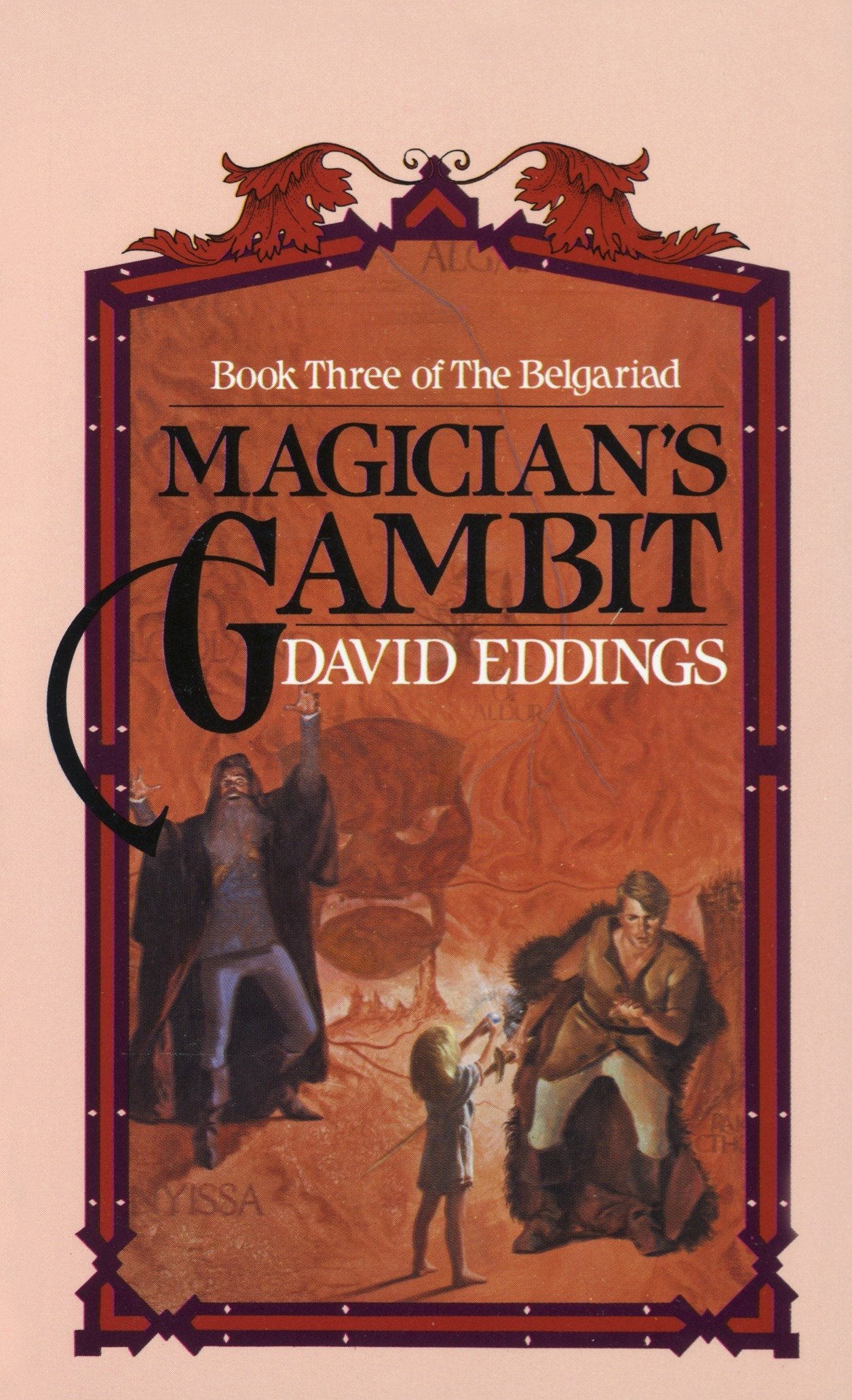
As I did with The Wheel of Time, today I look at The Belgariad as a whole. This five-book series was a fast read for me, done between March and May of this year. It follows the boy Garion, his Aunt Pol, Belgarath the sorceror, and others as they reclaim the stolen Orb of Aldur and confront the evil god Torak, who seeks to dominate the world and shape it in his image. Click on a book cover below to see my review of a given title:
Each book was similar in pacing and rating (they each got an 'A' from me). After a shorter book one (346 pages), books two-five were impressively close in length (447, 446, 444, and 445 pages, respectively).

Thoughts on the Series
Published in rapid succession (from 1982-4), Publisher's Weekly called this pentalogy "one of the founding megasagas in modern English-language fantasy." Others agree that it marks a transition from the classic fantasies of old to the modern times. Though I'm not well-read in this genre, I can certainly see the hints of transitions from the older style to today's multi-volume epics. 

This is a very straightforward 'coming of age' story, as Garion becomes aware of and involved in things much bigger than his previous life on Faldor's farm. I'm not sure it was always considered a young adult series, but it could be nowadays, as contemporary writings in this genre for adults tend to be more graphic.

What I liked:
  • Quick story progression
  • Fun and varied characters
  • Interesting world with impression of depth
  • No inappropriate language/content
  • Occasional wit or profound comment
  • Very 'human' depiction of the powerful (e.g. Belgarath gets in bad moods just like a typical human)
What I didn't:
  • It seems robotic at times. Garion has a 'dry voice' in his head that basically tells him what to do at key moments. He seems to mature very slowly (if at all), accomplishing impressive feats mainly through being compelled.
  • There can be stereotypes about different nationalities and genders ('all Arends are stupid,' 'all women are conniving')- voiced directly and even by allies- that are cruel.
  • Confusing theology. The gods here are similar to Greek gods, with very human characteristics. They serve a higher authority (maybe the universe itself?), but it's all unclear or confusing. There's a character or two in the same vein- they are special but of unclear origin/etc.
Resources
There's not much out there on Eddings or his work. Your typical wikipedia entries exist (both 'normal' and fandom versions). Eddings wrote a sequel pentalogy (the Malloreon), two stand-alone entries (on Belgarath and Polgara, respectively), and a background/reference work (the Rivan Codex) which would be the main recommendations for fans of the series.

Conclusion
Overall, I enjoyed this story. It's simple but done well and appropriate for all ages. The five volumes don't stand alone; this is more like one book published in five parts.

Wednesday, May 4, 2022

Enchanters' End Game (David Eddings)


The Belgariad concludes! Shortly after Castle of Wizardry . . .

Garion, Silk, and Belgarath travel east to confront Torak while their friends mount a huge diversionary campaign to the south against the Angarak peoples. Since the beginning, there have been two competing prophecies about the fate of the world- either Garion will slay the dark god, or Torak will be victorious and cover the world with shadow and compulsion to serve. And even the gods do not know the outcome . . .

So ends the pentalogy. Predictable in places, poignant in others, it's a decent conclusion to a satisfying (if straightforward) fantasy series.

Rating: A