Thursday, April 26, 2018

Confucianism (Louise Chipley Slavicek)


In Confucianism, Louise Chipley Slavicek provides a background to this ancient system of thought rooted in the teachings of Kong Fuzi, the Chinese scholar we in the West know as Confucius.*

Summary
Confucius was born around 550 BC in northeastern China.  Despite an impoverished childhood, he loved learning and was able to get an education, his passion for it intensifying after his mother's death.  He was obsessed with learning the ancient ways.  He became a well-respected scholar, and started a school, being "convinced that learned and virtuous men had the power to transform their communities by their words and actions," with a focus on developing government officials.

The Confucian canon of scriptures contains five works (called, suitably, the "Five Classics"): the Book of Changes, Book of Poetry, Book of History, Spring and Autumn Annals, and Book of Rites.  Some of these existed well before Confucius' time; indeed, his "self-proclaimed mission was to restore his troubled society to an earlier and better time by teaching traditional wisdom and values."  That said, in the centuries following his death, a new school of thought would emerge called Confucianism, based on his ideas (and those of later prominent disciples, Mencius and Xunzi) on "how to achieve an orderly society and a good government." 

Important concepts in Confucianism:
- Human-heartedness ("ren"), or love/compassion for all human beings
- Reciprocity ("shu"), or seeing things from another's perspective
- Filial piety (obedience and respect towards parents)
- "Li," the "traditional Chinese rules of social decorum and ritual"

Eventually (~150 BC), Confucianism became Chinese state doctrine, where it would remain strong for 400 years, before challenges from rival views like Daoism and Buddhism eroded its place in society.  Though Confucius was primarily concerned with life in this world, later scholars expanded his teachings to cover the afterlife and other core religious questions in response to (and in some cases based on) these competing schools of thought.  Eventually, Confucianism would regain its place, cementing its status in China for one thousand years, from the tenth to twentieth centuries, with a firm hold over education and politics.

In the last century, defeats to foreign powers (primarily British and Japanese) led the Chinese to question their devotion to this system of thought and associated rituals, and the communist takeover after WWII heralded great change.  That said, Confucian principles remain in Chinese, Japanese, and Korean societies, where (for example) a strong focus on ethics has resulted in societies stressing honor- for example, you can forget your wallet and expect to find it where you left it days later (try that in America).

Review
This was a decent introduction.  Straightforward and succinct.  The writing was basic, and geared towards teens, so not as eloquent as I prefer; a good treatment nonetheless.

Rating: B+

*Personally, Kong Fuzi sounds much cooler.

Monday, April 23, 2018

Those Liberty Ballers


Still high off the Eagles' Super Bowl win, I turn to another Philadelphia team with promise.

Several years ago, some sources were debating the Philadelphia 76ers and their rank among the worst NBA teams of all time as they were in the middle of an abysmal 10-72 campaign.  Now, fresh off a 52-30 season, the Sixers are poised to win a playoff series and may go deep into the playoffs.  Why the turn-around?  Smart drafting, certainly, but there's more to it than that: it takes a culture change.  From the linked ESPN article:
The Sixers have embraced a basic human truth -- people want to tell their stories -- and turned it into a team-building exercise.
Stories.  We love stories.  In a nutshell, stories add emotion and relevance to straight data.  Because at the end of the day, we're not fueled by plain facts- we're powered by stories that give those facts meaning.  We all have and hold different stories about ourselves, the world, each other- and those stories drive us forward, leading to powerful change.  In the Sixers case, it's helped turned a moribund franchise into a powerhouse in two short years.


The other thing I appreciate is their diverse makeup.  Three foreign-born stars- Joel Embiid (Cameroon), Dario Saric (Croatia), and Ben Simmons (Australia)- are all under 25 years old and leading the charge.  JJ Redick, Robert Covington, and Marco Belinelli add veteran poise, and rookie Markelle Fultz may finally be rounding into form off an injury.  They're fun personalities and fun to watch- I hope they go far. Here is their depth chart.

I grew up a David Robinson and San Antonio Spurs fan, and that franchise holds a special place in my heart for their unselfish play, quiet stars (Robinson, Tim Duncan, Kawhi Leonard), international finds (Tony Parker, Manu Ginobili, etc.), and no-nonsense, 'back to basics' style.  But change is in the air- my heart increasingly leans towards all things Philly- and those Liberty Ballers make it easy to do.  Phila Unite!

Sunday, April 22, 2018

A Familiar Pattern

The 4 Phases of Collecting

It just happened- I hit board game 'saturation.'  Every hobby I've ever had that involves purchasing, collecting, or acquisition* goes through a cycle- one I've only recently realized.  I break it into 4 phases:
1. Learning/Expansion
2. Saturation
3. Filtering
4. Appropriate Boundaries

In Phase 1, I acquire and pursue an interest, learning about it and growing a collection.  This phase is marked by (at times) rapid accumulation, often after little or no prior vetting, with a thirst for more.  I explore the options and sample as much as I can.

In Phase 2, I saturate.  I've explored enough of the space to understand what I like (and don't), and what I use (or won't).  My desire to acquire more diminishes markedly.

In Phase 3, I filter my existing collection based on what I learned in phase 2, selling or donating things as appropriate.  Such downsizing can take a tremendous amount of time.

In Phase 4, I reach 'appropriate boundaries'- I have a collection that doesn't vary much in size, and consists only of things I truly enjoy and use.  I set limits and acquire/reduce much less frequently, and much more intentionally (after much thought and review). 

Running through the phases using board games as an example:
- Phase 1: I acquired games based on one-time play, a good review, or a good price.  I purchased based on perceived interest, and owned more games than I play.  I bought games I thought were decent, but didn't love.  My collection swelled from ~35 games to ~65 in a year or two.
- Phase 2: I hit a point where I can know at a glance (or with minor research) whether or not most games are for me.  I realized a portion of my collection will rarely (if ever) get played.
- Phase 3: [current] I'm whittling down the collection, getting rid of games I don't expect to use.  In the case of collectible games, I do this at the individual card or miniature level (this is a big time investment).
- Phase 4: I will maintain a healthier number (~40) of games, my collection varying only mildly as new releases, changing tastes, and new seasons of life alter what I use.

Perhaps everyone goes through something like this (or maybe it's just me).  Either way, it's important to analyze your own habits to identify the good and weed out the bad.  Looking at this pattern, my goal: be more judicious in phase 1.  Discernment there would help cut out phases 2 and 3, and help save money, space, and time.

I'm not there yet, but in the right direction . . . I hope.

*for me: CDs, books, movies, legos, games 

Saturday, April 21, 2018

Longhorn


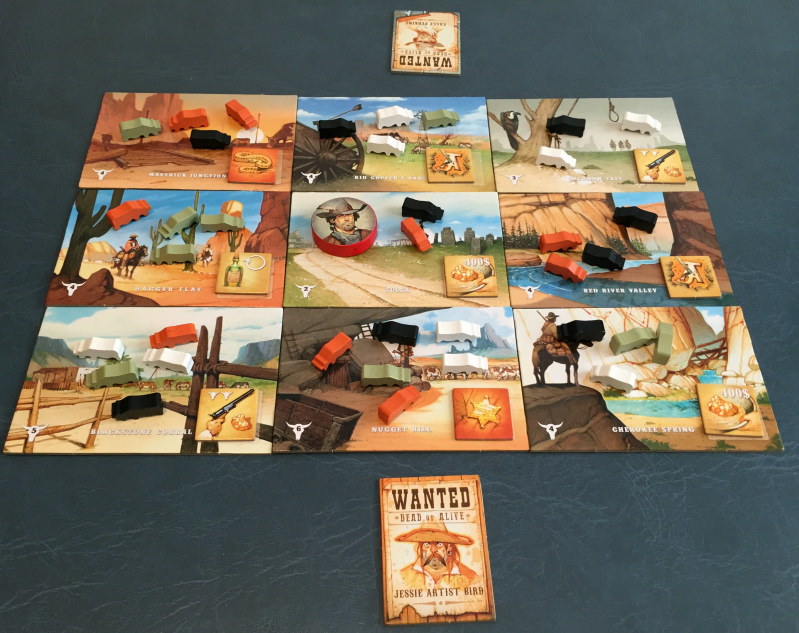
Today's review is of the 2013 release, Longhorn.  For two players, it takes 15 minutes.

Overview
You are a cattle rustler, looking to make as much money as possible from your illicit gains.  There are four colors of cattle, randomly distributed in numbers indicated on each tile in a 3x3 grid.  On your turn, you choose a color, take all cattle of that color on your current tile, and move the marker that number of spaces (take 3 cattle, move the maker 3 spaces).  Movement must be orthogonal (left/right/up/down).  Flip the marker; then it's your opponent's turn to do the same.

You must move the marker to a space with cattle if possible.  If you take the last cattle on a space, you get the token there (which could be good- like gold- or bad- like a rattlesnake that spooks the herd).  When you move the marker, if all legal spaces are empty, the game is over (there are other end conditions, not covered here), and you count up your earnings as follows:

For a given color of cattle, the number of cattle remaining on the board indicates their value.
1 orange cattle left = $100 per cow
4 orange cattle left = $400 per cow, etc.

So if you own 5 orange cattle, and there are 4 left on the board, you get 5 x $400 = $2000.  Do the same for each color, add other tokens if you have them, and the highest total wins!
game at start; image from here
Review
This game is okay.  The art is great, the modular nature of the grid is cool, and the random placement of cattle makes for a unique experience every time.  It's not intended to be deep, at a planned duration of 15 minutes.  The scoring is an interesting twist- it's a set collection game, sort of, but you don't to get too much of a given color, as there will be fewer cattle on the board, which drives down the price per head.  For this reason, it appears that you want to force an early end to the game, and leave lots of cattle on the board if you can.  That's interesting, but my dig is that it's hard to mentally calculate the best moves (especially at the beginning).  You understand what's going on, but it's hard to know how best to proceed- what strategy to use- until it's too late (close to the end).  So it feels random, though there's no chance involved.  That said, I could see some people being able to calculate turns ahead, and really enjoying this game; it's just not for me.

Rating: B-

Wednesday, April 18, 2018

Buddhism: A Very Short Introduction (Damien Keown)


Buddhism: A Very Short Introduction, is just that.

Summary
What is Buddhism?  "Is it a religion? A philosophy? A way of life? A Code of ethics? It is not easy to classify Buddhism as any of these things . . ."  Though Buddhism acknowledges no personal soul or Creator God, it does have supernatural beings.  The author classifies it as a religion, as it contains elements found in Ninian Smart's definition (which argues that 'seven dimensions' must be present):
Practical and ritual, Experiential and emotional, Narrative and mythic, Doctrinal and philosophical, Ethical and legal, Social and institutional, and Material.  

Buddhism has all of these dimensions, and I agree with the author that it should be so classified.  However, "Buddhism is a large and complex subject, and we should be wary of generalizations made on the basis of familiarity with any single part."

Siddhartha Gautama (~566-486 BC), from modern-day Nepal, was the first Buddha, or "awakened one."  Raised in luxury as a prince, the realities of life (frailty, death, suffering, etc.) shook him from complacency, and he left his family to search for spiritual knowledge.  He studied under several teachers in turn, tried things on his own (like living at extremes), and one day experienced enlightenment while meditating, attaining nirvana.  He decided to proclaim his teachings (Dharma) to the world, summarized in the Four Noble Truths:

1. The Truth of Suffering- "pain, grief, sorrow, lamentation, and despair are suffering"; "not to get what one wants is suffering"; "Buddhism locates the origin of human suffering in desire."
2. The Truth of Arising [of Suffering]- a "thirst or craving which gives rise to rebirth, which is bound up with passionate delight and seeks fresh pleasure now in the form of thirst for sensual pleasure, thirst for existence, thirst for non-existence."  Here are three roots of evil: greed, hatred, delusion.
3. The Truth of Cessation [of Suffering]- the withdrawal from/renouncing of/rejection of/liberation from craving; "when craving is removed suffering ceases and nirvana is attained."
4. The Truth of the Path [which leads to the cessation of suffering]- people attain nirvana by following the Noble Eightfold Path (known as the 'middle way') with three divisions:
- Wisdom (Right View, Right Resolve)
- Morality (Right Speech, Right Action, Right Livelihood)
- Meditation (Right Effort, Right Mindfulness, Right Meditation)

Basically, he taught that nirvana is attained when selfish desire is overcome, which stops craving/suffering.  It might not happen in one lifetime; Buddhists believe in reincarnation and a universe with 31 levels, with "acts through body, speech, and mind" in one life (karma) influencing where you go in the next (good acts: higher level in life next time).  Many schools believe merit is obtained through your own actions only (self-transformation), though some schools believe it can be transferred to others.  Either way, the Buddhist's goal is to attain nirvana, end desire/suffering, and stop the cycle of rebirth.

Buddha "appointed no successor and left his followers to interpret the Dharma for themselves."  Indeed, he encouraged followers to "look inward toward their own spiritual development."* Disagreements arose and various traditions followed, the two main schools being Theravada and Mahayana.
- Theravada Buddhists hold the Pali Canon (1st century BC)- the sole preserved written record of Buddha's oral teachings- as authoritative.  Their focus was on the enlightenment/salvation of self.
- Mahayana Buddhists arose later and hold their major sutras (like the Lotus Sutra- 200 AD) as authoritative.  Their practices in some ways resemble Christianity, and talk about the need for a Savior (working to save others- helping them attain nirvana- through self-sacrifice).

Buddhism spread as ideas do, and today, much of Asia holds Buddhist beliefs.  The Theravada school is prevalent in Myanmar, Thailand, Laos, and Cambodia; the Mahayana is prevalent in China, Mongolia, Korea, Japan, Tibet, Nepal, and Bhutan.

The author concludes with overviews of meditation (an important Buddhist practice), ethics (there are five main sets of precepts, with the first- the Five Precepts for laymen- forbidding killing, stealing, sexual immorality, lying, and taking intoxicants), and Buddhism in the West.

Review
Having no familiarity with this religion, it was a good introduction.  The latter chapters seemed less interesting/relevant, but it was an easy and fast read, and recommended for those wanting an overview.  Buddhism seems very much a "do it yourself" religion; in fact, to be a "buddha," one must arrive at enlightenment through self-discovery.  It doesn't change my own beliefs, but it's good to understand.

Rating: A-

*quote from Confucianism, by Louise Chipley Slavicek 

Monday, April 16, 2018

Bang! The Card Game


Today's review is of the 2002 release, Bang!  For 4-7 players, it takes 30-40 minutes.

Overview
In the wild west, you are a sheriff, deputy, outlaw, or renegade. Your goal depends on your role:
- sheriff: eliminate all outlaws and renegade(s)
- outlaw: eliminate the sheriff
- deputy: help and protect the sheriff
- renegade: be the last character in play

At the start of the game, each player is given a role card (kept secret except for the sheriff) and a character card (which grants a special and unique ability to each player and is visible to all).  Your goal (in general) is to eliminate other players based on their role. Since you know only your role and the sheriff's, pay close attention to what other players are doing. Once a person is eliminated (has 0 life), they reveal their role and sit out the rest of the game.

On your turn,
- draw two cards (from the common draw pile)
- play any number of cards (cards that help you or hurt your opponent; examples: bang! cards to 'hit' other players, beer cards to heal yourself, weapons cards to change who/how you shoot, etc.)
- discard excess cards (you can hold a number of cards equal to the life points you have)

The game continues until one side or the other has been eliminated.
the cards; image from here
Review
There's a lot to like about this game- it's fun, funny, and the cards give a lot of options.  It doesn't quite meet the heights of its successor, though (Bang! The Dice Game, released eleven years later) for two reasons:
- the player count (4-7) is more restrictive (the dice variant is 3-8)
- the card game feels like it takes soooo much longer.  Most games I played started out fun and became a "when will it end" affair.  I've seen games take an hour or more.

The one thing it has on its cousin is options- the cards give you lots of abilities the dice equivalent does not- but that's the only thing.  This is a good example of a game where removing options can sometimes be a net positive.  File this in the good, not great, category- and play the dice version if you get a chance.

Rating: B

Saturday, April 14, 2018

Bruges


Today's review is of the 2013 release, Bruges.  For 2-4 players, it takes 60 minutes.

Overview
In the beautiful "Venice of the North," your goal is to acquire the most victory points through smart use of resources.
game at start; image from here
Each player starts with 5 guilders (coins).  Starting with the first player, each round consists of phases:

Phase 1- each player draws until they have 5 cards (choosing from either of two draw piles)- cards have a color, shown on the house on back and person on front (yellow, blue, purple, red, brown)

Phase 2- first player rolls 5 dice (yellow, blue, purple, red, brown) and sorts them in ascending order in the designated area;

  • for every 5 or 6 rolled, each player gets a threat marker of the corresponding color.  If someone has 3 threat markers of the same color, a bad effect happens (flood/fire/plague/raid/intrigue; depends on the color)
  • add up every 1 or 2 rolled; this is the cost to advance on the reputation track this round.  Each player now may pay that amount to advance one spot in reputation. 

Phase 3- in turn order, each player plays a card and takes one of six actions using that card.  This is repeated until every player has taken four actions (meaning they'll have one card left in their hand for next round).  Each card has a color (yellow, blue, purple, red, brown).  The actions:

  1. Discard a card and take 2 workers from the supply matching the color of the card
  2. Discard a card and take guilders equal to the value on the matching die color (example: if you discard a blue card, and the blue die has "4" this round, you take 4 guilders)
  3. Discard a card to discard a threat marker of the corresponding color.  Get 1 victory point
  4. Discard a card and pay the amount indicated to build a canal on a space matching the color of the card discarded in your area (must be done in sequence, based on the order in your area)
  5. Build a house (play a card house side up by discarding a worker of the same color)
  6. Recruit a person (play a card person side up in a house (color needn't match) by paying the guilder fee indicated)

Characters have abilities that are activated either upon recruitment or whenever they're 'triggered' (varies by character).

Phase 4- check for majority.  Whoever has the highest reputation, most characters, or most canal progress flips their corresponding majority marker (worth 4 victory points at game end).  These stay flipped even if another has majority in another round.

After the phases, the next player becomes first player and the next round starts.  The game ends after draw piles are depleted to a certain point.  Then points are tallied- any majority markers, houses are each worth one, people worth the value indicated on their cards, reputation a certain amount, and canals a certain amount based on how much you've built.  Highest score wins!
game in progress; image from here
Review
This game is good in many ways- there are a lot of meaningful decisions. Color is very important here, relevant for all actions.  The fact that you can see the color on both sides of the cards is helpful and unique.  I like the different colored dice determining how much reputation costs, how much gold certain color cards can get you, and the threat marker concept.  And there's a lot going on; maybe too much going on. As the picture above may convey, there's a lot to keep track of.  Lots of different people, too, with different abilities- that was impressive (someone drew a lot of portraits).  It's straightforward enough once you get the hang of it, but it's still 'busy' and easy to lose track of things.  This has heavy appeal to certain audiences, but not for everyone.  For me, it's a good game, but not one I'll play frequently.

Rating: B+