Thursday, November 2, 2017

Set


Today's review is of the 1988 release, Set.  For 2-20 players, it takes 30 minutes.

Overview
As the name implies, Set is about identifying (and collecting) sets of cards.  Every card in the game pictures objects with four attributes:
- quantity (1, 2, or 3)
- shape (diamond, oval, or 'squiggly')
- fill (solid, lined, or empty)
- color (blue, red, or green)

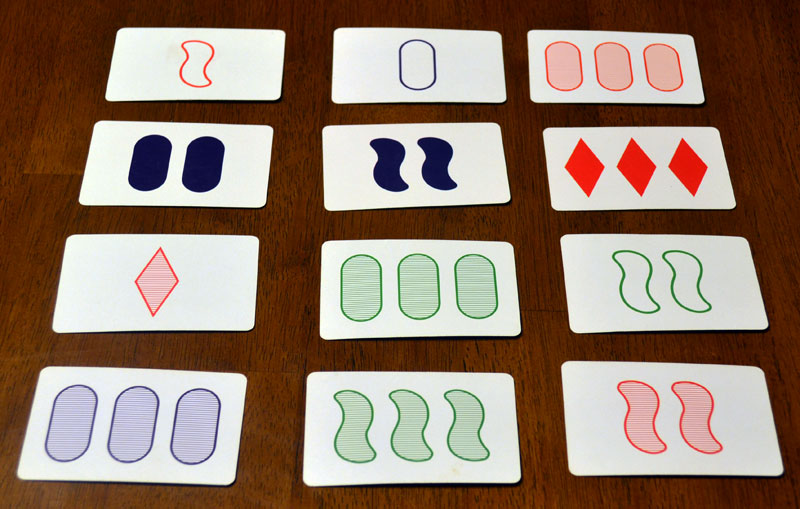
The game is prepared by shuffling these cards and creating a 3x4 grid of them for all to see.  There are no turns; all players look at the available cards and seek a set.  A set is defined as three cards which, for each of the four attributes, are all the same or all different.  Look at the picture below, then the following paragraph for an example.
image from here
There are several sets in the image above.  Here are two:
A) a set of cards with "two squigglies" each.  It's a set because the shape is the same on all (squiggly), the quantity is the same on all (two), the color is different on all, and the fill is different on all.

B) a set of cards with three ovals each.  It's a set because the shape is the same on all (oval), the quantity is the same on all (three), the color is different on all, and the fill is the same on all (lined).

There are other sets I see in the above . . . do you?

When a player identifies a set, they point it out, and everyone verifies that it meets satisfies all criteria.  If so, the player picks up those three cards, stacks them next to himself, and three new cards are drawn from the deck and placed in the vacated slots.  Play continues until no possible sets remain; the player with the most sets wins.

Review
This game is fun- if you like silence.  Since everyone goes at the same time, concentration is intense and (generally) nobody speaks until the game nears its conclusion.  It's simple in concept but can be impressively difficult to find a set in a given arrangement.  While I like the game, it's low on interaction and therefore well-suited to only specific crowds/situations.

Rating: B

Tuesday, October 31, 2017

95 Theses & Earthly Authority


Today's the day.  Five hundred years ago, Martin Luther put 95 theses on an announcement board in Wittenberg about Catholic practices he viewed as wrong.  Requesting a conversation, desiring a reformation, what followed was a revolution.

Luther wasn't the first (or the only contemporary) to express concern about how the Church had veered from Scripture; other movements were afoot throughout Europe.  But in a complex movement with many independent pieces, the Wittenberg event is an easy marker to remember, as it provoked a strong response from Rome and ignited into flame the heretofore embers of discontent throughout the continent.  Gutenberg's printing press would help, enabling distribution of pamphlets at a breathtaking pace (for the time) and enabling fast circulation of Luther's ideas.  Luther didn't want to break away from the Church; he wanted change and a return to the practices of Christianity laid out in the Bible.  But it soon became clear that the Papacy was too tied up in worldly affairs, and focused on worldly power, to take such concerns seriously; schism was the only option.  Luther broke away, and many others followed suit, eventually resulting in a collection of denominations known collectively as Protestants.

At its heart, the Reformation is about Earthly authority.  Christians view the Bible as God's word and, therefore, the ultimate authority on life.  But who interprets God's word?  The Church in Luther's day said that only the Pope had the authority to do so.  Luther argued otherwise, for "a priesthood of all believers," enabling even common men and women to read the Bible for themselves and access the word of God directly.  To facilitate this, he would translate the Bible into German, and many others would follow suit in their own languages in subsequent decades.

In denying a central (earthly) authority, Luther unwittingly appealed to a broader humanistic trend occurring at the time, and the idea ultimately established Protestantism as a movement set up to schism.  If the Pope isn't the central authority, who is?  Initially, many argued the Scriptures were clear enough that all could read, understand, and draw the same conclusions from the text.  In practice, there are many areas where Scripture isn't explicit, leading to varying conclusions about interpretation and application.  Scripture itself calls for both unity (in essential matters) and liberty (in others) but never defines which doctrines belong to which category.  And with no central authority to arbitrate disputes, many denominations would result.  Lutheran, Reformed, Anglican, and Anabaptist movements would spring up in the decades following Wittenberg, with many more on the horizon.  Even today, those who do not like the teaching in a given Church can simply find another more suited to their tastes- or start a new one entirely.

I thought I'd be happy today, reflecting on the momentous event and what has resulted.  Instead, I find sadness.  Sadness that the Church strayed so far, that reform from within was impossible, and that continued schism, even among those following Christ, is inherent in our fallen world.  Come quickly, Lord Jesus.

I've done a number of posts on the Reformation; I recommend you read a book or two about this momentous event, as its impact affects us to this day.

Pictures from Wittenberg (taken during my trip there, when we lived in Germany)
Summary of the Reformation from a recent men's retreat

The Unquenchable Flame (this is a fast read and great starting point)
The Reformation: How a Monk and a Mallet Changed the World
The Reformation of the Sixteenth Century (more in-depth work, but my summary gives you the gist of the Reformation)
Christianity's Dangerous Idea.  A phenomenal look at Protestantism and its impact on the world through the centuries.

Sunday, October 29, 2017

The Long Halloween (Various)


Gotham City is reeling from a new maniac.  Dubbed "Holiday" by the papers, a serial killer is taking out members of the Falcone crime family- always on holidays.  As Batman, Commissioner Gordon, and Harvey Dent race to bring him to justice over the course of a year, Falcone hires the rogue gallery  (Joker, Poison Ivy, Scarecrow, etc.) to get to the bottom of things in their own way.  For Gotham and its citizens, it seems an eternal nightmare . . . a long Halloween.

I enjoyed this one.  The art is monochromatic but good, the story has surprise and suspense, and the mystery is gripping.  Check this out if you can.

Rating: A

Saturday, October 28, 2017

The Workouts of Yore


I recently stumbled across some old race results (those running numbers you get for each race, on which I'd record my times).  Minimizing my stuff, it's time to part with them, but not before I reflect on fitness and how I've changed over the years.

Childhood
Growing up, I played intramural soccer consistently (fall & spring), and pickup games of baseball, basketball, and football with neighborhood friends.  That, plus occasional bike rides, was as far as it went for physical activity.  I hated jogging and most other forms of working out.  I loathed gym when it was wresting or gymnastics.  Things started to change between junior and senior years of high school.

High School
By the summer of '97, I had a decent gut (probably attributed, in no small way, to my daily habit of munching on cool ranch Doritos after dinner) and little strength- I recall being able to do only 4-5 push-ups.  But on a whim, and friend and I decided to try out for the football team.  So began a transformation.

I don't remember how much I worked out before tryouts; I think I did daily push-ups.  But once football started, oh boy.  Twice- or thrice-daily summer camps whipped me into some semblance of shape.  Circuit training (working to exhaustion at rotating exercise stations) was an amazing experience- I'd have trouble holding my arms up afterwards.  I took to standard weight training, and my initial bench of 95 lbs went up slowly but surely.

Surprisingly, I was announced as the starting placekicker for the team (the day before our season opener), a position I would hold all season despite being mediocre at best.  But success there encouraged me to continue training in all facets.  It would come in handy when I applied to the Air Force Academy.

Receiving a nomination to the Academy, I had one final hurdle: the physical test.  I did fine in push-ups and shuttle run, but fell one short of the 4 pull-up requirement.  I could have re-tested, but my enthusiasm waned, and having an offer from Penn State, I accepted without further thought to a military career.  I'd remember the pull-up failure, though.

College
I decided to try out for the Penn State football team.*  An elite unit, I knew it would take the utmost dedication to even have a shot.  That's when things really got started.  I was a machine freshman year, and for most of undergrad.  Every day (except for Sunday), I'd do 4-5 sets of push-ups throughout the day and an evening high-rep dumbbell routine with extensive stretching.  On specific days, I'd do the following:
M: Run 3 miles
T: Lift
W: Run 3 miles
R: Lift, run 1 mile
F: Lift
S: Jog 1 hour
S: Rest
The above, combined with miles of daily walking to/from class, had me in amazing shape.  I could do 12 pull-ups, bench 200lbs, and run 3 miles easily.  I put on 20-30 lbs of muscle between freshman and sophomore years, now weighing in at 180 lbs; it felt good.  Best of all, my metabolism increased as the week progressed, and on Fridays, I could eat anything I wanted.  In an all-you-can-eat dining hall, it was paradise.

It's funny how things change.  Once loathing the sport, I now loved running, and my runs were not jogs.  For the 3 mile intervals, I'd run hard but stop 3 times, at specified intervals, during the run.  My 1 mile was as fast as I could do it (PR is 5:30, achieved during this time).  After two years of this, I'd start running in 5Ks.

My best time in a 5K was my first: 19:55 on 3/26/2000.  I remember that race well; I ran the first two miles in 12:00 even (still my PR for that distance).  I came in 21/377 (overall) and 5/90 (M18-22 age group).  Subsequent 5Ks in following years would be 21:22 (2001), 20:00 (2002), 21:50 (2004).  I've run more but lost those records.

Senior year of college, an unusually large course load saw me taper off, and when I tried to start back up again, my body rebelled.  (I still remember stretching, feeling a gut, and think "where'd that come from?")  I'd continue working out regularly, but never again achieve that level of proficiency.

Ever Since
I left college in good shape.  That's varied over the years- I hit a low (or high?) point of 215 lbs in 2004- but in general, I'm in reasonable condition.  I shoot for 6 work outs per week, generally making 4 (since children).  My weight oscillates between 185-195 lbs.  I run 1 mile in 6:15 (as of last year) and 5Ks in 22:30 (pushing it) to 24:00.  I can bench my body weight and have reasonable strength.  For a time, I'd end each workout with those 4 pull-ups I couldn't do back in high school, helping me remember where I was and be thankful for progress.  Today, the back isn't what it used to be, my arthritic knees aren't getting better, a shoulder is getting problematic, and my children are intent on my destruction, but I can't complain overall.

If I could go back and do anything differently, it would be working out more in middle/high school, and getting into that routine earlier.  Life is better when you're in good shape; I need to remember that, especially as these goals get harder to achieve.


*didn't make the team, but it was a worthwhile endeavor


Friday, October 20, 2017

Van Helsing


A 2004 film, Van Helsing pits the famed vampire hunter against a number of foes.  Dracula, predictably, is causing chaos in Transylvania and must be stopped.  He and his brides are trying to create legions of spawn, and (for some reason) need to electrocute humans during lightning storms to give their eggs life.  But it has to be a certain amount of energy, or else the babies randomly explode after living for a few minutes.  Also, Dr. Frankenstein creates his monster, and there are werewolves and must obey Dracula, but not entirely, or something.  And the last line of a family of hunters appears to be the last hope, or isn't.  Thankfully, there are tons of ropes around for the swinging necessary to get around.  And Jekyll/Hyde even shows up at the beginning for an unnecessary scene.

As can be inferred from my summary, this movie didn't do it for me.  I can't think of a good thing to say.  Plot was horrible, characters poor, dialogue pitiful, humor flat, and action blasé.  They tried to put too many monsters into one story; the result was a nonsensical mess that fails to impress on any level.

Rating: D-

Tuesday, October 17, 2017

The Vampyre and Other Tales of the Macabre (Various)


It's October; time for the macabre.  As can be insinuated from the title, The Vampyre and Other Tales of the Macabre is a selection of 14 short stories by various nineteenth-century authors on gruesome subjects.  The goal "is to exhibit the variety and vitality of the terror-tales and similarly macabre fiction published in the rival magazines of London and Dublin, in the two decades following the appearance of Polidori’s tale; that is, the 1820s and 1830s."  Vampires, the dead returning, murder most foul, demonic visitations, body snatchers, people hidden away for years or buried alive . . . it's the standard fare of the genre.  I had read two of the authors (James Hogg and Sheridan Le Fanu) previously.

All stories contained herein are eloquent, though some are difficult to follow (long/convoluted sentences, references to events unfamiliar to modern readers, and Scottish dialects contributed).  Most are told well and suspenseful; I enjoyed this overall.  I chose the book for the title tale, written in 1819 by John Polidori (but erroneously attributed to Lord Byron at its publishing), which kicked off a vampire craze that Bram Stoker would solidify almost 80 years later with Dracula:
The story had made an indelible impression on the imagination of Europe, and Polidori had succeeded, however inadvertently, in founding the entire modern tradition of vampire fiction. Not only was his tale the first sustained fictional treatment of vampirism in English, it also completely recast the mythology upon which it drew.
While this collection isn't quite as good as the stories of M.R. James, it's worth a look.

Rating: A-

Saturday, October 14, 2017

Codenames


Today's review is of the 2015 release, Codenames.  For 2-8 players, it takes 15-30 minutes.

Overview
On a 5x5 grid of words, you and your teammates have one goal: expose all 'your' cards before your opponents do the same for theirs, while avoiding the forbidden word that will lose you the game instantly.

Each team has one clue speaker, with the rest being guessers.  Team colors (red and blue) are assigned.  The grid is laid out by randomly selecting and placing 25 word cards.  Then, a tile is chosen, which tells the clue speakers on both sides:
- which team goes first
- which cards as associated with the red team (and the blue)
- which are neutral (white)
- which is forbidden (black). 

The first team to go has nine words; the second has eight.  There are seven neutral words and one forbidden.

Simplified Gameplay
On its turn, the team's clue speaker looks at the grid, the tile, and chooses one (and only one) word to tell his team, along with a number indicating how many cards he thinks fit that word. 
Example: the blue team goes first, and their nine words, when matching the template with the grid, are "France, Cathedral, Dog, Rain, Grass, Lamp, Car, Politician, Government."  The clue speaker could say "Paris, 2."  The rest of the team would confer and decide which two of the 25 words best fit "Paris."  They guess one at a time.  When the guess a word, the color of that word is revealed by placing the appropriately-colored marker on top of it.  If it's blue, they can guess again.  If blue again, they can guess a third time (you can always exceed the clue speaker's stated number by one).  But if any of their guesses reveal a red or white word, play immediately passes to the other team.  And if they reveal the black word, it's game over! 

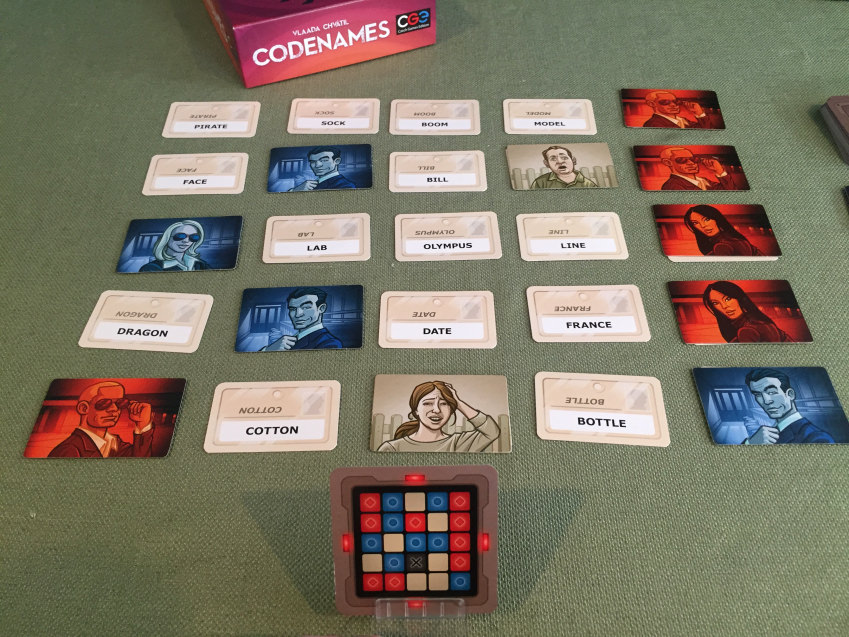
game in progress; image from here.  In this example, "date" is the forbidden word, and the red team needs to reveal four more cards to win (pirate, face, bill, cotton)
The obvious goal is to guess your words without guessing another color's.  The challenge is finding that perfect word to enable your teammates to do so.

Review
This is a simple yet challenging and fun game.  It's impressively difficult in many cases.  I love the "one word only" rule; that's the key for me.  For example, in one game I played, I had two words left to make my team win, and my opponent one.  My words were "mine" and "crane;" his was "drill."  I failed to find a word that would clue my teammates into my words without them potentially guessing my opponent's, because many associations with mines and cranes would also apply to drills (like "dig," "excavate," "tunnel", etc.).  And you never know what associations other people will make with your one-word clue.

With near-infinite variety due to many templates and many grid layout possibilities, this is a winner.

Rating: A