Saturday, July 29, 2017

1-2-3 Magic (Thomas Phelan)


According to author Thomas Phelan, "1-2-3 magic is a simple, precise and effective way of managing- gently and firmly- the behavior of children in approximately the two-to-twelve-year-old range."  His basic parenting philosophy: "effective parents have two important qualities.  They are:
1. Warm and friendly on the one hand [I'll love you and take care of you]
2. Demanding and firm on the other" [I expect something from you]

Parents use these qualities for their three parenting jobs:
1. controlling obnoxious behavior
2. encouraging good behavior
3. strengthening your relationship with your children
Everyone has problems disciplining their children.  Phelan argues that this is because many parents have the "little adult assumption" towards their kids- expecting them to be able to understand and reason like adults.  You can tell a parent has this assumption when during discipline they do too much talking [trying to reason with the kids] and display too much emotion [often yelling when the kids don't listen].

The solution?  1-2-3 magic.  When a child is acting up for any reason, rather than explain the wrong, simply say "that's 1."  If they keep it up, "that's 2."  If it continues, "that's 3" and put them in timeout (for as many minutes as their age, or longer if the offense warrants it).  Don't demand an apology, don't explain or rationalize, don't yell.

I don't know how effective this is.  Phelan argues that half of kids will catch on right away and become wonderfully behaved super-children capable of impressive feats and more.  The other half, he says, will fight at first but eventually catch on.  I'll try it this week . . . but I'm doubtful.

Gotta run- kids are acting up.

Rating: B

Friday, July 28, 2017

Lords of Scotland


Today's game review is of the 2010 release, Lords of Scotland.  For 2-5 players, it takes 30 minutes.

Game Overview
The king's throne lies empty, begging for a strong leader to unite bickering clans and assume the right to rule.  Muster your clans, use their powers if you can, and ascend to the top!

In Lords of Scotland, you amass and play armies (clan cards).  Each clan card has a bloodline (family name), strength (number 1-12) and power (based on the bloodline).  See below examples.

example cards; image from here
Simplified Gameplay
After setting up the table according to the rules (establishing a draw pile, recruit row, support row, and discard pile) and drawing 5 cards, the game is played over a series of skirmishes.  Each skirmish lasts 5 rounds.  One round gives each player a turn in clockwise order, during which you prepare by:
- recruiting (drawing a card from the recruit row) or
- mustering (playing a card to the table)

At the end of the 5 rounds, sum the strength of your played cards (doubling the total if they're all of one bloodline) and compare the total to your opponents'; highest total wins and claims a supporter from the support row.  These are clan cards randomly selected and displayed on the side of the table, the value of which equals its strength (remember: numbered 1-12).  The player with the second highest total picks the next supporter and so on until each player has a supporter.  You can pick any supporter you wish on your turn; generally, you'll choose the highest valued.  Then your played cards are discarded, recruit/support rows discarded (and replenished), and a new skirmish begins; the first player to accumulate 40 total power in supporters wins the throne!

One nuance to the game is clan powers.  When you muster (play a card), you can play it face up or face-down.  If you play it face up and it's the lowest strength played so far that skirmish, you can activate its power.  The powers inject fun twists into the game, allowing you to draw cards, switch army members with another player, take a second supporter at the end of the skirmish, and more.

Since you can replenish your hand only through recruiting during the game, you have manage it carefully.  And since the support row is randomly selected, there are some skirmishes you may want to focus on recruiting because the potential victory points are low.  So plan carefully.

Review
I like this game.  It takes a skirmish or two to get the hang of it, but it's simple with fun twists, nice variety, strategic depth, and good interaction.  Highly recommended.

Rating: A

Sunday, July 23, 2017

Isle of Skye


Today's game review is of the 2015 release, Isle of Skye.  For 2-5 players, it takes 30-60 minutes.

Overview
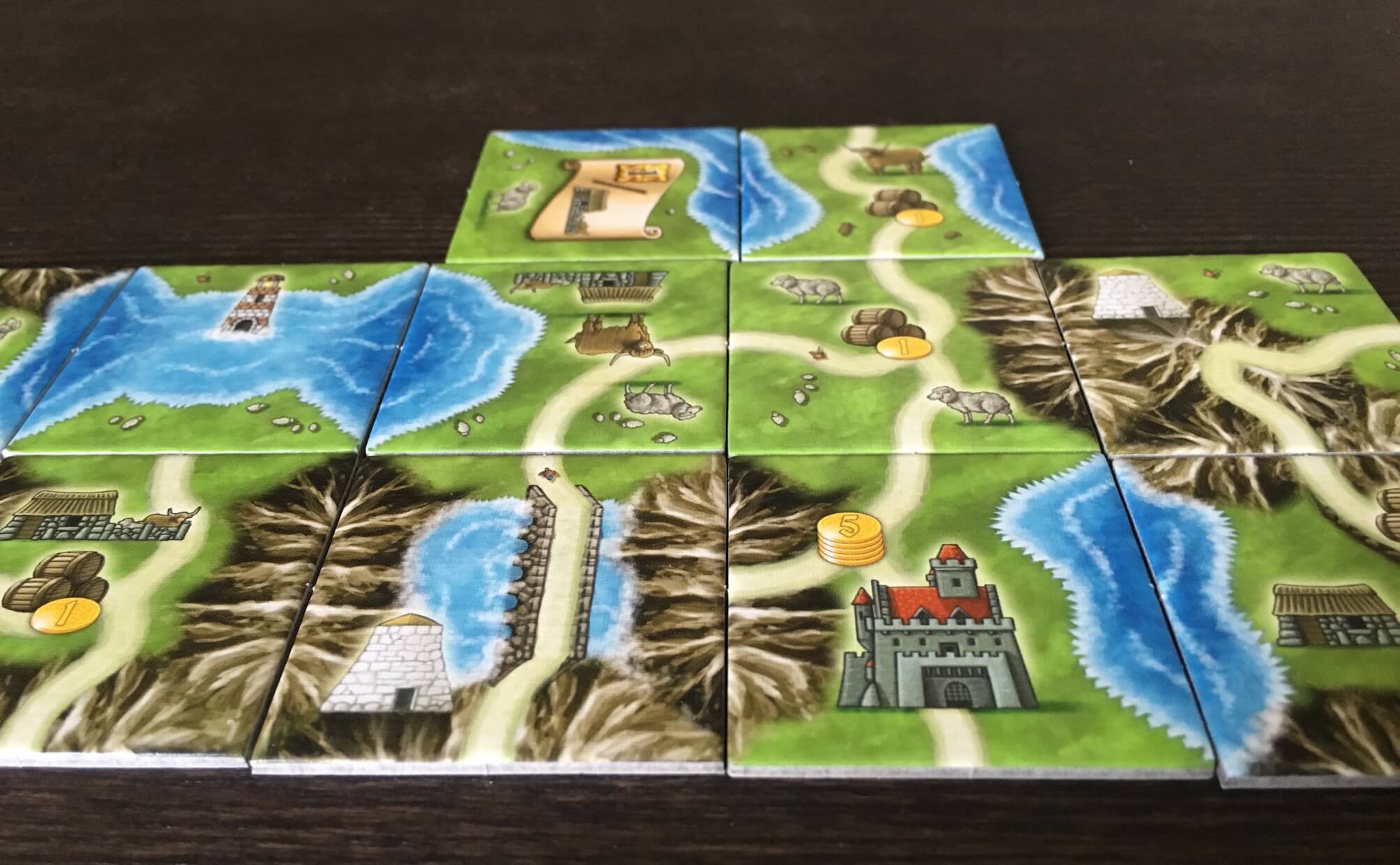
You are a chieftain, charged with leading your clan to glory.  To do so, you will build your kingdom by laying landscape tiles to expand your territory.  Each landscape tile will have type(s) of terrain (pasture, mountain, water) and a combination of other features (road, whiskey barrel, sheep, cattle, farm, ship, lighthouse, broch, or victory parchments).  Each turn, you'll acquire these tiles and position them in your kingdom for maximum impact. Choose and place carefully- each game has different victory conditions, denoted by four scoring tiles (chosen randomly from sixteen available)- which will guide your decisions.
game in progress; image from here
Simplified Gameplay
The youngest player is the first player for round one.  Each round has the following phases:
  1. Income
    • Each player takes from the bank 5 gold (for their castle) + gold for whiskey barrels on connecting roads + [in later rounds] gold based on the number of players ahead of you on the victory track
  2. Draw Tiles and Set Prices
    • Each player randomly selects 3 tiles from the bag, laying them in front of their screen (see illustration above).  Assign a discard marker to one and monetary values to the other two (at least one gold for each).
  3. Discard a Tile
    • Each player discards the tile chosen with the discard marker.  Now each player has 2 tiles in front of them.
  4. Buy a Tile
    • Starting with the first player, each player in clockwise order can buy exactly one tile from another player.  The price of the tile is the value assigned by that opponent in step 2; give that amount of gold to that player and take the tile (the player returns the money he assigned to that tile to his pool as well).  You don't have to buy one if you don't want to.
    • If nobody buys your tile(s), you get them, but you must give the money you assigned to them to the bank- you effectively bought them for that amount.
    • Based on these rules, you'll end up with 0-3 tiles to place in the next phase.
  5. Build
    • Each player places their acquired tile(s) according to the game rules (terrain edges must match, though roads don't need to; you must place a tile adjacent to one already in your kingdom)
  6. End of Round and Scoring
    • All players receive points based on the scoring tiles of the current round (the game board shows which of the four tiles is used for scoring in a given round- each round is different). 
The next player (clockwise order) then becomes the first player, the round marker is advanced, and the next round begins.  The game lasts five rounds (for 5 players) or six rounds (for 2-4 players).  After the final round, additional points are scored if you have any scrolls on your tiles or remaining gold.  Highest point total wins!  Check out the full rules here if interested.
a kingdom in progress; image from here
Review
This is a great game.  It's like Carcassonne, but (in my opinion) more fun, with lots of choice and variety.  Assigning monetary value to your tiles is key to the game, and takes some thought- pricing them too high or low has risks.  The varied victory tiles mean no game is ever the same, and you have to pay attention to the round, too, as that dictates which victory tiles are scored.  I see why this game won awards (Kennerspiel des Jahres- the 'thinking game' of the year).  The only downside is the amount of things going on- it can overwhelm some players.

Rating: A

Monday, July 17, 2017

Treasure Island (Robert Louis Stevenson)


Young Jim Hawkins is in for a surprise when Billy Bones comes to stay at his parents' inn.  Billy tells Jim of a vast treasure, but dies of fright after an encounter with his former shipmates before more can be said.  Jim finds a map of the treasure island and, with the help of local adults, prepares for the adventure of a lifetime.  But after the ship gets underway, Jim finds that the crew (led by Long John Silver) may have other plans.  Will he have the wit to survive?

A classic, I loved this adventure tale, penned in the 1880s.  Many modern pirate stereotypes can be traced to it.  It reads quickly, is well written, and captivating the entire way.  Another winner from Victorian Britain.

Rating: A

Sunday, July 16, 2017

Clank!


Today's game review is of the 2016 release, Clank!  For 2-4 players, it takes 30-60 minutes.

Overview
You are a thief, longing to be tops in the realm.  There's a dungeon filled with loot and of course a dragon guarding it all.  Need I say more?

In Clank!, your goal is to earn the most points by delving into the dungeon, grab one artifact plus what loot you can in the various rooms you'll explore, and get outta there before the dragon comes and puts a damper on the fun.  Of course, competing thieves, monsters, and other challenges are down there, too.  But it's not all bad- there's a market and allies who can be quite helpful . . . though sometimes the best things you can do make a lot of noise (symbolized by adding 'clank' cubes to a bag).  Whenever the dragon attacks, a certain number of cubes are taken at random from the bag, and you take damage whenever your color is drawn.  So plan carefully!  You die if your health meter reaches zero.

A deck building game combined with a dungeon crawler, Clank! has players using cards to move from room to room in search of secrets and artifacts.  Some chambers can be accessed only via certain means, and the paths can be fraught with monsters.  So make sure your deck can address all of these challenges (more on this later).

the board with some cards; image from here
There are effectively three board areas: outside, inside the dungeon (but above ground), and the depths.  You cannot leave the dungeon until you go into the depths and take one artifact.  Then you can hang out to grab more loot or high tail it back to fresh air.  What will you choose?


Simplified Gameplay
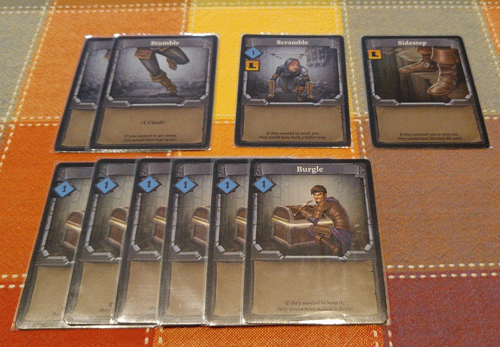
You start the game with a shuffled 10-card deck of fixed cards (see image below).  On your turn, you draw 5 and must play all of them on your turn (even ones that may have a negative effect) in any order.  Generally cards give you one (or more) of three resources: skill (needed to buy cards to add to your deck), swords (to fight monsters), and boots (to move around the dungeon).  Some can give you money, too, which you can use in the market to buy cool objects.  Play your cards, use your resources to buy/fight/move, and strategize accordingly.  Used (and purchased) cards are placed in your discard pile, to be shuffled into your deck and used again when the deck runs out.  Make sure you get the right mixture of skill, swords, and boots . . . all the skill in the world won't matter if you can't move from room to room.
starting cards; image from here
Turns proceed clockwise.  Any player who gets out of the dungeon gets 20 points, and the first to do so starts the countdown to ending the game.  The other players have 5 turns to get out, marked by increasing dragon attacks.  If you end up above ground (but still inside the dungeon), your points are tallied but without that 20-point bonus true escapees enjoy.  But if you're in the depths at game's end, you're annihilated [in the game] and you get no points.

Points are awarded at game's end by adding the value of your artifact, loot, money, and certain cards in your deck (labeled with points on them).

Review
I really like this game, which combines deck building with dungeon crawling in a fun way.  If you like Dominion, you'll love this.  The point system is well constructed (with lots of ways to earn them) so that it's not all about speed- I was the first out of the dungeon, with a decent artifact, and finished third.  This will be a staple in my collection.

Rating: A

Thursday, July 13, 2017

Castlevania: Season 1


It's 1476 in Wallachia.  The Church has killed Dracula's wife, burning her as a witch.  The count has sworn revenge by releasing an army of demons on the countryside.  Trevor Belmont, of the renowned monster hunter family, vows to destroy Vlad.  But to do so, he will require help from an unlikely source . . .

Having enjoyed several releases in the Castlevania video game line, I was intrigued to see Netflix release a 4-episode Castlevania animated series.  It was okay.  The art was good, and I was drawn into the story.  On the downside, it was horribly violent and profane in places (it's rated M), and not much happens in four episodes . . . it felt more like a long introduction, with the meat of the story to come.  To that end, they've agreed to produce eight more episodes.  I think I'll check them out.

Rating: B-

Wednesday, July 12, 2017

The Book of Lost Tales (J.R.R. Tolkien)


The Book of Lost Tales is a two-volume set collecting J.R.R. Tolkien's first drafts of his writings on Middle Earth.  These in more finished form became The Silmarillion, which covers the early days of this enchanting universe, giving us insight into some events and personalities referenced in The Hobbit and The Lord of the Rings.

I couldn't get through these books.  I enjoyed the foreword, but the tales themselves are boring and difficult to read at best.  In many cases, multiple versions of a tale are presented, showing the evolution of it.  In short, these books are for Tolkien fanatics who gobble up every scrap of writing the man produced.  The rest of us can content ourselves with his finished products.

Rating: C-