Friday, May 28, 2021

TLG: Grains

Continuing The Long Goodbye series, today we look at 'grains'- so baked goods and cereal.

Baked Goods
The Germans have a breathtaking variety of breads (3,200 kinds are officially recognized). We enjoyed the variety but didn't partake often (and have no particular favorites), because whenever I was in a bakery-which was all the time- I focused on their pastries.


Ahhh, German pastries. Clockwise from upper left, my favorites were Karlschens (from Backhaus Schröer), Kirschplunders (many places- Aldi had good ones), Quarktaschen (also from Aldi), And Streusels (many places). We only recently discovered Franzbrötchen (below), which quickly became another favorite. 

We enjoyed the Berliners (jelly doughnuts) and other products from time to time, but nothing compares to the above.

Waffles
I call out waffles separately from other baked goods because they stand alone. When in Belgium . . . one eats liege-style waffles as frequently as one can. If you pass a store and see the below in a window, you stop and get one (or two . . . or more). Plain is amazing enough, but covered with whipped cream, chocolate sauce, or other toppings heightens the experience. And one place- Vitalguafre- shoves chocolate rods into the rows, which then melt in the warm interior, for a true delight.

Cereal
I enjoy routine, and every single morning I breakfasted in our house, with almost no exceptions, I had Schokomüsli mit feinherber Schokolade. Every. Single. Morning. Served with Oatly oat milk. I ordered this stuff by the crate- buy six, get one free on the website, so I'd order 14 at a time- can't risk running out. There's no better way to start the morning.

Of all the foods we love here, I'll miss the baked goods most of all. They were staples to start my morning, and the bakeries were necessary stops on my longer bike rides. I'll miss them so.

Tuesday, May 25, 2021

TLG: Sweets


I'll start my "Long Goodbye" series on a sweet note.

European sweets are amazing. They're hardly unique to Europe, of course; we'll enjoy them in the States, and there's no shortage of quality there either. What we'll miss is the brands or taste combinations available here that will no longer be accessible to us when we move back home. And there does seem to be a general heightened quality here that we'll miss.

An Aldi brand, we enjoy many varieties of Choceur chocolate bars (Feinherb Nuss, Salzbrezel, Cookies & Cream, Caramel, and Pfefferminz, to name a few). The Caramel variety plus a handful of peanuts is an amazing Snickers variant, and their "Choco und Keks" line is amazing. Will these be available in US Aldi stores? I sure hope so.

Belgian Chocolates
No trip to Belgium is complete without irresponsible indulgence in their quality cocoa concoctions. Leonidas brand is prevalent throughout the country and excellent in selection and taste. But what I like the most? Chocolaterie Mary and their dark chocolate-covered marshmallows. They are so expensive (4€ individually!), but worth it.

These famously-square chocolate bars are available in the States (I think), but the flavors can differ, and the ingredients always do (this is true for any brand). Pfefferminz was my favorite here.

Liquor-filled Chocolates
When the Germans put alcohol in chocolates, they take it seriously. These chocolates pack a punch- a delicious punch. Asbach and Eierlikor pralines were my favorites- but always choose the dark chocolate variety.


Why are these not available in America? WHY?! The tastes and textures blend marvelously in this product. Perhaps our favorite sweets.

Gummy Bears
The German Haribo brand is widely available in the States, but I've never cared for those. The real money is in the Bären-treff brand (online store here). Their fruit snacks (grapefruit blood orange or strawberry rhubarb) are outstanding, but the best is the sour currant gummies. We also quite enjoy Lachgummi "Milchgeister" chews, which are effectively half-gummy, half-marshmallow.

Ice Cream
We will greatly miss the "eiscafes" that dot each town. I've always turned to chocolate as my mainstay- until living here. The fruit flavors are varied and fantastic; I've had green apple, blood orange, blueberry, grape, apricot, currant, and other fruit selections. They appear less sweet than US counterparts would be (if we had those flavors) and range from good to flat-out outstanding. The cafe near Burg Runkel is our favorite in the region.

I think that covers it for sweets (I'll cover baked goods later). I can always add things as I think of them.

Friday, May 21, 2021

The Long Goodbye


Our time in Europe is running short- less than two months remain. In the weeks to come, I'll reflect on our time here through a series of posts I'll dub "The Long Goodbye" (TLG).

Moving is hard. Even local moves feature a good deal of stress, work, and change- not to mention goodbyes. Two and a half years ago, my daughter drew the above picture as we prepared to leave America. We were excited for what lay ahead, but dreadfully sad to be leaving the friends, family, and familiarity of home. We're back in that mindset.

When we left America, I recall those final two weeks being a frenzy of activity. There were hundreds of tasks: paperwork, move prep, clean-outs, charity runs, yard sales, house prep/sale, and goodbyes to friends/family/favorite things (foods, stores, etc.). The days were long and exhausting; tempers were short; emotions were high. This time, we expect the same- though we hope to spread it out a bit more to lessen the pain. So I'll start my goodbyes to our favorite things. The hope is to capture what we held dear here and be thankful for it as we reflect on the blessings we enjoyed. I also hope it allays some of the sadness I've been feeling.

For the past few weeks, I've felt a deep sense of sorrow. It started a few months ago, but then, it was focused on languishing in the pandemic. We're still in that, of course, but as so many (including almost all friends and family) are now vaccinated, my sadness has shifted. But I can't tell to what.

It's bizarre; I've been trying to pinpoint what I'm really upset about. Lost opportunities is an obvious possiblility, but as I think more specifically:
  • Is it trips we missed out on? Not really. We may go on one or two before we leave, but we've seen a lot of Europe in our previous tours. We enjoy traveling, and wish the kids could have seen Rome, Paris, and London, but I can't say that's the source of my heartbreak. 
  • Is it experiences we didn't have? I don't think so. Yes, we missed some more 'exotic' adventures, but the pandemic enabled us to explore more locally, and that was more satisfying than expected- in some ways, even better than the long trips.
  • Is it fellowship we were denied? That could be it. I desperately miss getting together with friends. We've been able to meet virtually (for fellowship or games) with a handful of people, and that's been delightful.
  • Is it relationships we never formed? Also possible. I think of the people that have moved here during the pandemic that we would have loved to know better, but never had a chance. Or the people we wanted to have over but didn't. That is heartbreaking. 
  • Is it job-related? I'm not sure. I wish I could have accomplished more, but that's probably true of everyone. 
  • Is it the visits we stopped getting? We loved but were worn out by our six sets of visitors in 2019. I sure wish parents and siblings could have visited again, but we were blessed with the visitors we did get.
On my bike ride today- my favorite route- I had a thought that might be the clue to the answer. The weather has been poor, so my rides have been infrequent, and on today's trek, I thought "I better enjoy this- it might be the last time I ride this route." Ahhh- I may be on to something.

Ultimately, I think my sadness is because I didn't get my goodbyes. It's not that we didn't get to go to [x] or do [y] or see [z] again- it's that we didn't realize it was our last time going to, doing, or seeing those things or people. That's what gets me more than anything. 

When you know it's the last time you'll do a favored activity, eat a favorite food, or see a beloved friend, you treat the time with greater reverence.  You savor those last times, bites, or fellowship. You reflect on them and are thankful for them. There may be tears at that final parting, but there's closure. Though our final days in America were hectic, we had that closure.

In the pandemic, so many people have left without being able to say goodbye. I've done so many things for the last time without realizing it was the last. That's what has been gnawing at me. 

What's the lesson? Probably gratitude- to be thankful for who you know, what you have, and what you do. To savor the 'little' things, even if you think they'll happen many times in the future. To treasure the time you have with people. I live so much of my life not appreciating blessings to the extent that I should. I assume they will be there again. This pandemic has taught me that they may not be. 

So this forthcoming "TLG" series will look at things we got to enjoy here that we won't stateside. It will be my way of getting closure that has been denied in too many areas. Of having gratitude for what lies behind, before we shift to look ahead in anticipation of what's to come.

Sunday, May 16, 2021

GRL: Reflections


One final post on my German Reading List, the multi-year effort to 'get' Germany- to understand her history, literature, language, and culture (here is the complete list, highlights, omissions). Today, I reflect on the experience, as I did for my British Reading List.

Did it work? Do I know 'get' Germany? Yes and no. Certainly, I understand more now then I did before this list. And as I have lived here four years previously, it's telling that my reading list helped more than my prior life here (where I invested less in language and reading). Reading is an important and valuable pursuit, giving one insight much faster than you could otherwise obtain. That said, it's abundantly clear that I'm not a native here, and will never be. 

Here are some lessons I learned from, or reflections I have on, this reading list:

1) Study the language
I studied German in high school, and made sporadic attempts when I lived here last time. This time, I was more focused and disciplined in the pursuit. It made a difference. I didn't mention this in my GRL, but I read a handful of books in German, and that was valuable. Knowing the language heightens your experience and opportunities. I wanted to test at the B2 level here, but won't get the opportunity before I fly home. I'm hoping to take a similar fluency test in the USA as a sort of 'keepsake' for my efforts, and then move on to learn another language (French or Spanish are on my mind). 

2) Learn the history
I had studied the Reformation and World Wars in some detail before living here, but lacked almost all other knowledge about German history. This time, I learned quite a bit about the Holy Roman Empire, Thirty Years War, the Napoleonic era, Prussia, and German Empire. It was valuable- even events centuries old can leave their imprint on an area. 

3) Enjoy the talent
A reading list always introduces me to authors I wouldn't have heard of or read otherwise. And there are many talented writers out there. This time around, I became enamored with German fantasy. I'd like to explore it more in the future. There's so much out there, if we just take the trouble to look.

4) Study the mindset
The literature and history of the people gives insight into their mindset- their prevailing attitudes that drive their view on and reactions toward life. This time around, the literature in particular around the turn of the twentieth century gives us insight into the horrors that would dominate the first half of it: two world wars. You see a combination of both ultra-nationalism and hopelessness that created an aggressive mindset. May we learn from the past.

I think that's it. I'll conclude with this: pick a topic that interests you and create a reading list for it today. You'll be glad you did.

Saturday, May 15, 2021

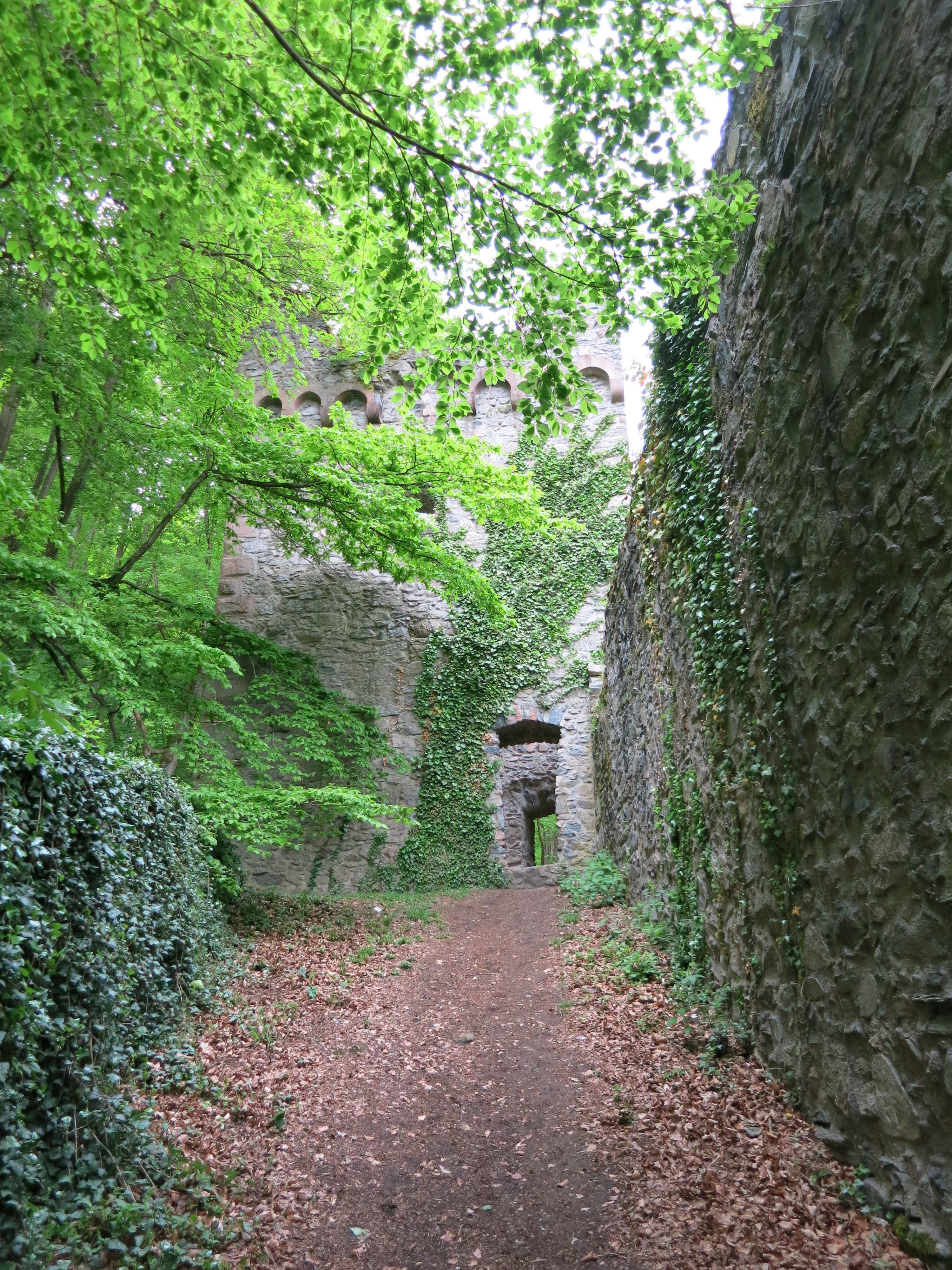
Burg Rodenstein


At long last! We get out and about in local nature, but it was nice to do a day trip today (the first since last October- oi). We had a 3.7-mile route planned, but cut it down to 2.2 miles given the weather forecast. It was a good decision; a light rain started as we neared the end, and our drive home was mostly wet.

The objective was Burg Rodenstein, a castle ruin nestled in the mountains south of Darmstadt. We began at an elevation above the castle, passed a site where (I think) women used to live in a cave or something, then cut down a mountain bike path (and what a trail that was- the jumps were impressive) to curtail our journey and reach the castle. 

I wonder why Rodenstein was constructed at that site. It's surrounded by the hill, so enemies would have had a nice vantage point in a battle. Whatever the reason, its ruin makes a scenic area even better, and it was delightful to 'stumble upon it' as we walked (the GPS tipped us off, of course).


Another day, another castle. I'll miss this so much.

Friday, May 14, 2021

GRL: Omissions


Today I continue my thoughts on the German Reading List (GRL) I recently finished. You can view the complete 52-book list and my top 11 recommendations for background if you wish.

No reading list can be perfect or complete. My GRL had less than half as many books as the prior British Reading List I tackled when we lived in England. But whether a list is 50 books, 100, or 200, you'd hit the same problem: you can't read it all. There will always be notable works omitted. 

I capped the GRL at ~50 books for a few reasons:
- our tour here (2.5 years) is shorter
- it was harder (or more expensive) than I anticipated to obtain some of the desired books in English
- limits forced me to focus on what I suspected were the most important (or at least a good representative of a given genre, author, or style)
I was glad I did. Nevertheless, I know I missed some good ones, and I wanted to document a selection of those here for my future reference and general awareness, should others desire to undertake a similar task. With that said, here are works, authors, or topics I wish I had read (or read more). 

DW's "100 German Must-Reads"
I compile reading lists, in part, through Google searches for 'best of' lists. DW's list of 100 German books (written since 1900) that "you must read" was one of my references. You can find the PDF list on their website. I read only nine of the 100 recommended, but found each to be excellent, suggesting the list is done well. If I had more time, I would have done more from this list, to include:
- Alfred Doblin, Berlin Alexanderplatz
- Lion Feuchtwanger, The Oppermanns
- Anna Seghers, The Seventh Cross
- Ernst Lothar, The Vienna Melody
- Gunter Grass, The Tin Drum
- Gert Hofmann, The Film Explainer
- Christa Wolf, They Divided the Sky
- W.G. Sebald, Austerlitz

Older Literature & People
DW's list is great, but it covers only the last 120 years. What about older works? Here are a few authors or topics I'd have liked to cover more:
- Hans von Grimmelshausen, Simplicius Simplicissimus
- Johann Goethe, The Sorrows of Young Werther

It would be nice to delve into books about artists- or at least, books featuring their works. Durer, Hans Holbein, Caspar David Friedrich, and so on.
- Norbert Wolf, Albrecht Dürer
- The Complete Woodcuts of Albrecht Dürer

Germany has many famous classical music composers. I'd have enjoyed books about musicians Beethoven, Brahms, Wagner, and more. But what kind of books? Biographies? Or should I expand the reading list to include music, and have listened to these composers instead? 

What about philosophers? I didn't investigate this space at all. But I should probably explore Leibniz, Kant, Hegel, Marx, Nietzsche, and Heidegger. And though he's not a philospher, I'd include Freud in the group. I'm not keen on this area, so I'd love to find a work that surveys the field.

History
You can't read enough history. If I had more time, I would have studied the Holy Roman Empire, Prussia, and the Third Reich more (yes, even Hitler's book):
- Joachim Whaley, Germany and the Holy Roman Empire
- James Charles Roy, The Vanished Kingdom
- William Shirer, The Rise and Fall of the Third Reich
- Adolf Hitler, Mein Kampf

For historical fiction, I enjoyed Oliver Pötzsch's The Hangman's Daughter, and would explore more by him (like The Castle of Kings).

Fantasy
I fell in love with Germany fantasy writing. If only there were more of it! Some titles I'd check out that I missed in my initial sampling:
- Markus Heitz, The Dwarves
- Kai Meyer, Pirate Curse
- Bernard Henne, The Elven
- Cornelia Funke, the remaining two books of the Inkheart trilogy
- Michael Ende

I may get to these titles and topics someday. But as we prepare to move back home, it's time to develop and focus on my next list.

Wednesday, May 12, 2021

GRL: Highlights


I'm done my German Reading List (GRL). I read 52 books (14,545 pages) total in my quest to understand Germany- its people, language, history, literature, culture, etc. As with prior efforts of this nature, it was a fantastic and recommended experience. You can see the complete list here.  

Of the 52 books, I enjoyed most of them (34 got an "A-" or better in my book). Of these, I've chosen 11 that I recommend for those interested in becoming familiar with the seminal German events and books. Keep in mind: this doesn't necessarily mean I thought these were the 11 best, or even the 11 I most enjoyed- what follows are the 11 most appropriate for achieving the above objective.  Here they are, with some elaboration following:

Neil MacGregorGermany: Memories of a Nation History
Collins Complete German Language
The Brothers Grimm Grimm's Fairy Tales Fairy Tales
Thomas Mann Buddenbrooks Literature
DK Publishing World War I- The Complete Visual History History
Erich Maria Remarque All Quiet on the Western Front Memoir
DK Publishing World War II- The Complete Visual History History
Elie Wiesel Night Memoir
Peter Schneider The Wall Jumper Fiction
Michael Ende The Never Ending Story Fantasy
Cornelia Funke Inkheart Fantasy

Elaboration
History
You don't need to love history, but it's important to understand it. MacGregor's Memories of a Nation is an outstanding overview of German history, told in a highly visual style (this is the same author that produced A History of the World in 100 Objects).

No German treatment can ignore the two world wars. DK Publishing's volumes on WWI and II, respectively, are excellent and fair overviews to these horrifying conflicts. 

As I love history, I was tempted to include many more here. MacGregor gives a satisfying introduction, but look at the full reading list for more excellent works on specific periods- Nichols's The Reformation, Wedgwood's The Thirty Years War, Clark's Iron Kingdom, and Tuchman's The Guns of August come to mind.

Language
Live in Germany? Learn German. At least try. There are many good resources out there- apps (like DuoLingo), courses (online or in-person), and books. Of the books, I recommend Collins's Complete German. It's done extremely well, and a valuable reference.

Memoirs
There are many poignant memoirs out there, especially regarding the war years. All Quiet on the Western Front and Night are powerful looks at the horrors of WWI and WWII, respectively, from the common man's eyes.

Literature
I'm not going to lie . . . I found a lot of German literature (at least in my sampling) overly morose or despondent. But their popularity and endurance is a window into the soul of the German people, and well worth the time. Buddenbrooks is long but a great work. There are many other authors worthy of mention; check out the full list for more.

I'll include Grimm's Fairy Tales here, too. The original release had ~80 stories if memory serves; the collection swelled with subsequent editions until their final contained over 200 stories. I read a few iterations of selected tales (210 stories in this version, 21 stories here, and seven here)-  The one linked above was the best (the one with 21 stories). Don't read all 210 tales- many stories are repetitive and uninteresting. But there are a handful of good ones.

Fiction
What's the difference between fiction and literature? I don't really know. Perhaps you could count The Wall Jumper as literature instead, but however you bin it, I found it outstanding- a portrait of a divided land, looking at the contrasting mindsets of East and West Germans.

Fantasy
I fell in love with German fantasy writings. Chosing only two was hard, but I had to leave room for other works. Michael Ende's books were outstanding- if you like The Never Ending Story, check out Momo. Cornelia Funke's Inkheart was also excellent (and the first of a trilogy, if you wish to continue).

Conclusion
Eleven books is too few to fully 'get' Germany, but it's a great start. I recommend you read these, then branch out to other works as you better understand your goals and tastes.