Tuesday, March 8, 2022

Compassion & Conviction (Giboney et al.)


Compassion & Conviction was written as a "resource to help believers engage the civic space as faithful Christians and informed citizens." Everyone is political, "government is a God-ordained institution," and "Christians should engage politics because doing so provides us with a robust opportunity to love our neighbor by acting justly, promoting human flourshing, and seeking the prosperity of our community." This book provides a framework for how to engage in politics.

Highlights
How do Christians participate? What about separation of church and state? "No one makes political decisions from a neutral position." "Many people have misinterpreted the separation of church and state to mean that religious views shouldn't play a role in public discussions and lawmaking . . . [but] whether political views derive from religious tenets or secular philosophy, invoking values to influence the legislative process violates neither the constitution nor the spirit of the deliberative process." "In fact, all policies and laws come from some set of values." So what does that mean for Christians? How should we apply Biblical principles to our political decisions?

We'll start with the obvious: for the Christian, "the gospel of Jesus Christ is the ultimate authority in all arenas of life, including politics. This means the gospel should be the foundation and staring point of our political decisions." Yet "the Bible does not provide a political platform, and we should be careful to not confuse our personal policy preferences with religious doctrine. Two Christians can disagree on an important policy without one or the other necessarily being unfaithful . . . even when the Bible does speak directly to an issue, Christians might disagree on how to apply the principle in the public square. It's a mistake to suggest that Christians should always come to the same political conclusions. However, all Christians should make those decisions from a biblical framework . . . that emphasizes love and truth, compassion and conviction, social justice and moral order." So what is that framework?

First, Christians must frame questions of the day correctly. A common political tactic is to frame complicated issues deceptively by presenting a false choice (like "do you love the poor or do you believe in personal responsibility?"). In America's two-party system, such false choices are common on both sides of the aisle and must be rejected by the Christian. Parties can make it seem as though two concepts are "somehow at odds with each other" when in fact they are not. It is possible to think biblically- but doing so may result in a conclusion that aligns with neither political party. So question assumptions and frame questions correctly, being fair to both sides of the argument in so doing.

In general, all Christians should "evaluate all political issues through the love and truth of the gospel. This is a both-and proposition, and not either-or." This means (among other things) that "we must seek justice for our neighbors" while we remember that moral "truth is established by the Bible; it must frame our civic engagement." (Though "how to apply moral standard to politics can get complicated . . . sometimes it is wise to accept that the best use of the law in a given situation is not to enforce morality but rather to allow for the freedom to be moral.") 

Evaluating issues through a gospel lens will likely run afoul of both of today's main political parties. "Neither progressivism nor conservatism satsifies the love or truth imperatives of the gospel. Both fall outside of a biblical framework. Christians must recognize the failings and blind spots in their own political party and ideological tribe in order to avoid indoctrination and to faithfully correct unexamined assumptions." We must also remember that "the Bible doesn't speak to every politcal issue. We might have political preferences that the Bible neither affirms nor forbids. We need to be honest about that and not use the Bible to fortify a position that faithful Christians can see differently." We must fight against a common trend- that "some Christians are more willing to defend their ideological tribe than the Christian faith."

The book proceeds to discuss tips on:
  • partnering with non-Christians on issues of common concern, 
  • faithful and effective communication (messaging & rhetoric),
  • racial reconciliation,
  • advocacy and protest, and
  • civility and political culture.
Review
This short (130-page) book is an excellent introduction to faithful political engagement. The framework is very high-level; they will not tell you how to vote on a given issue/etc. Written by (and to) Americans, the intent is to suggest a better way of approaching politics than many Christians (on either side of the aisle) have shown in recent years. Highly recommended.

Rating: A

Friday, March 4, 2022

The Batman


It has been two years since Batman assumed the cape and cowl. A serial killer is loose in decaying Gotham, targeting high-level officials and claiming their lies will soon be exposed. Batman and Jim Gordon are on the case, racing to get ahead of the mastermind before he can kill again, while trying to figure out which public figures can be trusted. But in a city this corrupt, will these riddles be beyond the Bat?

Long-anticipated and critically-acclaimed, I expected this to be amazing. It was good, if long (almost three hours). It is a raw and gritty noir film, with a focus on sleuthing- it's more of a layered mystery than anything. (Batman is called the world's greatest detective, but other films seldom highlight that.) The action here is good and not over-the-top; it reminded me of the Bourne trilogy in its goal of 'realism.' Batman and the other characters (Riddler, Penguin, and Catwoman) are portrayed quite well. Music is powerful and haunting, if repetitive (oscillating between the movie score, Nirvana's Something in the Way, and Schubert's Ave Maria). 

Mild spoilers (on message, not plot): the film explores how Batman and his focus on vengeance isn't so very different than the Riddler he hunts- both want the same goal (a city rid of lies and crime), and their methods differ less than Batman would care to admit. He grapples with that and realizes that part of his charge must include bringing hope to the people- by helping them vs. focusing on 'getting the bad guys.' It's a good concept and I wish they had fleshed that out more. In addition, you learn more of Batman's family past, with surprises contributing to the Dark Knight's angst.

Overall, there is a lot of good here. As I sat in the theater last night, though, something didn't ring true, and I'm having a hard time identifying what. It could be that the movie was long and I found the ending a touch lackluster. Or that the message wasn't as fleshed out as I would have liked. I may change my mind, but for now: this film is solid, but I'm not ready to call it spectacular. Christopher Nolan's trilogy still reigns supreme in Batman lore.

Rating: A-

Thursday, March 3, 2022

The Wheel of Time


Finally; yesterday, I finished the Wheel of Time (WoT) high fantasy series. It was quite the commitment, running 14 books (12,456 pages). Weaving those into my reading plans, it took me 29 months (Oct. 2019- Mar. 2022) to get through them all. Click on a book cover to see my review of a given title: 


Here are charts with the page counts and my ratings, respectively, for each book:


Thoughts on the Series
Published between 1990-2013, WoT is a product of a recent yet bygone era. Everything about the series, to include the art for each cover, reminds me of the nineties. I like it.

This is a solid (if typical) 'hero's journey' story. Jordan weaves elements of Buddhism, Christianity, and literature or pop culture (Lord of the Rings, Star Wars, Arthurian lore) in a unique combination to deliver the tale. 

As is shown by my ratings, the series starts and ends well, but the middle is a mixed bag. My ratings for books 5-7 are probably generous, giving the author the benefit of the doubt and riding the wave of previous entries. But they're slow. By book 8, I was getting fed up, and remained so through book 11. Sadly, Jordan passed away before he could finish, leaving Brandon Sanderson to take over and do books 12-14. Those were much better and brought the series to a fitting conclusion. (I must say, I'm impressed with Brandon Sanderson. It is an achievement to take up another's story and finish it well.)

My impressions remain remarkably similar to what I felt when I was halfway through the series. Those thoughts reprinted here, with minor updates:

What I liked:
  • Compelling story
  • The overall world, with intriguing elements and the impression of depth
    • To include ruins, lost knowledge, and strange artifacts
    • Cool magic system
  • Interesting characters with differing abilities or strengths
  • Character development (of Rand and Perrin especially)
    • You see these characters wrestle with self-doubt, responsibility, and the gifts they've been given, and there is notable maturation
  • Variety of cultures and customs among the different peoples
  • Multiple perspectives revealing the faults, doubts and internal struggles of the main characters (even some evil ones)
  • Balanced power struggles and mysterious motives within and between the 'good guys' and 'bad guys'
  • No graphic depictions of sex, violence, and language
  • Limited knowledge. The characters (good and bad) don't know about events outside their immediate situation, and act with the best knowledge they have. I like that- some novels have heroes whose intuition is suspicuously complete and correct. You don't have that here.
  • Rand's Christlike attributes. Especially towards the end [mild spoiler alert], you see him restoring things around him.
What I didn't:
  • Uneven pacing. Especially true in the middle books, plots would plod along for hundreds of pages, then suddenly accelerate.
  • Uneven development. Major characters or plotlines would 'disappear' from entire books. Several elements felt rushed, ignored, unsatisfactorily addressed, or insufficiently foreshadowed.
  • Over-reliance on certain focus and phrases (in Jordan's books). I've gotten used to it, but it's mildly annoying that Jordan always focuses on the same aspects of clothing, same descriptions of characters, same phrases to describe certain things, etc. 
  • Sheer number of characters combined with inadequate appendices to keep track of them all
  • The appendix in each book is appreciated but not updated- nobody I looked up was in there. The main characters have entries, but they're the least necessary.
  • Difficulty in understanding "the One Power" and the limits of those who use it. This is similar to the problem I have with the Force in Star Wars. The power-wielding characters alternate between shockingly strong abilities and standard weaknesses. They can move mountains, then get easily surprised or overpowered. It seems inconsistent.
  • The handling of religion. They mention a 'Creator' and say things like "the Light willing" throughout, but the WoT's god is deistic- there is no participation in the world. The Dark One, however, is quite active, even while imprisoned. That bothered me.
  • Overall length. One critic called this "the wheel of too much time." I agree.
Resources
WoT has its own wiki.
Dragonmount has nice book summaries.
Regular wikipedia has a series of pages, of course.

Conclusion
Overall, I'm glad I read this- but also glad it's over. It's a good story, just too long in the telling. Jordan originally planned for it to be 6 books . . . he died after book 11 and it took his successor three more to finish it off. The 14 books could be condensed to 10 easily- maybe fewer.

Wednesday, March 2, 2022

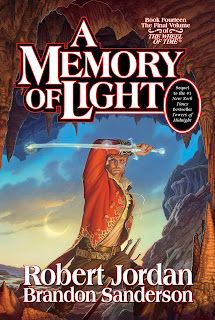
A Memory of Light (Robert Jordan and Brandon Sanderson)


The Wheel of Time saga concludes! Shortly after Towers of Midnight . . .

The Last Battle has come. As Rand faces off against the Dark One at Shayol Ghul, his allies and their armies take up the fight against the Shadow across the continent. The odds are overwhelming. There are traitors everywhere. The Forsaken weave their schemes. Blood will run. Heroes will fall. Yet not all hope is lost . . . Let the Dragon ride again on the winds of time.

So ends the Wheel of Time. I'm filled with a range of emotions. I'm happy and sad. I long for more but am glad it is done. I don't want to spoil the ending, but it was satisfying and unexpected. I'd imagine that it is hard to wrap up such an epic tale, but Sanderson did a great job. (He mentioned that Jordan had written some of the ending before he died- I don't know how much of this final book was the original author's. Either way, they both did well.) There are a few plotlines I wish to know more about, but such is the way of good stories- you want them to go on, but they must end.

In a future post, I'll reflect on the series as a whole. For this book specifically, it is a fitting and solid conclusion.

Rating: A

Saturday, February 26, 2022

DungeonQuest


Today's review is of the 2014 release, DungeonQuest (revised edition). For 1-4 players, it takes 60 minutes.

Overview
You are exploring Dragonfire Dungeon. You'll encounter monsters, treasure, traps, and maybe a dragon, but most importantly- treasure. Can you get the most loot- and get out alive- to win?

This is a tile-laying game with many small decks, each labeled appropriately ("dungeon deck," "trap deck," "search deck," "treasure deck," "catacomb deck," etc.). Each player chooses a hero miniature (with unique abilities, laid out on their accompanying stat card) and places them in one corner of the map (which is blank to start). On your turn, you'll activate any abilities, then perform one action: move, search, or go into the catacombs (an area beneath the dungeon). 
  • Move: move your hero into an existing adjacent tile OR randomly choose a new dungeon tile, then placing it in a legal adjacent space and moving the hero into it. Do anything the new tile indicates (one common action is drawing a card from the dungeon deck and doing what it says). 
  • Search: if your hero is on a tile with a search icon, you can draw a card from the search deck and do what it says- it may be a trap or monster, but could also yield loot!
  • Go into the catacombs: if you're on a tile with a catacomb entrance, you can go into the catacombs (draw a card from the catacomb deck and do what it says). On each subsequent turn, you draw an additional catacomb card until/unless you can escape the catacombs and return to the dungeon- often in a completely different location.
game in progress; image from here


After each play has had one turn, the sun will advance and a new round begins. To win, a player must 1) escape the dungeon before the sun advances too far and the dragon awakes, and 2) have the highest total value of loot. Can you survive?

Review
DungeonQuest is a straightforward game. The cards in various decks will tell you what to do- which can include drawing a card in another deck and following its instructions. You may encounter monsters and other hazards- or nothing at all- as laid out in the cards. This game is easy to learn but hard to master- it is easy to die quickly here.

While the game's different dungeon tiles and decks are a neat twist and way to inject randomness or variation, this game ultimately fell flat for me. There are plenty of choices- but there are few informed options. To be good, games must include meaningful choices. Here, it's all random. Moving, searching, or catacombs are your choices, but they all involve random tile laying or card drawing, so this is really "choose your random outcome."  Every choice was like rolling the dice- no skill involved. This is the revised edition- the original came out in 1985. This game definitely has that "legacy" vibe to it; gaming mechanics have come a long way since then. So while there's some good here, it will go on my stack to sell.

Rating: C+

Friday, February 25, 2022

Ten Years Later

"Man Writing" by Oliver Ray

Happy blogiversary! Ten years ago, I made my first blog post. Today, I recount the journey.

It started with books. We lived in England at the time; with young children and poor weather, I suspected lots of time indoors. (I was right.) I thus committed myself to rekindle an old flame- a love of reading. But I have a bad memory, so I wanted a way to remember what I read. I hit on blogging- doing book reviews as a way to improve what I retained and look back on the works I had enjoyed. Little did I know what it would become.

I soon expanded the blog to travel recaps and movie reviews. I also added overviews of my favorite subjects to share interests, document reading lists, and serve as a reference (for myself and others). I dabbled in poetry and humor. I talked about our years in Europe and the struggles we had re-adjusting to America. I had a game post or two (those posts began in earnest in 2017). I reflected on life and personal struggles like materialism. At the end of the year, I looked back. At the beginning of the next, I looked ahead. The blog became a way to document hobbies, experiences, and goals.

Though most technical elements were there near the beginning, I refined things as time went on. I started adding graphics to each post, then went back and retroactively did so for my earliest entries (one big advantage of the medium). I started adding tags. I changed the URL in 2016 (it was initially "overlord musings," an inside joke). I added pages (accessible across the top of the main site) to focus and organize my main interests. I learned how to embed videos, hyperlinks in pictures, and more. I even started a second blog in 2020 focusing on Magic:the Gathering.

Ten years later, here we are. I looked at why I write back in 2014, and those reasons are still the driving force. Blogging for me is a chance to share, organize my thoughts, document progress, and practice writing. Here are the stats so far:

Posts: 1,397 (counting this one)
Views: Over 88,000 total- 57,893 (for this URL) plus ~30,800 (for the original URL)
Most common labels* (with number of posts so labeled):
  • books (689) 
  • movies (205) 
  • games (178) 
  • religion (155) 
  • reflections (153) 
  • Europe (131) 
  • superhero (122) 
  • Star Wars (119)
  • history (116)
  • travels (114)
  • graphic novel (100) 
It's been a great ten years. Here's to many more.

*note: many posts have more than one label

Monday, February 21, 2022

Crusaders: Thy Will Be Done


Today's review is of the 2018 release, Crusaders: Thy Will Be Done. For 2-4 players, it takes 40-60 minutes.

Overview
You are the head of a militaristic order in Medieval Europe. Your goal is to have the most influence by building (banks, farms, castles, and churches) and crusading (against Prussians, Slavs, and Saracens). To do those, you'll have to muster troops, move your knights, and manage your resources strategically. Once all the orders get too powerful, King Philip will shut them all down. Will you be on top when he does?
game in progress; image from here
In Crusaders, your turn is simple:
- do an action
- upgrade a wedge (turn it over, which gives you two possible actions instead of one in a future turn)

You have a wheel that dictates how many of which action(s) you can take during your turn. The actions- travel, muster, build, crusade, and influence- are each shown on wedges. Each wedge starts with the 'one action' side up and two action tokens. On your turn, you choose one wedge, implement the action(s) based on the number of action tokens on it [so two action tokens on a 'travel' wedge would enable you to travel two spaces], and move those tokens one at a time (in clockwise order) on the following wedges in the wheel. Over time, you'll find some wedges accruing many tokens, while others are empty. So choose actions wisely, as what you do now affects what you can do in the future.

As players build or muster, they'll unlock bonuses to different actions. Building a bank, for example, gives a player one extra build bonus. If they have two tokens on a build wedge, they could then build something that costs three (using the two wedge tokens plus the aforementioned build bonus). Each build, muster, crusade, or influence action also grants influence points. There are a limited number of those (200 for a three-player game), and once they're gone, the game is over once all players have had the same number of turns. Highest influence wins!

Review
Hooray! I finally got to play this! I was gifted it before the pandemic, and then life shut down for in-person gaming. I really like this game. The action wheel (called a rondel) was fun. Turns moved rapidly. The rules are clear and straightforward. Each military order has different abilities and the board has 'modular' components to mix things up. This is a bit of a 'points salad'-type game, meaning most things you do will earn you points in some way, but you need to manage your turns efficiently to be successful. A few times, I found myself pinned into unwanted actions based on how my action tokens were distributed on the rondel. Though I don't yet understand the game well enough to discern a winning strategy, there is a lot of good here. Recommended.

Rating: A