Friday, January 27, 2017

Archaeology: The New Expedition


Today's game review is of the 2016 release, Archaeology: The New Expedition.  For 2-5 players, it plays in 40 minutes.

Overview

In the Egyptian-themed Archaeology: The New Expedition, your goal is to collect sets of treasure cards and sell them to a museum.  You collect through 'digging' (drawing cards), trading (at the marketplace), or exploring (monuments).  But beware: thieves and sandstorms can deprive you of hard-won treasures.  So do you sell what you have, or press your luck and hold out for greater profit?

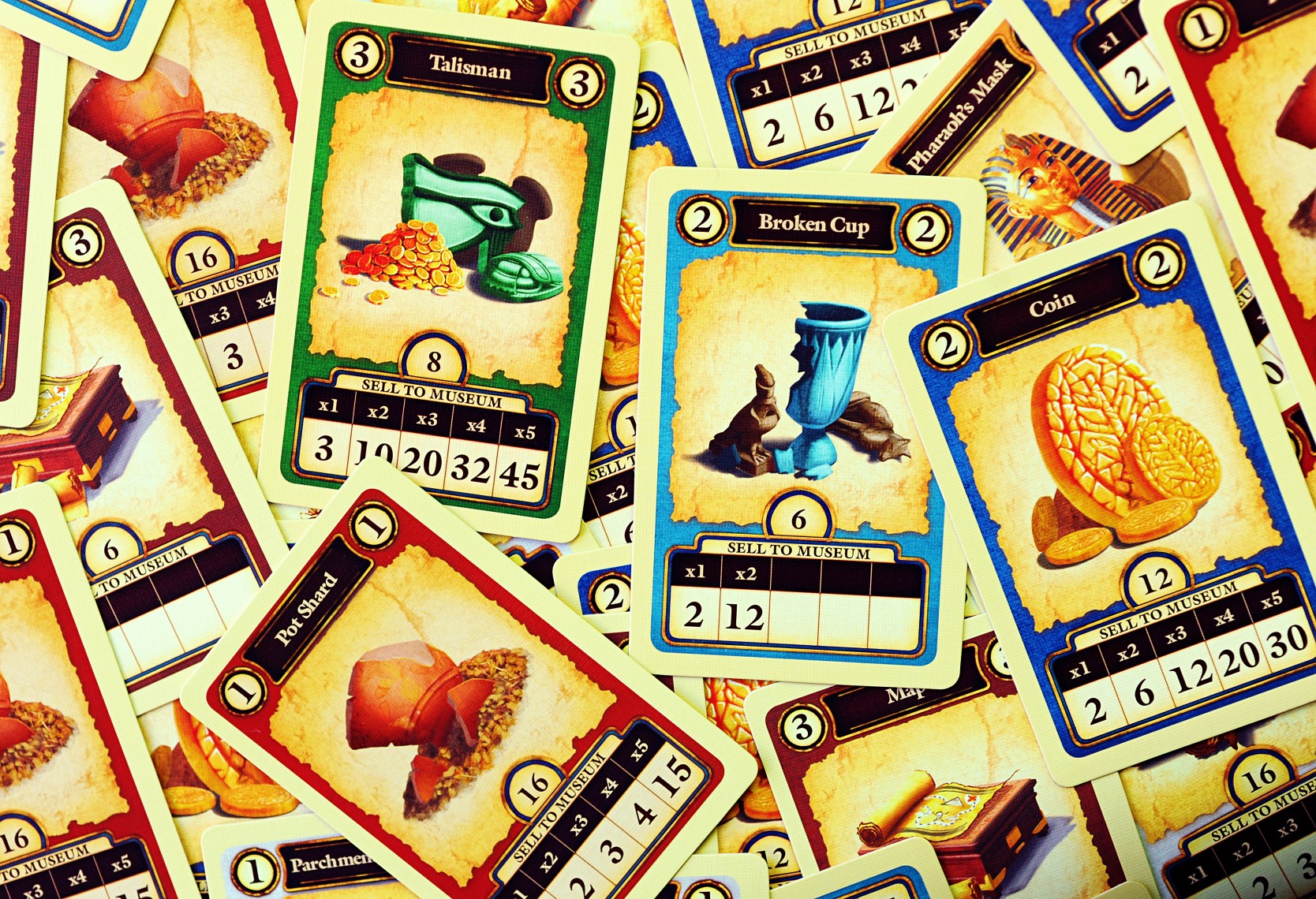
Each treasure card has a:
- title
- trade value
         Upper right and left corners, this is its worth in exchange at the marketplace
- quantity
         Lower center, this tells you how many total treasure cards of that type there are in the game.  This shows rarity and helps you guess your odds at finding more.
- sale value 
        Bottom, this shows how much money you earn when you sell to the museum.  If you sell multiple copies of a card, you earn more money as indicated on the card.

some treasure cards; image from here
For examples, look at the picture.  There are 16 "pot shards" in the game, and if you can collect 5 of them, you can sell them to the museum for 15 gold.  There are 8 "Talisman," and 5 of them will net you 45 gold.

Simplified Gameplay

Setting up the game first requires tuning the card pool based on the number of players (remove tent, thief, sandstorm, and map cards and adjust quantities of certain treasure cards).  After numbers are adjusted,

  • deal 4 treasure cards and 1 tent card to each player
  • place 5 treasure cards face-up in the marketplace
  • choose 1 monument tile at random (there are 6 possibilities) and place treasure cards around it according to its game text

Then, a portion of the thief and sandstorm cards (again, quantities will vary based on players) and all map cards are returned to what remains of the card pool to form the 'dig pile,' and you're ready to begin!

a game after setup; image from here
Choose a player to start; he takes the following actions on his turn:

  1. Dig for treasure (draw a card from the dig pile)
    • Take the card into hand unless it's a thief or sandstorm- play those according to the rules
  2. Trade at the marketplace if desired
    • Use one or more cards to trade for one or more cards in the market
    • Add up the trade value(s) of the card(s) you wish to exchange; the total must equal or exceed the trade value(s) of the card(s) you desire in the market
  3. Explore a monument if desired (once per turn max)
    • Discard the appropriate number of map cards to look at/take pile(s) of monument's treasure cards as prescribed on the monument tile 
  4. Sell to the museum if desired
    • Place cards (probably sets of cards) face-up in front of you to indicate sale to the museum
    • Once sold, cards cannot be stolen or lost

After his turn is done, play proceeds clockwise.  Once the dig pile is empty, turns continue (minus step 1, of course) until all players have no cards left in their hands.  Then, point totals are tallied for each player for the cards they sold to the museum.  The highest score wins!

Review

This is a nice little game.  Setup is a bit clunky (removing/re-inserting cards was initially confusing), but the game flows nicely and players pick up the concept quickly.  As a set collection/press your luck game, this is effectively a variant of Rummy, with enough twists (with monument tiles, varying card rarities, and thief/sandstorm cards) to keep things fresh and interesting.  Overall, this one is recommended.

Rating: A


Sunday, January 22, 2017

Wisdom in the Rings, Part 3


This is the third and final part looking at wisdom in The Lord of the Rings trilogy (Part 1 and Part 2).  We conclude with Return of the King.  The two main categories of wisdom I found in this film revolve around roles and restoration.


Roles

There are some amazing roles in Return of the King, which serve to illustrate the fact that we are a community, and we each serve a different function (1 Corinthians 12:12-27).  Let's look at a few roles in this movie:

Aragorn
Aragorn, reluctant king

We knew since the first film that Aragorn the ranger was in fact the heir of Isildur, and as such the rightful king of Gondor.  We also knew that he was reluctant to claim his heritage, fearing that the weakness of his ancestors might run in his veins as well.  He recognized that power corrupts and evaded it for decades.  However, in Return of the King, the end is at hand, and he can run no longer.  Elrond re-makes the sword wielded by the kings of old and delivers it to Aragorn with a message:
"Become who you were born to be."  We cannot escape our destinies (Jeremiah 1:5Romans 11:29).


Denethor
Denethor, forgetful steward

Due to Aragorn's situation, Gondor is ruled by a steward.  Denethor has long forgotten his role, however- he says "rule of Gondor is mine!" and attempts claim what is not his.  Gandalf delivers a powerful retort: "Authority is not given to you to deny the return of the king, steward!"

We, too, are stewards of the Earth (Genesis 1:26-28), called to remember that it is not we who are in control but rather the Lord (Romans 11:18) and the Earth is His (Psalm 24:1-2).  May we act accordingly.


Sam
Sam, faithful companion

Sam has been with Frodo from the beginning, and as they near Mount Doom, Frodo's remaining strength fails.  Sam recognizes that his task is not to carry the Ring, but to support the one who does.  "Come on, Mr. Frodo. I can’t carry it for you, but I can carry you."  He even saves Frodo after being betrayed by him.  Sam is the ultimate servant, one who would lay down his life for his friends (1 John 3:16).


Gollum
Gollum, unwitting hero

Smeagol/Gollum has been with the party since The Two Towers, and his infatuation for the Ring is coming to its ultimate conclusion here. Though his intent is evil, it is ultimately for the good (as in Genesis 50:20)- and his treachery saves the day.  It's a blessing to know that even failures can serve a purpose.


The Army of the Dead
Army of the Dead, redeemed

The Free Peoples' need is dire; and in that desperation, Aragorn turns to a supernatural source.  The Army of the Dead betrayed Aragorn's ancestor long ago.  As punishment, they have found no rest and now live in the dark recesses deep in a mountain.  Aragorn offers them a choice: fight for him, and he will hold their oaths fulfilled and allow them to rest in peace.  Of course, they help him, and are finally freed of their curse.

Works are important, and work along with our faith (James 2:14-26).  The Army needed faith to trust Aragorn, but then worked according to their faith.  We must do the same- faith without works is dead.


Rohan rides to Gondor's Aid
Rohan, rescuers

Rohan was spurned by Gondor in The Two Towers, and Theoden (Rohan's king) is justifiably furious about that.  However, he looks beyond the slight, forgives Gondor, and rides to their aid knowing that many of his people will die in so doing.  Mercy triumphs over judgment (James 2:13), and repaying evil for evil is forbidden (1 Thessalonians 5:15).


Restoration

Return of the King is ultimately about restoration- about removing evil from the world.  "I do not think this darkness will endure," reflects Sam, who adds "There’s light- beauty up there, which no shadow can touch."  Yes- this world is evil and dark (Mark 7:15-23, Romans 3:10-12), but Christ is reconciling all things (Colossians 1:15-20) and the new heaven and earth will be perfect (Revelation 21:1-5).  There is hope!


Conclusion

So concludes a wonderful story.  I recommend The Lord of the Rings trilogy heartily.  Few films combine action, adventure, and wisdom so well.


Monday, January 16, 2017

Germany


Germany is a land of history, culture, and natural beauty.  We feel blessed to have called it home for 5+ years.  This post collects our travel posts, presenting them by region.

image from here (subsequently modified)

Region 1: East
Berlin, Wittenberg, Wartburg

Region 2: West
Rhein Valley
Mosel Valley
Wiesbaden
Mainz, Köln

Region 3: Southwest
Black Forest to Ulm
Heidelberg

Region 4: North Bavaria
Rothenburg
Coburg, Dachau, Munich

Region 5: South Bavaria
Berchtesgaden region
Garmisch region
Neuschwanstein region


If you check out any, see region 5- South Bavaria.  It's my favorite place in the entire world.


UPDATE
The below links summarize our travels during our second stint in the country (2018-present):
Region 2:
Burg Königstein
Burg Eppstein
Burg Frankenstein
Reichsburg Cochem
Schloss Drachenburg
Frankfurt: Dinosaur Museum
Frankfurt
Driving the Rhein
Romerkastell Saalburg
Burg Runkel
Idstein
Christmas Markets


Region 4:
Rothenburg ob der Tauber  (and again)
Dinkelsbühl
Legoland Deutschland

Region 5:
Garmisch: the town
Garmisch: Partnach Gorge
Garmisch: Wank
Garmisch: Zugspitze
Neu Schwanstein


Thursday, January 12, 2017

Mainz & Cologne


Tying up some loose ends on our Germany travels, today's post looks at Mainz and Cologne (or, more accurately, Köln).  Both cities are dominated by (and primarily toured for) their impressive cathedrals.  They also happen to be cities in which we (apparently) didn't take many (good) pictures.

Mainz

Near scenic Wiesbaden, Mainz is a Roman town with impressive history and a spooky cathedral.  My favorite part of the town was the Gutenberg Museum, which housed an amazing collection of beautifully-done Medieval manuscripts.


image from here

image from here
Cologne

About 100 miles northeast of Mainz is Cologne.  Its cathedral is huge and, frankly, quite dirty on the outside.  But when 770 years old you reach, look as good, you will not.


Wednesday, January 11, 2017

Genesis and the Decay of the Nations (Ken Ham)


In Genesis and the Decay of the NationsKen Ham argues that "Genesis is the foundation book of the Bible and, therefore, of all Christian faith and life."  He believes in taking Genesis literally; therefore, he is a young-earth creationist and gives evolution no credence.  Further, he claims that evolution is the basis of humanism and creation the basis of Christianity.  The book explores this concept further and discusses related events (like the worldwide flood) or doctrines (like marriage) found in Genesis.

Though I agree with some of what Ham says, this is not a great book.  First, his tone is unnecessarily abrasive and condescending throughout (indeed, he's been criticized for things like this from others).  Second, some things he claims are obvious in Scripture don't always appear to be so.  His reasoning can be a little off, and some of his claims (about history and the current state of the church) overly generalized or even false.

I agree with him that science always requires a framework; there's no such thing as straight data- it always requires interpretation.  And he makes an occasional good point.  But there are much better treatments of this topic out there (like The Soul of Science or God's Undertaker).

Rating: C

Tuesday, January 10, 2017

The Reformation of the Sixteenth Century (Roland Bainton)


The Reformation of the Sixteenth Century is a compact overview of of the same and looks at many aspects of this formative time in history.  Scholar Roland Bainton talks about Martin Luther's faith and reform, then moves on to discuss the Reformed Church in German Switzerland (led by Ulrich Zwingli), Anabaptism, the Reformed Church in Geneva (John Calvin), and the Free Spirits.  After this, he discusses the fight for recognition of the Lutheran and Calvinist faiths, Anglicanism, and the struggle for religious liberty.  He concludes with how the Reformation affected political, economic, and domestic spheres, and includes a discussion of related/relevant historical events in the same time frame (like humanism and the disintegration of the Holy Roman Empire through the forces of nationalism).  What follows summarizes some key concepts.

Summary

What was the Reformation?  "The Reformation was a religious revival.  Its attempt was to give man a new assurance in the presence of God and a new motivation in the moral life."

How did it begin?  To Luther and others, "the quarrel centered on the view of man and God.  The Catholic Church had in his judgment too low an opinion of the majesty and the holiness of God and too high an estimate of the worth and potentiality of man."  Luther, after much study of the Bible and internal turmoil, concluded that "by faith and only by faith are we saved."  The Catholic Church, he argued, had strayed from the Holy Scriptures and relied too heavily on the works and traditions of men.  He took issue with other things, to include indulgences, papal infallibility, the number of sacraments, and the nature of communion.

Luther wasn't alone (or the first) in seeing the need for reform. "More or less unrelated attempts were made to meet the same problem.  Wittenberg [Luther], Zurich [Zwingli], Geneva [Calvin], and Canterbury were sisters rather than lineal descendants."  In the end, three or four main types emerged; they differed "chiefly at the point of their positions with regard to the relation of church and society."  They (and their views on this topic) are:

  • Lutheran: "The attitude to society was pessimistic.  The kingdom of God cannot be erected on earth though villainy can be restrained, and the Christian should not withdraw but should lend a hand in the maintenance of order."
  • Reformed (associated with Zwingli and Calvin): They "were more hopeful for the erection of the kingdom of God upon the earth through the chosen of the Lord, the elect."
  • Anabaptist: They believed that the "Church should not be united with the state . . . it must maintain its purity and preserve its example by segregation."
  • Socinians: They believed in rational pietism/mysticism.

Aside: Bainton does not include the Church of England as a main type, as he argues they combined Lutheran, Reformed, humanist, and other elements.

What was the result of the Reformation?  In the near term, "the emergence of . . . rivals . . . to the Catholic Church disrupted the structure not only of the religious but also of the social and political life of the Middle Ages."  How so?  The problem was the widespread belief of "one faith, one king, and one law- [this] was still the model for any sound body politic."  People of most nations were therefore "of no mind to tolerate more than one religion in their domains."  How did they handle the situation?  "The political strains arising from the religious tension of rival confessions could be eased in one of several ways."  In a nutshell,

  • Religious liberty: "The peace of those who agree to differ."  This didn't happen often or easily.
  • Territorial division: "The religion of a particular territory should be determined by the civil ruler," where "dissenters were free to emigrate to a region of their own faith."
  • Comprehension: "Only one religion is recognized in a given territory but in order to reduce emigration the attempt is made to satisfy as many as possible by making only minimal demands . . . " effectively, this is a "spirit of latitude."

Bainton spends some time looking at how each approach was handled, going land by land and confession by confession.

Was the Reformation successful?  After all, Luther "has been accused . . . on the one hand of opening the floodgates of individualism, producing an inundation of all the vagaries of private interpretation, and on the other hand of investing one particular interpretation of Scripture with all the rigidity and finality of papalism."  The Reformation had good and bad results.  "How far it succeeded no one can ever tell . . . This only one can say, that the Reformation at once rent and bound.  The external unities were shattered, but the Christian consciousness of Europe was renewed."

Review

This was a great book.  Bainton's writing is informed, fair, succinct and eloquent; I enjoyed reading this.  It's high-level and introductory, but covers more than Nichol's treatment of the same topic.  I wish it were longer, so he could have provided more context/background to the time period and Catholic Church of the day (he at times assumes a familiarity that only history enthusiasts would possess). That said, this is a gem.

Rating: A

Friday, January 6, 2017

Wisdom in the Rings, Part 2


This is part two of looking at wisdom in The Lord of the Rings movie trilogy (part one is here).
Today's focus is The Two Towers.  As before, I look at themes by category.

Gollum/Smeagol and the dual nature of man

The Two Towers is the first time we get a good look at Gollum, the creature who found the ring years (centuries?) ago.  He was "not so very different than a hobbit once," but the corrupting power of the ring has turned him into a monster of sorts.  His original name was Smeagol, and that 'other nature' is still inside him, albeit deeply.  Throughout the film, you see his dual natures fight with each other as he debates whether to help (or hurt) the Hobbits.

Smeagol/Gollum is a wonderful illustration of the warring of the flesh and spirit as discussed in The Strange Case of Dr. Jekyll and Mr. Hyde or in Romans 7:15-25.  Romans 7:21-23 in particular describes the struggle in this miserable creature:
So I find it to be a law that when I want to do right, evil lies close at hand. For I delight in the law of God, in my inner being, but I see in my members another law waging war against the law of my mind and making me captive to the law of sin that dwells in my members.
Gollum
Empathy

This film looks at depth between the relationships of Frodo, Sam, and Gollum/Smeagol.  Sam is ever supportive of Frodo- a much-needed companion to the troubled ringbearer.  Gollum is with them in their quest, and is treated quite differently by the two hobbits.  Frodo- who now bears the burden that was once Gollum's- is much more empathetic to the creature than Sam.  Sam is often judgmental, quick to anger, and lacks any compassion in his dealings with Gollum.

Their interactions remind me of Luke 7:36-50, where Jesus is speaking about a women in much need of forgiveness who's showing him great love.  His point is verse 47: "Therefore I tell you, her sins, which are many, are forgiven—for she loved much. But he who is forgiven little, loves little.”

Frodo, well familiar with Gollum's struggles because he shares in them, is able to love him more easily than Sam, who feels superior because he's ignorant of the struggle.  Yet we're all fallen and tempted in many ways . . . when we realize how much we need forgiveness and grace, we more easily give it to others.  Effectively, we learn empathy for the fallen when acquainted with our own shortcomings.


Frodo (left) and Sam

The 'Order' of Life

Theoden, king of Rohan, awakes from his magical stupor to find his son dead.  He delivers two excellent quotes:
"Alas that these evil days should be mine. The young perish and the old linger."
"No parent should have to bury their child."
Losing one of my children is my primary fear in this world.  I mourn with those who have experienced this horror.
Theoden mourns for his son

On War

The Two Towers is the first place we see significant battles- the Battle of Helm's Deep chief among them.  And it's not pleasant.  “War will make corpses of us all,” remarks one character.  Well said.

Helm's Deep

On Stories

Towards the end, Sam and Frodo have a great exchange about stories:
Frodo: I can’t do this, Sam.
Sam: I know. It’s all wrong. By rights we shouldn’t even be here. But we are. It’s like in the great stories, Mr. Frodo. The ones that really mattered. Full of darkness and danger, they were. And sometimes you didn’t want to know the end. Because how could the end be happy? How could the world go back to the way it was when so much bad had happened? But in the end, it’s only a passing thing, this shadow. Even darkness must pass. A new day will come. And when the sun shines it will shine out the clearer. Those were the stories that stayed with you. That meant something, even if you were too small to understand why. But I think, Mr. Frodo, I do understand. I know now. Folk in those stories had lots of chances of turning back, only they didn’t. They kept going. Because they were holding on to something.
Frodo: What are we holding onto, Sam?
Sam: That there’s some good in this world, Mr. Frodo… and it’s worth fighting for.
Stories are powerful, and perhaps all stories reflect upon the main story of this world (as discussed in Storied Leadership): "perfection distorted and restored."  Our hope is in Jesus (see Titus 2:11-14), who created and is reconciling all things to himself (see Colossians 1:15-20).


Conclusion

The Two Towers was, like its predecessor, a great film.  It had a lot of good themes and points to ponder.